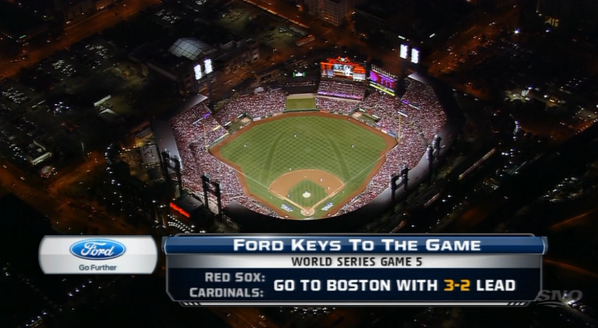
One of the pregame features of the Joe Buck/Tim McCarver baseball broadcast on FOX is called "Ford Keys to the Game." It's relatively self-explanatory -- it provides some broad goal each of the teams should be pursuing to best maximize their odds of winning, like "Get to the bullpen" or "No mistakes" or something else similarly obvious and/or cliche. It's usually a mindless exercise not even worth mentioning. But the "Keys to the Game" they rolled out before Monday's pivotal Game 5 in St. Louis represented a hilarious new low. With the series tied 2-apiece, here's the sage advice Buck and McCarver offered the Red Sox and Cardinals:
There you have it, folks: the key to winning the game is to win the game. But how exactly, you might ask? First, by winning the game, and second, by correctly advancing to the city where the next game will be played. Truly insightful, FOX.
Showing posts with label St. Louis Cardinals. Show all posts
Monday, October 28, 2013
Saturday, October 26, 2013
Pinch-Hitting is Still Allowed, Right?
Just a few moments ago, in the top of the ninth inning in Game 3, Red Sox manager John Farrell let his pitcher hit in a tie game. As in, with Brandon Workman (a pitcher) due up against elite closer Trevor Rosenthal, with one out in the ninth inning of a tie game, Farrell chose to allow his pitcher to bat rather than use a pinch-hitter. Now, some quick reminders:
A) pinch-hitting is a legal strategy in National League baseball
B) it was a tie game
C) Brandon Workman is a rookie pitcher with zero career at-bats in his professional career
D) it was a tie game in the World Series
E) rookie pitchers with zero at-bats aren't good at hitting
F) it was a tie game in the ninth inning in the World Series
By letting Workman hit against Rosenthal, Farrell was literally throwing away an out. The rules of baseball granted him three outs in the ninth inning, and he refused that offer. "Nah, I'm good with two, thanks." There are only two hypothetical scenarios where letting Workman "hit" in a tie game in the ninth makes an ounce of sense:
1. The Red Sox had no pitchers left and Workman was their last hope.
2. The Red Sox had no hitters left and therefore couldn't replace Workman with anyone.
Did the Red Sox have a pitcher left? They actually had three. And one of them was Koji Uehara, only one of the three most dominant pitchers in the league this year.
Did the Red Sox have a hitter left? Well, Mike Napoli, for one. Otherwise known as this team's starting first baseman for the entire season.
What makes this decision even more mind-boggling is the events in the bottom of the ninth. Workman began the inning (obviously, after the huge price Farrell paid to keep him eligible). He struck out Matt Adams. Then Yadier Molina singled. And then ... JOHN FARRELL TOOK BRANDON WORKMAN OUT OF THE GAME.
AAAHHHHHHHHHHHHHHHHHH
In the top of the inning, Farrell decided that keeping Workman on the mound was of such paramount importance, so critical to his team's chances of winning, that he let him "bat" against Rosenthal, instead of pinch-hitting Mike Napoli and bringing in Uehara. Then in the bottom of the inning, all it took was a one-out single to convince Farrell that Workman no longer offered any value and it was time to use Uehara.
This begs the question: if Farrell was going to remove Workman after just one measly baserunner anyway -- if his leash was that short to begin with -- why was it so important that he remain in the game? If he was willing to use Uehara in the ninth all along, why not pinch-hit for Workman (with Mike Napoli!) and have Uehara start the ninth with a clean inning? There was no logic here. This was a stupendously stupid in-game decision by someone who's being paid millions of dollars by a premier sports franchise to make good in-game decisions.
After the game, Farrell said this:
"In hindsight having Workman bat against Rosenthal was a mismatch."
Wait a second -- you needed hindsight to realize that your pitcher batting against a closer who throws 100 miles per hour was a mismatch???
The Red Sox technically lost Game 3 on a bizarre obstruction call. They really lost it the moment their manager let a pitcher hit in the top of the ninth of a tied game in the World Series -- with a great hitter available to pinch-hit and a great reliever ready to take the mound -- and then removed him from the game anyway after facing just two more hitters. Awful awful awful.
A) pinch-hitting is a legal strategy in National League baseball
B) it was a tie game
C) Brandon Workman is a rookie pitcher with zero career at-bats in his professional career
D) it was a tie game in the World Series
E) rookie pitchers with zero at-bats aren't good at hitting
F) it was a tie game in the ninth inning in the World Series
By letting Workman hit against Rosenthal, Farrell was literally throwing away an out. The rules of baseball granted him three outs in the ninth inning, and he refused that offer. "Nah, I'm good with two, thanks." There are only two hypothetical scenarios where letting Workman "hit" in a tie game in the ninth makes an ounce of sense:
1. The Red Sox had no pitchers left and Workman was their last hope.
2. The Red Sox had no hitters left and therefore couldn't replace Workman with anyone.
Did the Red Sox have a pitcher left? They actually had three. And one of them was Koji Uehara, only one of the three most dominant pitchers in the league this year.
Did the Red Sox have a hitter left? Well, Mike Napoli, for one. Otherwise known as this team's starting first baseman for the entire season.
What makes this decision even more mind-boggling is the events in the bottom of the ninth. Workman began the inning (obviously, after the huge price Farrell paid to keep him eligible). He struck out Matt Adams. Then Yadier Molina singled. And then ... JOHN FARRELL TOOK BRANDON WORKMAN OUT OF THE GAME.
AAAHHHHHHHHHHHHHHHHHH
In the top of the inning, Farrell decided that keeping Workman on the mound was of such paramount importance, so critical to his team's chances of winning, that he let him "bat" against Rosenthal, instead of pinch-hitting Mike Napoli and bringing in Uehara. Then in the bottom of the inning, all it took was a one-out single to convince Farrell that Workman no longer offered any value and it was time to use Uehara.
This begs the question: if Farrell was going to remove Workman after just one measly baserunner anyway -- if his leash was that short to begin with -- why was it so important that he remain in the game? If he was willing to use Uehara in the ninth all along, why not pinch-hit for Workman (with Mike Napoli!) and have Uehara start the ninth with a clean inning? There was no logic here. This was a stupendously stupid in-game decision by someone who's being paid millions of dollars by a premier sports franchise to make good in-game decisions.
After the game, Farrell said this:
"In hindsight having Workman bat against Rosenthal was a mismatch."
Wait a second -- you needed hindsight to realize that your pitcher batting against a closer who throws 100 miles per hour was a mismatch???
The Red Sox technically lost Game 3 on a bizarre obstruction call. They really lost it the moment their manager let a pitcher hit in the top of the ninth of a tied game in the World Series -- with a great hitter available to pinch-hit and a great reliever ready to take the mound -- and then removed him from the game anyway after facing just two more hitters. Awful awful awful.
Labels:
Boston Red Sox,
John Farrell,
Managers,
MLB,
St. Louis Cardinals,
World Series
Monday, October 14, 2013
Beltran, the Greek God of Clutch
His game-tying grand slam in the eighth inning of Game 2 of the ALCS was yet another clutch postseason triumph for David Ortiz. But claiming that Ortiz has the supernatural ability to perform at a higher level in the playoffs ignores the facts:
David Ortiz career OPS: .930
Career postseason OPS: 935
Ortiz has more than his fair share of epic October moments. He is one of only two players with multiple walk-off home runs in the playoffs. His overall postseason performance, however, is almost exactly in line with his overall regular season performance. The 'clutch' reputation ascribed to Ortiz is a product of our minds' tendency to remember the extraordinary (his handful of big hits) and forget the ordinary (his many failures).
This irrational labeling of certain players as 'clutch' is of course not exclusive to David Ortiz. Our need for narrative has pushed that label onto quite a few players from the last few decades of postseason play. And almost none of them truly deserved it:
Derek Jeter career OPS: .828
Career postseason OPS: .838
Bernie Williams career OPS: .858
Career postseason OPS: .850
Reggie Jackson career OPS: .846
Career postseason OPS: .885
Manny Ramirez career OPS: .996
Career postseason OPS: .937
Andy Pettitte career ERA: 3.85
Career postseason ERA: 3.81
Jack Morris career ERA: 3.90
Career postseason ERA: 3.80
There is certainly something to be said for the ability of these players to maintain (and in Reggie Jackson's case slightly improve upon) their regular season performances in the playoffs, given the elite pitching and higher stakes. It is, however, hyperbole to claim that a few players (Ortiz, Jeter, etc.) somehow possess the supernatural ability to elevate their performance to previously-unseen heights just because the calendar reads "October."
Except in the case of Carlos Beltran.
Carlos Beltran career OPS: .854
Career postseason OPS: 1.188
Only five players have a higher postseason OPS than Beltran, and Beltran has more plate appearances than all of them. His career line in the postseason is .340/.448/.740. In 41 postseason games, he has 51 hits, 16 home runs, 34 RBIs, 11 steals without getting caught once, and 29 walks against just 21 strikeouts. In 2004, he tied the record for home runs in a single postseason (eight) despite playing in only two postseason series (just 12 games).
Beltran has been so good in the playoffs that he's earned the 'clutch' label without ever even appearing in the World Series once. Beltran has been so good in the playoffs that he's earned the 'clutch' label despite spending almost 90% of his career with the Kansas City Royals, Houston Astros, and New York Mets. These are impressive feats.
His reputation was muddied for a while after he took a called strike three with the bases loaded to end Game 7 of the 2006 NLCS. But the pitch he took was an Adam Wainwright curveball, and in the seven years since 2006 we have learned that succumbing to Adam Wainwright's curveball is hardly something to be ashamed of. And anyway, Beltran hit three home runs and had an OPS of 1.054 in that series.
In his two-year stint with the Cardinals, Beltran has rebuilt his postseason reputation for the benefit of those who temporarily doubted his powers. Last year, his OPS totals in two series were 1.486 and .964. In the deciding Game 5 of the NLDS against the Washington Nationals, with his team trailing by two in the ninth, he hit a leadoff double that began a four-run series-clinching rally. Most recently, in Game 1 of this year's NLCS against the Dodgers, Beltran hit a game-tying two-run double in the third, threw out the potential go-ahead run at the plate in the 12th, and hit the game-winning walk-off single in the 13th.
Beltran is now two wins away from finally advancing past the NLCS. In a postseason that has already eliminated all potential underdogs, rooting for Beltran to reach his first-ever World Series stands out as a noble rooting cause. Because if he gets there, the destruction he unleashes could be downright biblical.
David Ortiz career OPS: .930
Career postseason OPS: 935
Ortiz has more than his fair share of epic October moments. He is one of only two players with multiple walk-off home runs in the playoffs. His overall postseason performance, however, is almost exactly in line with his overall regular season performance. The 'clutch' reputation ascribed to Ortiz is a product of our minds' tendency to remember the extraordinary (his handful of big hits) and forget the ordinary (his many failures).
This irrational labeling of certain players as 'clutch' is of course not exclusive to David Ortiz. Our need for narrative has pushed that label onto quite a few players from the last few decades of postseason play. And almost none of them truly deserved it:
Derek Jeter career OPS: .828
Career postseason OPS: .838
Bernie Williams career OPS: .858
Career postseason OPS: .850
Reggie Jackson career OPS: .846
Career postseason OPS: .885
Manny Ramirez career OPS: .996
Career postseason OPS: .937
Andy Pettitte career ERA: 3.85
Career postseason ERA: 3.81
Jack Morris career ERA: 3.90
Career postseason ERA: 3.80
There is certainly something to be said for the ability of these players to maintain (and in Reggie Jackson's case slightly improve upon) their regular season performances in the playoffs, given the elite pitching and higher stakes. It is, however, hyperbole to claim that a few players (Ortiz, Jeter, etc.) somehow possess the supernatural ability to elevate their performance to previously-unseen heights just because the calendar reads "October."
Except in the case of Carlos Beltran.
Carlos Beltran career OPS: .854
Career postseason OPS: 1.188
Only five players have a higher postseason OPS than Beltran, and Beltran has more plate appearances than all of them. His career line in the postseason is .340/.448/.740. In 41 postseason games, he has 51 hits, 16 home runs, 34 RBIs, 11 steals without getting caught once, and 29 walks against just 21 strikeouts. In 2004, he tied the record for home runs in a single postseason (eight) despite playing in only two postseason series (just 12 games).
Beltran has been so good in the playoffs that he's earned the 'clutch' label without ever even appearing in the World Series once. Beltran has been so good in the playoffs that he's earned the 'clutch' label despite spending almost 90% of his career with the Kansas City Royals, Houston Astros, and New York Mets. These are impressive feats.
His reputation was muddied for a while after he took a called strike three with the bases loaded to end Game 7 of the 2006 NLCS. But the pitch he took was an Adam Wainwright curveball, and in the seven years since 2006 we have learned that succumbing to Adam Wainwright's curveball is hardly something to be ashamed of. And anyway, Beltran hit three home runs and had an OPS of 1.054 in that series.
In his two-year stint with the Cardinals, Beltran has rebuilt his postseason reputation for the benefit of those who temporarily doubted his powers. Last year, his OPS totals in two series were 1.486 and .964. In the deciding Game 5 of the NLDS against the Washington Nationals, with his team trailing by two in the ninth, he hit a leadoff double that began a four-run series-clinching rally. Most recently, in Game 1 of this year's NLCS against the Dodgers, Beltran hit a game-tying two-run double in the third, threw out the potential go-ahead run at the plate in the 12th, and hit the game-winning walk-off single in the 13th.
Beltran is now two wins away from finally advancing past the NLCS. In a postseason that has already eliminated all potential underdogs, rooting for Beltran to reach his first-ever World Series stands out as a noble rooting cause. Because if he gets there, the destruction he unleashes could be downright biblical.
Labels:
Carlos Beltran,
David Ortiz,
MLB,
MLB Playoffs,
St. Louis Cardinals
Sunday, May 5, 2013
30 Games Later: Readjusting Expectations
Last season, after thirty games, the following teams were leading baseball's six divisions:
AL East: Baltimore and Tampa Bay (tied)
AL Central: Cleveland
AL West: Texas
NL East: Washington
NL Central: St. Louis
NL West: Los Angeles
Only one of those teams would actually go on to win their division -- Washington. In fact, the Rays, Indians, and Dodgers missed the playoffs altogether. Meanwhile, the two eventual pennant-winners, Detroit and San Francisco, had combined to win 30 games and lose 29. So it's not like the standings in early May offer any predictive value for what they'll look like in late September.
But sometimes, the evidence provided by the season's first thirty games is enough to reevaluate what we thought we knew during the winter months. Sometimes, stubbornly sticking to obsolete perceptions of teams is counter-productive. At this time last year, the Athletics were surprisingly 16-14 and the Orioles, at 19-11, were even better; both were expected to fall back into the last place slots that had been reserved for them, but they never did. On the other end of the spectrum, the Angels were 13-18 and the Red Sox were 12-17; both were expected to snap out of their funks and contend for the World Series, but they never did. So yes, it might be early to totally re-calibrate expectations -- still, that doesn't mean that several important trends haven't already started to reveal themselves.
1. The Blue Jays are somewhere between 'Train Wreck' and 'Dumpster Fire' status. On paper, this was the best team in the AL East, maybe the best team in the league. A rotation headed by a pair of aces; a lineup anchored by a pair of elite power hitters; a solid cache of depth. There weren't many holes on the roster.
Just a month into the season, the Blue Jays are not only stuck with a dismal 11-21 record, and not only are they in last place -- they're also 9.5 games out of first. NINE POINT FIVE. Not even the Marlins are that far out of first, and the Marlins are intentionally trying to lose baseball games. No team has gotten worse production out of the #5-hole in the lineup than Toronto, thanks to inconsistency from Melky Cabrera, Adam Lind, and Colby Rasmus. R.A. Dickey's ERA is 5.36; Josh Johnson's is 6.36; Mark Buehrle's is 6.43. Jose Reyes, this team's best player in the early going, will be on the disabled list for another couple of months. In the meantime, the role of shortstop will be played by something called a "Munenori Kawasaki." Add it all up, and you get a team that's been outscored by a total of 47 runs, second-worst in baseball ahead of only the Astros.
Now: are the Blue Jays really this bad? Of course not. The pitching will improve just because there's nowhere to go but up. Jays hitters have actually been the unluckiest in baseball as a group; random chance will be friendlier to them. But this struggling squad faces the same problem that the Angels did last year: all of these losses are permanently banked. There's no changing that 11-21 record. They're already looking at a ten-game deficit in the division. Just to get to 90 wins, they have to go 80-50 the rest of the way. Is that impossible? No. Is it likely that this uninspiring group will play nearly-perfect baseball for the next five months, without Jose Reyes for half that time? Hardly. Especially not in their hyper-competitive division. As stunning and unfortunate as this is, the Blue Jays are pretty much dead in the water already. Who saw that coming?
1. The Blue Jays are somewhere between 'Train Wreck' and 'Dumpster Fire' status. On paper, this was the best team in the AL East, maybe the best team in the league. A rotation headed by a pair of aces; a lineup anchored by a pair of elite power hitters; a solid cache of depth. There weren't many holes on the roster.
Just a month into the season, the Blue Jays are not only stuck with a dismal 11-21 record, and not only are they in last place -- they're also 9.5 games out of first. NINE POINT FIVE. Not even the Marlins are that far out of first, and the Marlins are intentionally trying to lose baseball games. No team has gotten worse production out of the #5-hole in the lineup than Toronto, thanks to inconsistency from Melky Cabrera, Adam Lind, and Colby Rasmus. R.A. Dickey's ERA is 5.36; Josh Johnson's is 6.36; Mark Buehrle's is 6.43. Jose Reyes, this team's best player in the early going, will be on the disabled list for another couple of months. In the meantime, the role of shortstop will be played by something called a "Munenori Kawasaki." Add it all up, and you get a team that's been outscored by a total of 47 runs, second-worst in baseball ahead of only the Astros.
Now: are the Blue Jays really this bad? Of course not. The pitching will improve just because there's nowhere to go but up. Jays hitters have actually been the unluckiest in baseball as a group; random chance will be friendlier to them. But this struggling squad faces the same problem that the Angels did last year: all of these losses are permanently banked. There's no changing that 11-21 record. They're already looking at a ten-game deficit in the division. Just to get to 90 wins, they have to go 80-50 the rest of the way. Is that impossible? No. Is it likely that this uninspiring group will play nearly-perfect baseball for the next five months, without Jose Reyes for half that time? Hardly. Especially not in their hyper-competitive division. As stunning and unfortunate as this is, the Blue Jays are pretty much dead in the water already. Who saw that coming?
2. The Orioles are for real, once again. It was reasonable to expect Baltimore to regress from last year, because last year was either an unrepeatable feat of remarkable overachievement or the product of Buck Showalter's dark magic. Instead, the opposite is true: this team is better now than it was a year ago.
The pitching is still average at best, so the Orioles have just decided to outscore everybody with a suddenly-unrelenting offense. Much of it is fueled by the usual suspects -- Adam Jones and Matt Wieters and such. But there are three others who have helped transform this team into a contender. One is Chris Davis, who's successfully swapped bodies with Josh Hamilton to get from failed prospect to elite slugger (hitting .327/.425/.673 will do quite nicely, thank you very much). The second is Nate McLouth, whose career was once as dead as the 2013 Blue Jays; yet he's now the leadoff hitter for this offense against right-handers. Somehow he's hitting .313/.411/.490 with nine steals and, most amazingly, 16 walks against just 10 strikeouts.
The third is the most important, and also one of the most overlooked young superstars in baseball. Manny Machado has been largely overshadowed by the Trout-and-Harper Mania. But this guy joined the Orioles in the middle of their playoff push last summer without a single game of Triple-A experience, having to transition from his natural position of shortstop over to third base in order to accommodate J.J. Hardy. Now he's a 20-year-old shortstop playing Gold Glove defense at third while hitting .311/.350/.508 and holding down the #2-slot in the Orioles order. He's a huge reason why Baltimore is a serious contender for the AL East title.
3. The Los Angeles teams have proven that money doesn't buy happiness. Over the past year or two, the Angels and the Dodgers have spent hundreds of millions of dollars to import superstars to Southern California -- from Albert Pujols, Josh Hamilton, and C.J. Wilson to Zack Greinke, Carl Crawford, and Adrian Gonzalez. It hasn't exactly paid off yet. Both are in fourth place, with a lot of concerns up and down their rosters.
For the Dodgers, the problem is offense. With Hanley Ramirez injured, the non-first-base positions are being held down by a sad troupe of deeply flawed guys who might be good if you rolled them all up into one player: Juan Uribe, Mark Ellis, Jerry Hairston, Justin Sellers, Luis Cruz, and Dee Gordon. Those awful bats are rendering the bottom half of the Dodgers lineup useless. To wit: their current #5 hitter A.J. Ellis has only scored five runs all year despite his excellent .390 on-base-percentage. And two of those runs came from his own homers. That's how ugly this offense is right now, especially with Matt Kemp struggling (.342 slugging percentage ... yowza). Thank goodness Carl Crawford is enjoying a fantastic bounceback season (.311/.383/.495), or else things could be even worse.
At least the Dodgers have Clayton Kershaw starting every fifth day. The other L.A. team is in even worse shape. Thought to be a World Series contender before the season started, it's clear that the Angels don't have the pitching to fulfill that potential, and their hitting might not be good enough to even get them to the playoffs in the first place. Over the past calendar year, Josh Hamilton has hit .253/.321/.494, or essentially 156 games of Delmon Young-like production. He's a major reason why the Angels only rank 15th in the majors in runs scored, which isn't good enough when their pitching staff ranks 28th in ERA. Last year, the Angels fought their way back into contention by calling up Mike Trout and trading for Zack Greinke. Neither of those things are happening this time around. In a division with the Rangers and Athletics, competing with the entire AL East for a wild card spot, the Angels are in a bad place right now and it wouldn't be a shock if manager Mike Scioscia gets fired.
The pitching is still average at best, so the Orioles have just decided to outscore everybody with a suddenly-unrelenting offense. Much of it is fueled by the usual suspects -- Adam Jones and Matt Wieters and such. But there are three others who have helped transform this team into a contender. One is Chris Davis, who's successfully swapped bodies with Josh Hamilton to get from failed prospect to elite slugger (hitting .327/.425/.673 will do quite nicely, thank you very much). The second is Nate McLouth, whose career was once as dead as the 2013 Blue Jays; yet he's now the leadoff hitter for this offense against right-handers. Somehow he's hitting .313/.411/.490 with nine steals and, most amazingly, 16 walks against just 10 strikeouts.
The third is the most important, and also one of the most overlooked young superstars in baseball. Manny Machado has been largely overshadowed by the Trout-and-Harper Mania. But this guy joined the Orioles in the middle of their playoff push last summer without a single game of Triple-A experience, having to transition from his natural position of shortstop over to third base in order to accommodate J.J. Hardy. Now he's a 20-year-old shortstop playing Gold Glove defense at third while hitting .311/.350/.508 and holding down the #2-slot in the Orioles order. He's a huge reason why Baltimore is a serious contender for the AL East title.
3. The Los Angeles teams have proven that money doesn't buy happiness. Over the past year or two, the Angels and the Dodgers have spent hundreds of millions of dollars to import superstars to Southern California -- from Albert Pujols, Josh Hamilton, and C.J. Wilson to Zack Greinke, Carl Crawford, and Adrian Gonzalez. It hasn't exactly paid off yet. Both are in fourth place, with a lot of concerns up and down their rosters.
For the Dodgers, the problem is offense. With Hanley Ramirez injured, the non-first-base positions are being held down by a sad troupe of deeply flawed guys who might be good if you rolled them all up into one player: Juan Uribe, Mark Ellis, Jerry Hairston, Justin Sellers, Luis Cruz, and Dee Gordon. Those awful bats are rendering the bottom half of the Dodgers lineup useless. To wit: their current #5 hitter A.J. Ellis has only scored five runs all year despite his excellent .390 on-base-percentage. And two of those runs came from his own homers. That's how ugly this offense is right now, especially with Matt Kemp struggling (.342 slugging percentage ... yowza). Thank goodness Carl Crawford is enjoying a fantastic bounceback season (.311/.383/.495), or else things could be even worse.
At least the Dodgers have Clayton Kershaw starting every fifth day. The other L.A. team is in even worse shape. Thought to be a World Series contender before the season started, it's clear that the Angels don't have the pitching to fulfill that potential, and their hitting might not be good enough to even get them to the playoffs in the first place. Over the past calendar year, Josh Hamilton has hit .253/.321/.494, or essentially 156 games of Delmon Young-like production. He's a major reason why the Angels only rank 15th in the majors in runs scored, which isn't good enough when their pitching staff ranks 28th in ERA. Last year, the Angels fought their way back into contention by calling up Mike Trout and trading for Zack Greinke. Neither of those things are happening this time around. In a division with the Rangers and Athletics, competing with the entire AL East for a wild card spot, the Angels are in a bad place right now and it wouldn't be a shock if manager Mike Scioscia gets fired.
4. The Yankees might be better than we thought. A month ago, had you told someone that the Yankees starting lineup in early May would include Jayson Nix, Eduardo Nunez, Chris Stewart, Lyle Overbay, and Vernon Wells, that person would have guaranteed that the Yankees would be a last-place team. That would have been a smart, rational guess.
Yet for some reason, that person also would have been wrong. The Yankees have won 18 of their first 30 games and sit tied for second place in the AL East. And this is with a combined zero at-bats from Derek Jeter, Mark Teixeira, and Curtis Granderson, as well as injuries to Kevin Youkilis and Francisco Cervelli. If an injury to Francisco Cervelli deals a harsh blow to your lineup, then you know the offense is desperately seeking help.
Good pitching has basically driven New York's early success, but it's three scrap-heap pickups that have kept the lineup afloat despite the injuries. Against left-handers, Vernon Wells is hitting .333/.383/.595. Against right-handers, Lyle Overbay is hitting .328/.377/.656 and Travis Hafner is hitting .317/.414/.617. They've all suffered against same-handed pitchers, which is a problem because they've all been forced into everyday duty by other injuries. But the Yankees would be absolutely nowhere without these three, who have unexpectedly pummeled whenever they've had the platoon advantage. Oh, and that Robinson Cano fellow has a .972 OPS. He might be an okay player someday.
The Yankees still can't count on making the playoffs, not with all their aging-and-injury question marks. But given the sorry state of their lineup, they could've easily had a Blue Jays-style start to the season and doomed themselves from the beginning. Instead, they've banked 18 wins when their roster was at its weakest. And the impending returns of Granderson, Teixeira, and Youkilis should help relegate the Wells/Overbay/Hafner trio to platoon duty, where they've thrived. This team has kept itself alive, an admirable feat in its own right.
Yet for some reason, that person also would have been wrong. The Yankees have won 18 of their first 30 games and sit tied for second place in the AL East. And this is with a combined zero at-bats from Derek Jeter, Mark Teixeira, and Curtis Granderson, as well as injuries to Kevin Youkilis and Francisco Cervelli. If an injury to Francisco Cervelli deals a harsh blow to your lineup, then you know the offense is desperately seeking help.
Good pitching has basically driven New York's early success, but it's three scrap-heap pickups that have kept the lineup afloat despite the injuries. Against left-handers, Vernon Wells is hitting .333/.383/.595. Against right-handers, Lyle Overbay is hitting .328/.377/.656 and Travis Hafner is hitting .317/.414/.617. They've all suffered against same-handed pitchers, which is a problem because they've all been forced into everyday duty by other injuries. But the Yankees would be absolutely nowhere without these three, who have unexpectedly pummeled whenever they've had the platoon advantage. Oh, and that Robinson Cano fellow has a .972 OPS. He might be an okay player someday.
The Yankees still can't count on making the playoffs, not with all their aging-and-injury question marks. But given the sorry state of their lineup, they could've easily had a Blue Jays-style start to the season and doomed themselves from the beginning. Instead, they've banked 18 wins when their roster was at its weakest. And the impending returns of Granderson, Teixeira, and Youkilis should help relegate the Wells/Overbay/Hafner trio to platoon duty, where they've thrived. This team has kept itself alive, an admirable feat in its own right.
5. The St. Louis Cardinals could be the best team in baseball. This is certainly not something anyone would have predicted before the season. The Cardinals are 20-11, in first place in the Central Division with the second-best run differential in baseball. Carlos Beltran, Matt Holliday, and Yadier Molina remain a devastatingly effective trio in the heart of that lineup. Most impressively, the team ranks 6th in runs scored and 2nd in ERA across baseball, a testament to its balance.
The key to this early success has been unexpectedly dominant starting pitching. The Cardinals' five starters have combined to pitch to a crazy 2.25 ERA over 192 innings, which would seem to be several rungs above "solid." Jake Westbrook leads the league in ERA at 1.07; heralded rookie Shelby Miller is at 1.96 while striking out over a batter per inning; Adam Wainwright has announced his return to ace-dom by striking out 48 batters and walking just three all season.
On top of all that: the team has skillfully handled adversity in the bullpen, too. Incumbent closer Jason Motte is headed for Tommy John surgery, and his first replacement, Mitchell Boggs, was a disaster. The answer? Previously-unknown Edward Mujica has taken over the role with surprising ease. A year ago he was a middle reliever toiling away for the Marlins; now he's converted eight save opportunities for the team with the best record in the National League. Without Motte, or Chris Carpenter, or Albert Pujols, St. Louis is yet again a World Series contender. These Cardinals seem to know what they're doing.
The key to this early success has been unexpectedly dominant starting pitching. The Cardinals' five starters have combined to pitch to a crazy 2.25 ERA over 192 innings, which would seem to be several rungs above "solid." Jake Westbrook leads the league in ERA at 1.07; heralded rookie Shelby Miller is at 1.96 while striking out over a batter per inning; Adam Wainwright has announced his return to ace-dom by striking out 48 batters and walking just three all season.
On top of all that: the team has skillfully handled adversity in the bullpen, too. Incumbent closer Jason Motte is headed for Tommy John surgery, and his first replacement, Mitchell Boggs, was a disaster. The answer? Previously-unknown Edward Mujica has taken over the role with surprising ease. A year ago he was a middle reliever toiling away for the Marlins; now he's converted eight save opportunities for the team with the best record in the National League. Without Motte, or Chris Carpenter, or Albert Pujols, St. Louis is yet again a World Series contender. These Cardinals seem to know what they're doing.
Labels:
Baltimore Orioles,
Los Angeles Angels,
Los Angeles Dodgers,
MLB,
New York Yankees,
Predictions,
St. Louis Cardinals,
Toronto Blue Jays
Tuesday, February 5, 2013
Chris Carpenter, Forever Immortal
The baseball world was taken by surprise on Tuesday when news broke that St. Louis Cardinals pitcher Chris Carpenter might never appear on a mound again. Continued concern over nerve damage in his neck and shoulder is going to prevent him from pitching at all in 2013. He's already had one serious procedure to correct his condition; it's difficult to envision him ever fully recovering. If he is in fact done with baseball, he's leaving behind of the most memorable and bizarre major league careers we've ever seen.
While Carpenter is best known for his work in St. Louis, he actually began his career in Toronto. He arrived in the majors at the same time as a pitcher named Roy Halladay, and the two of them were supposed to anchor the Blue Jays staff for years. Only one of the two delivered on their promise. Across six seasons between 1997 and 2002, Carpenter's ERA was a mediocre 4.83 in 135 total starts. He was unremarkable and injury-prone. In his final season in Toronto, he was placed on the Disabled List three separate times for a shoulder injury and ended up needing surgery. The Blue Jays understandably cut him. He signed on with the Cardinals in 2003, but didn't throw a single pitch that entire season thanks to a torn labrum. It would not have been a surprise if Carpenter never appeared in the majors again.
Instead, somehow, he immediately transformed himself into an ace. In 2004, he turned in the best season of his career. In 2005, he won the Cy Young Award with a 2.83 ERA in 241.2 innings. In 2006, the suddenly-quite-durable Carpenter threw another 221.2 innings with a 3.09 ERA and finished third in the Cy Young voting. He helped the Cardinals win the championship that year with eight shutout innings against the Detroit Tigers in Game 3 of the World Series. He earned a five-year, $65 million contract to stay in St. Louis. It was a stunning rebirth for a pitcher who had been left for dead.
Then it all came crashing down, again. Carpenter pitched six innings on Opening Day in 2007; they were the only innings he would throw all season. Bone spurs in his elbow forced him back under the knife. As he was attempting to return to the mound, it was discovered that he would also need Tommy John surgery, which wiped out most of the following season. Between 2007 and 2008, Carpenter made a total of four starts. Again, it appeared as though his career was in jeopardy.
And, again, he returned from the dead to regain his ace form. His 2009 season, despite the recovery from all those arm troubles, was spectacular. In 192.2 innings he led the league with a microscopic 2.24 ERA and finished second in a close Cy Young race. He went on to surpass the 200-inning mark in each of the next two years. And then came the 2011 postseason, where he left his permanent mark on the game. His Cardinals were massive underdogs in their first-round series against the mighty Philadelphia Phillies. In the decisive Game 5, he went up against Roy Halladay, his former teammate and the best pitcher of the previous decade. Halladay gave up one run in the first inning and nothing else. Carpenter had no margin for error. Here are the highlights from that start:
While Carpenter is best known for his work in St. Louis, he actually began his career in Toronto. He arrived in the majors at the same time as a pitcher named Roy Halladay, and the two of them were supposed to anchor the Blue Jays staff for years. Only one of the two delivered on their promise. Across six seasons between 1997 and 2002, Carpenter's ERA was a mediocre 4.83 in 135 total starts. He was unremarkable and injury-prone. In his final season in Toronto, he was placed on the Disabled List three separate times for a shoulder injury and ended up needing surgery. The Blue Jays understandably cut him. He signed on with the Cardinals in 2003, but didn't throw a single pitch that entire season thanks to a torn labrum. It would not have been a surprise if Carpenter never appeared in the majors again.
Instead, somehow, he immediately transformed himself into an ace. In 2004, he turned in the best season of his career. In 2005, he won the Cy Young Award with a 2.83 ERA in 241.2 innings. In 2006, the suddenly-quite-durable Carpenter threw another 221.2 innings with a 3.09 ERA and finished third in the Cy Young voting. He helped the Cardinals win the championship that year with eight shutout innings against the Detroit Tigers in Game 3 of the World Series. He earned a five-year, $65 million contract to stay in St. Louis. It was a stunning rebirth for a pitcher who had been left for dead.
Then it all came crashing down, again. Carpenter pitched six innings on Opening Day in 2007; they were the only innings he would throw all season. Bone spurs in his elbow forced him back under the knife. As he was attempting to return to the mound, it was discovered that he would also need Tommy John surgery, which wiped out most of the following season. Between 2007 and 2008, Carpenter made a total of four starts. Again, it appeared as though his career was in jeopardy.
And, again, he returned from the dead to regain his ace form. His 2009 season, despite the recovery from all those arm troubles, was spectacular. In 192.2 innings he led the league with a microscopic 2.24 ERA and finished second in a close Cy Young race. He went on to surpass the 200-inning mark in each of the next two years. And then came the 2011 postseason, where he left his permanent mark on the game. His Cardinals were massive underdogs in their first-round series against the mighty Philadelphia Phillies. In the decisive Game 5, he went up against Roy Halladay, his former teammate and the best pitcher of the previous decade. Halladay gave up one run in the first inning and nothing else. Carpenter had no margin for error. Here are the highlights from that start:
He ended up throwing a masterful complete-game, three-hit shutout in Philadelphia that ranks as one of the most dominant postseason starts ever. The Cardinals rode all that momentum to the World Series against the Texas Rangers. With that series knotted at three games apiece, Carpenter was tabbed to pitch Game 7. He did so on just three days' rest, even though his elbow and shoulder were at this point held together by string and Scotch tape:
He completed six innings against the best offense in baseball and the Cardinals won the World Series.
Appropriately, Carpenter followed up his stellar 2011 with an injury-plagued 2012. He began the season on the Disabled List and was eventually diagnosed with thoracic outlet syndrome, which was causing dangerous nerve problems in his shoulder. He underwent surgery that involved the removal of one of his ribs and, hit with a six-month recovery time, he was declared out for the rest of the season in July. Of course -- because he's Chris Carpenter -- he was back by September. He made three starts in the playoffs and helped knock off the favored Washington Nationals in the first round.
But now, finally, it seems as though he's run out of pixie dust. He's still experiencing numbness and other symptoms of thoracic outlet syndrome. Forget about his pitching career -- his livelihood could be at stake. The Cardinals have already announced that he's unlikely to play in 2013, which is the final year of his contract anyway. The writing's on the wall: this time, this time, he's definitely finished as a major league pitcher.
So when he's starting Game 7 of the 2014 World Series, try to act surprised.
Labels:
Chris Carpenter,
MLB,
Retirement,
St. Louis Cardinals
Tuesday, October 9, 2012
Please Ignore Facts and Stick to Narrative
Carlos Beltran of the St. Louis Cardinals clobbered two home runs in a rout of the Washington Nationals on Monday, helping his team tie the Division Series at one game apiece. Beltran is no stranger to postseason heroics: he famously parlayed his 2004 playoff explosion (8 homers in 12 games!) into a huge contract with the New York Mets. As Beltran's second Monday homer left Busch Stadium, baseball insider and CBS Sports writer Jon Heyman had this to say on Twitter:
So because Beltran didn't come through in that moment, he was a playoff choker with the Mets. Never mind that Beltran actually scored the Mets' only run of the game. Never mind that Beltran's OPS during that seven-game series was 1.054, and he hit three home runs. Never mind that in the previous series, when the Mets swept the Dodgers, Beltran reached base in half of his 14 plate appearances. Never mind that Beltran is one of the greatest active postseason players with a line of .362/.478/.819 and 13 home runs in 25 career playoff games. He failed that one time, so he couldn't have been very good after all.
Beltran's career is still defined by this one moment in one postseason at-bat, and for people like Heyman, that one moment clouds all of his other accomplishments. When Beltran's name appears on the Hall of Fame ballot, Heyman might not vote for him in part because of the looming specter of that one bad postseason moment. On the flip side, Heyman is more sympathetic to players like Jack Morris because of one great postseason moment. Yet in a vacuum, Morris making the Hall and Beltran missing it would be a joke.
Truthfully, Carlos Beltran shouldn't need another signature postseason moment to erase the memory of that one strikeout in 2006. But for his sake, I'm kind of hoping he gets one anyway.
carlos beltran is so completely totally awesome as playoff player. *except as a new york metHeyman is probably referring to one specific moment of Beltran's playoff career with the Mets: Game 7 of the 2006 National League Championship Series, when Beltran came to the plate in the bottom of the ninth with the bases loaded and his team trailing 3-1. Beltran famously struck out looking on an Adam Wainwright curveball and the Mets were eliminated.
— Jon Heyman (@JonHeymanCBS) October 8, 2012
So because Beltran didn't come through in that moment, he was a playoff choker with the Mets. Never mind that Beltran actually scored the Mets' only run of the game. Never mind that Beltran's OPS during that seven-game series was 1.054, and he hit three home runs. Never mind that in the previous series, when the Mets swept the Dodgers, Beltran reached base in half of his 14 plate appearances. Never mind that Beltran is one of the greatest active postseason players with a line of .362/.478/.819 and 13 home runs in 25 career playoff games. He failed that one time, so he couldn't have been very good after all.
Beltran's career is still defined by this one moment in one postseason at-bat, and for people like Heyman, that one moment clouds all of his other accomplishments. When Beltran's name appears on the Hall of Fame ballot, Heyman might not vote for him in part because of the looming specter of that one bad postseason moment. On the flip side, Heyman is more sympathetic to players like Jack Morris because of one great postseason moment. Yet in a vacuum, Morris making the Hall and Beltran missing it would be a joke.
Truthfully, Carlos Beltran shouldn't need another signature postseason moment to erase the memory of that one strikeout in 2006. But for his sake, I'm kind of hoping he gets one anyway.
Labels:
Bad Sports Journalism,
Carlos Beltran,
Jon Heyman,
MLB,
MLB Playoffs,
New York Mets,
St. Louis Cardinals
Friday, October 5, 2012
Picking the Wild Card Winners
Orioles Over Rangers
This pick makes absolutely no sense, for the following reasons:
1) The game is in Texas
2) The Rangers are starting Yu Darvish, who is filthy-good
3) The Orioles are starting Joe Saunders, who is filthy-bad, especially against right-handers
4) The Rangers' lineup is primarily right-handed
But the whole Orioles season doesn't make sense. Why should reason get in the way now?
The O's have a significant strategic advantage over the Rangers because Buck Showalter is a great tactician and Ron Washington is whatever the opposite of a great tactician is. Joe Saunders is probably going to get rocked, and Showalter isn't stupid. At the first sign of trouble, he'll have no qualms about yanking Saunders and handing the game over to his excellent bullpen. From that moment on, the Orioles will have the advantage. In the middle and late innings, the game could come down to pitching changes, pinch-hitters, and platoon advantages, and Showalter will out-maneuver Washington in this department.
If I was Showalter, I would have Saunders start but only pitch to the first three hitters (so his ultimate job is to retire Josh Hamilton). Then I'd bring in Steve Johnson, a right-handed starter, to go a couple innings. Ron Washington will certainly stack his lineup with righties against Saunders, so bringing in Johnson counters that move. It forces Washington to either give up the platoon advantage for the first half of the game, or burn his pinch-hitters early. This should stunt the Rangers' offense. Then Showalter can mix and match with his great bullpen for the final five or six innings.
The point is that Joe Saunders is extremely unlikely to pitch well tonight. But Showalter is the kind of manager who won't be timid about taking him out early if necessary. After all they've done, why pick against the Orioles now?
Orioles advance in a high-scoring, home-run-happy thriller.
Braves Over Cardinals
I give Braves manager Fredi Gonzalez a lot of credit (despite being known as the Ron Washington of the National League) for making two tough lineup decisions in advance of this do-or-die game.
For one, he chose to start the less-proven (but completely dominant) Kris Medlen in this game as opposed to experienced veteran Tim Hudson. A lot of managers would defer to the 'guy who's been there before.' Medlen is the better choice and Gonzalez got it right. In twelve starts this season, his ERA is 0.97. That's insane.
Gonzalez also chose to bench his struggling starting catcher, Brian McCann, in favor of backup David Ross. This would've been considered unthinkable a few months ago. But McCann is struggling through a shoulder injury so Gonzalez is going with the superior defender in what should be a low-scoring affair. A tough decision, but again, the right one.
The Cardinals are starting Kyle Lohse, a right-hander, who has been spectacular this season. He also doesn't have much of a platoon split, so the fact that the Braves are very left-handed won't matter too much. It could, however, matter in the late innings when Lohse is gone. The Cardinals don't have a shutdown left-handed reliever, which will be a problem against Michael Bourn, Jason Heyward, Freddie Freeman, and switch-hitters Martin Prado and Chipper Jones.
The Braves, on the other hand, have the best reliever in baseball: their closer, Craig Kimbrel. The Cardinals aren't going to score on him. In fact, if Fredi Gonzalez is willing to use Kimbrel for two innings, and Medlen goes seven, the Cardinals will be trying to score against the two most unhittable pitchers in baseball right now. The fact that the Braves also have one of the best defenses in baseball makes them masters of preventing runs.
And the fact that the Braves have Chipper Jones karma...well, that doesn't mean nothing.
Braves advance in a tight affair.
This pick makes absolutely no sense, for the following reasons:
1) The game is in Texas
2) The Rangers are starting Yu Darvish, who is filthy-good
3) The Orioles are starting Joe Saunders, who is filthy-bad, especially against right-handers
4) The Rangers' lineup is primarily right-handed
But the whole Orioles season doesn't make sense. Why should reason get in the way now?
The O's have a significant strategic advantage over the Rangers because Buck Showalter is a great tactician and Ron Washington is whatever the opposite of a great tactician is. Joe Saunders is probably going to get rocked, and Showalter isn't stupid. At the first sign of trouble, he'll have no qualms about yanking Saunders and handing the game over to his excellent bullpen. From that moment on, the Orioles will have the advantage. In the middle and late innings, the game could come down to pitching changes, pinch-hitters, and platoon advantages, and Showalter will out-maneuver Washington in this department.
If I was Showalter, I would have Saunders start but only pitch to the first three hitters (so his ultimate job is to retire Josh Hamilton). Then I'd bring in Steve Johnson, a right-handed starter, to go a couple innings. Ron Washington will certainly stack his lineup with righties against Saunders, so bringing in Johnson counters that move. It forces Washington to either give up the platoon advantage for the first half of the game, or burn his pinch-hitters early. This should stunt the Rangers' offense. Then Showalter can mix and match with his great bullpen for the final five or six innings.
The point is that Joe Saunders is extremely unlikely to pitch well tonight. But Showalter is the kind of manager who won't be timid about taking him out early if necessary. After all they've done, why pick against the Orioles now?
Orioles advance in a high-scoring, home-run-happy thriller.
Braves Over Cardinals
I give Braves manager Fredi Gonzalez a lot of credit (despite being known as the Ron Washington of the National League) for making two tough lineup decisions in advance of this do-or-die game.
For one, he chose to start the less-proven (but completely dominant) Kris Medlen in this game as opposed to experienced veteran Tim Hudson. A lot of managers would defer to the 'guy who's been there before.' Medlen is the better choice and Gonzalez got it right. In twelve starts this season, his ERA is 0.97. That's insane.
Gonzalez also chose to bench his struggling starting catcher, Brian McCann, in favor of backup David Ross. This would've been considered unthinkable a few months ago. But McCann is struggling through a shoulder injury so Gonzalez is going with the superior defender in what should be a low-scoring affair. A tough decision, but again, the right one.
The Cardinals are starting Kyle Lohse, a right-hander, who has been spectacular this season. He also doesn't have much of a platoon split, so the fact that the Braves are very left-handed won't matter too much. It could, however, matter in the late innings when Lohse is gone. The Cardinals don't have a shutdown left-handed reliever, which will be a problem against Michael Bourn, Jason Heyward, Freddie Freeman, and switch-hitters Martin Prado and Chipper Jones.
The Braves, on the other hand, have the best reliever in baseball: their closer, Craig Kimbrel. The Cardinals aren't going to score on him. In fact, if Fredi Gonzalez is willing to use Kimbrel for two innings, and Medlen goes seven, the Cardinals will be trying to score against the two most unhittable pitchers in baseball right now. The fact that the Braves also have one of the best defenses in baseball makes them masters of preventing runs.
And the fact that the Braves have Chipper Jones karma...well, that doesn't mean nothing.
Braves advance in a tight affair.
Labels:
Atlanta Braves,
Baltimore Orioles,
MLB,
MLB Playoffs,
Predictions,
Previews,
St. Louis Cardinals,
Texas Rangers
Thursday, September 13, 2012
Some Journeys End Before They Even Begin
A tale of dashed hopes, starring Josh Beckett:
Labels:
Carlos Beltran,
Josh Beckett,
Los Angeles Dodgers,
MLB,
St. Louis Cardinals,
Video
Tuesday, September 11, 2012
I Don't Mean To Alarm You, But...
On this date (September 11) last year, the St. Louis Cardinals were 4.5 games out of a playoff spot.
On this date (September 11) in 2012, the Philadelphia Phillies are 5 games out of a playoff spot.
Labels:
MLB,
MLB Playoffs,
Philadelphia Phillies,
St. Louis Cardinals
Tuesday, August 14, 2012
Lance Berkman and the Hall of Fame
Betrayed by his knees, Cardinals first baseman Lance Berkman may never appear in a baseball game again. He's had five knee surgeries already; he's currently sitting on the disabled list with a right knee injury; and a recent MRI revealed compromised cartilage behind his left knee. If Berkman's career really is over, where does he stand with regards to a Hall of Fame induction?
Probably a lot closer than the baseball writers will ever allow him to get. Lance Berkman was one of the best hitters of the previous decade, excelling in undervalued skills like walking and hitting doubles. The only players with a higher OPS than his .972 mark between the years 2000 and 2009 are Barry Bonds, Albert Pujols, Manny Ramirez, Todd Helton, and Alex Rodriguez. Berkman's OPS is better than Jim Thome's, Chipper Jones', Vladimir Guerrero's, Sammy Sosa's, and David Ortiz's over that same span.
In fact, Berkman's career OPS (.953) is the 19th-best career OPS of all-time. All 18 players ahead of him are either in the Hall of Fame, or deserve to be there.
Unfortunately for Berkman, the Hall is stingy when it comes to first basemen. Only about 25 have ever been inducted, thanks to the high standards of offense that the position comes with. Berkman's career line is actually very similar to Edgar Martinez's, and he hasn't gotten in yet, either. Other current first-base candidates like Jeff Bagwell, Mark McGwire, and Rafael Palmeiro have all met resistance on the ballot too, though their troubles have more to do with expected steroid use than career statistics.
The last first baseman to be inducted in the Hall is Eddie Murray, in 2003. So it makes sense to compare him to Berkman.
Murray's hits and home runs: 3,255 and 504
Berkman's hits and home runs: 1,842 and 360
Based on those numbers alone, people would assume Murray was the far better player. However:
Murray's career line: .287/.359/.476
Berkman's career line: .296/.409/.545
Berkman has the better rate statistics. Murray simply has more counting stats because he played longer. How you compare the two careers depends on how much value you place on Murray's ability to hang around at the end of his career, racking up hits and home runs to reach the 3,000 and 500 milestones that the baseball writers adore.
Judging players solely by the total number of hits and home runs they accumulate is silly. Sure, durability and career longevity are baseball skills. But over the final seven years of his career, Murray posted an OPS over .800 just once and was essentially a league-average hitter. Hardly a Hall of Fame player. It was during this mediocre span that he got the 900 hits and 125 home runs he needed to reach those coveted milestones. How much stock should we really put into Murray's gaudy hit and home run totals, considering how they were achieved?
No, Eddie Murray did not make the Hall of Fame just because of seven mediocre years that allowed him to reach the 3,000 hit and 500 home run plateaus. He's in the Hall of Fame because of his best years. His ten-year peak looked like this:
Murray, 1978-1987: .298/.376/.506, 1677 hits, 278 home runs, 143 OPS+
That was Murray at his best. Now, hey, let's look at Berkman's ten-year peak:
Berkman, 2000-2009: .300/.413/.559, 1553 hits, 309 home runs, 148 OPS+
Very very similar players. Berkman may even have a slight edge. So the only difference between the two was Murray's ability to hang around as an average player for seven years? Is that what makes Murray a better baseball player than Berkman? A more worthy Hall of Famer than Berkman?
Quite simply, if you contend that Murray was a Hall of Fame player, it's hard to argue that Berkman isn't. When both men were playing their best baseball in the prime of their careers, they were at least equals. The advantage Murray holds over Berkman is a bunch of mediocre years at the downswing of his career that were far from Hall of Fame-caliber, when Murray piled up the counting stats that Berkman never got.
At the end of the day, Berkman is somewhat of a test case for the baseball writers. Does a Hall of Famer just need a great peak to be enshrined, or does he also need some additional longevity, even if those extra years aren't Hall of Fame-like? Specifically, in Berkman's case: is ten years as one of the best hitters in the game (unblemished by steroid use) good enough for enshrinement in the Hall of Fame? Based on how poorly similar players like Edgar Martinez and Jeff Bagwell have fared on the ballot, Lance Berkman might not win this battle.
Probably a lot closer than the baseball writers will ever allow him to get. Lance Berkman was one of the best hitters of the previous decade, excelling in undervalued skills like walking and hitting doubles. The only players with a higher OPS than his .972 mark between the years 2000 and 2009 are Barry Bonds, Albert Pujols, Manny Ramirez, Todd Helton, and Alex Rodriguez. Berkman's OPS is better than Jim Thome's, Chipper Jones', Vladimir Guerrero's, Sammy Sosa's, and David Ortiz's over that same span.
In fact, Berkman's career OPS (.953) is the 19th-best career OPS of all-time. All 18 players ahead of him are either in the Hall of Fame, or deserve to be there.
Unfortunately for Berkman, the Hall is stingy when it comes to first basemen. Only about 25 have ever been inducted, thanks to the high standards of offense that the position comes with. Berkman's career line is actually very similar to Edgar Martinez's, and he hasn't gotten in yet, either. Other current first-base candidates like Jeff Bagwell, Mark McGwire, and Rafael Palmeiro have all met resistance on the ballot too, though their troubles have more to do with expected steroid use than career statistics.
The last first baseman to be inducted in the Hall is Eddie Murray, in 2003. So it makes sense to compare him to Berkman.
Murray's hits and home runs: 3,255 and 504
Berkman's hits and home runs: 1,842 and 360
Based on those numbers alone, people would assume Murray was the far better player. However:
Murray's career line: .287/.359/.476
Berkman's career line: .296/.409/.545
Berkman has the better rate statistics. Murray simply has more counting stats because he played longer. How you compare the two careers depends on how much value you place on Murray's ability to hang around at the end of his career, racking up hits and home runs to reach the 3,000 and 500 milestones that the baseball writers adore.
Judging players solely by the total number of hits and home runs they accumulate is silly. Sure, durability and career longevity are baseball skills. But over the final seven years of his career, Murray posted an OPS over .800 just once and was essentially a league-average hitter. Hardly a Hall of Fame player. It was during this mediocre span that he got the 900 hits and 125 home runs he needed to reach those coveted milestones. How much stock should we really put into Murray's gaudy hit and home run totals, considering how they were achieved?
No, Eddie Murray did not make the Hall of Fame just because of seven mediocre years that allowed him to reach the 3,000 hit and 500 home run plateaus. He's in the Hall of Fame because of his best years. His ten-year peak looked like this:
Murray, 1978-1987: .298/.376/.506, 1677 hits, 278 home runs, 143 OPS+
That was Murray at his best. Now, hey, let's look at Berkman's ten-year peak:
Berkman, 2000-2009: .300/.413/.559, 1553 hits, 309 home runs, 148 OPS+
Very very similar players. Berkman may even have a slight edge. So the only difference between the two was Murray's ability to hang around as an average player for seven years? Is that what makes Murray a better baseball player than Berkman? A more worthy Hall of Famer than Berkman?
Quite simply, if you contend that Murray was a Hall of Fame player, it's hard to argue that Berkman isn't. When both men were playing their best baseball in the prime of their careers, they were at least equals. The advantage Murray holds over Berkman is a bunch of mediocre years at the downswing of his career that were far from Hall of Fame-caliber, when Murray piled up the counting stats that Berkman never got.
At the end of the day, Berkman is somewhat of a test case for the baseball writers. Does a Hall of Famer just need a great peak to be enshrined, or does he also need some additional longevity, even if those extra years aren't Hall of Fame-like? Specifically, in Berkman's case: is ten years as one of the best hitters in the game (unblemished by steroid use) good enough for enshrinement in the Hall of Fame? Based on how poorly similar players like Edgar Martinez and Jeff Bagwell have fared on the ballot, Lance Berkman might not win this battle.
Labels:
Lance Berkman,
MLB,
MLB Hall of Fame,
St. Louis Cardinals
Thursday, August 9, 2012
The Beautiful Thing That Is the Cardinals' Offense
Some guy named Albert left St. Louis for the Left Coast over the winter. It hasn't affected the Cardinals one bit. Even without their franchise icon, their lineup reads like a Murderer's Row:
1B Allen Craig: 17 homers in only 70 games. Hitting just south of .300 and slugging .566.
LF Matt Holliday: Hitting .319/.400/.543 with 21 homers. An MVP candidate.
RF Carlos Beltran: 27 homers, the most RBIs in the National League, and a .545 slugging percentage.
3B David Freese: Hitting over .300 with a .371 OBP and 15 homers.
C Yadier Molina: Also hitting over .300 and slugging over .500 with 16 homers.
The middle infielders hit at the bottom of the order, but it's not like Rafael Furcal is a slouch. The reserves are very strong, too: Skip Schumaker is yet another Cardinal hitting over .300 and Matt Carpenter's season line sits at .299/.377/.492. Heck, this team should have Lance Berkman too, but the slugger is back on the DL. Actually, the current lineup is so good that Berkman probably wouldn't even have a spot in it right now, unless he can learn to play second base.
Unsurprisingly, the Cardinals have been one of the three best run-scoring teams in baseball. Only the Yankees and Rangers (AL teams that benefit from their ballparks and DHs) have higher team OPSes than the Cardinals. Their team on-base percentage is the best in the land. Add it all up and the Cards have outscored opponents by over 100 runs, the best differential in baseball.
And they wouldn't make the playoffs if the season ended today.
St. Louis sits five-and-a-half games behind the Reds in the NL Central, and three games back of the Pirates for the second wild card spot. It's nearly unfathomable to think that the Orioles (outscored by nearly 50 runs this season) would make the playoffs today while the Cardinals (150 runs better) would be on the outside looking in.
What's gone wrong for St. Louis? The bullpen has been fairly miserable. So is their record in one-run games. A lot of it has to do with bad luck.
However: their front three of Adam Wainwright, Kyle Lohse, and Lance Lynn is quite good. Jaime Garcia is on the way back. The offense is obviously clicking. There's still 50-odd games to go. As awesome as the Reds and Pirates have been recently, they've played a bit over their heads while the Cards have underperformed. That's about to be corrected: I think St. Louis is about to go on a crazy hot streak to end the season. They'll make the playoffs, either via the division title or a wild card, and once they're in, they'll become the instant favorites to reach the World Series again. If I was a National League team, I would be very afraid of the Redbirds and their scary, scary offense.
Thursday, April 12, 2012
Stop Talking Up the Tigers, And Other Tidbits
- There's something about the Detroit Tigers that has everyone all in a tizzy. They're ranked #1 in the Power Rankings for ESPN.com, FoxSports.com, and CBSSports.com. That last website has accompanied Detrot's ranking with this bit of sickening hyperbole:
1. Tigers. Evidently the Doug Fister injury was just to give everyone else a chance to stay close.
The Tigers do have the best chance of making the postseason out of all 30 teams, given their weak division. However, they are not the best team in baseball. They have three legitimate stars that cloud everyone's judgment: Justin Verlander, Miguel Cabrera, and Prince Fielder. But for the Tigers to win 96 games last season, they needed remarkably good health (outside of Brennan Boesch) and career seasons (or half-seasons) from Verlander, Cabrera, Victor Martinez (now out for months), Jhonny Peralta, Alex Avila, Delmon Young, Doug Fister, and Jose Valverde.
Every single one of those players (except, well, Cabrera) will experience natural regression to the mean this season (and Martinez will regress all the way to zero, considering he may not suit up until the playoffs). Also, most of the Tigers' rivals in the AL Central will be stronger in 2012 than they were in 2011. Prince Fielder and full seasons from Fister and Young can't possibly make up this gap by themselves. So the question is: can the Tigers make up for the expected regression through improvement in other areas?
That means: if you think the Tigers are the best team in baseball, you are betting on Austin Jackson, Brennan Boesch, Ryan Raburn, Max Scherzer, Rick Porcello, and Drew Smyly. I'm not ready to do that.
If I were ranking the best teams in baseball, the Tigers would likely come in sixth, after the Rangers, Yankees, Rays, Cardinals, and Angels. They're comparable, I think, to the Red Sox and Diamondbacks. Good teams, but not among the best in baseball, like everyone seems to think.
In the words of Charles Barkley: I may be wrong, but I doubt it. - While everyone's been fawning over the Tigers, the most impressive team for me has been the Cardinals, and it's not particularly close. Gone are Pujols and LaRussa; Chris Carpenter is out indefinitely; and Adam Wainwright is coming off Tommy John surgery. None of it has mattered in their 5-2 start. Their offensive stars so far:
David Freese: .429/.448/.750, 3 HR, 10 RBIs
Lance Berkman: .375/.565/.625, 6 BBs
Carlos Beltran: .320/.393/.680, 3 HR
Rafael Furcal: .407/.467/.593
Yadier Molina: .304/.385/.739
Freese looks like a star. Beltran looks like a steal. The Cardinals have the best offense in the National League, and the starting pitching has been impressive even without Carpenter. They look like the favorites in a muddled National League.
- What are the Reds doing with Aroldis Chapman? They're clearly in win-now mode given the Votto and Phillips extensions, but the highest-ceiling pitcher on the roster is wasting away in middle relief. He seemed to put his command issues behind him during an outstanding spring, yet he was still bumped to the bullpen in favor of the relic formerly known as Bronson Arroyo. He struck out five Cardinals in two scoreless innings on Wednesday. When will he get another chance at starting? There's no in-between for Dusty Baker: either he's pushing Mark Prior to 130 pitches per start, or he's limiting Aroldis Chapman to five innings a week out of the pen.
- The team with the worst ERA in the National League? The Giants. Even after Barry Freaking Zito threw a complete-game shutout against the Rockies at Coors Field. The main culprit here is Tim Lincecum, who has been brutally shelled early on. His fastball has averaged under 91 mph, and he hasn't located it well, either. Given how miserable San Francisco's offense is (gotta love that Emmanuel Burriss/Brandon Crawford double-play combo), there's no way the Giants make the playoffs without Lincecum at his best.
- Johnny Damon signed with the Cleveland Indians, and his contract allows him to opt out on a specified date after Grady Sizemore returns. If he wasn't already perceived as a mercenary looking to bolster his Cooperstown chances with a few extra hits, he must be now.
Labels:
Aroldis Chapman,
Detroit Tigers,
Johnny Damon,
MLB,
San Francisco Giants,
St. Louis Cardinals,
Tidbits
Thursday, April 5, 2012
MLB Season Preview: St. Louis Cardinals
Even without Albert Pujols, Tony LaRussa, and Dave Duncan, the Cardinals are equipped to win the NL Central.
Offense: The Cardinals managed the departure of Pujols perfectly. Lance Berkman shifts to first base and his replacement in right field, Carlos Beltran, is a massive defensive upgrade. And excellent insurance for Beltran's health is already in place: Allen Craig homered every 18.2 at-bats last year (comparable to David Ortiz). Much of Pujols' offense should be recovered between those players. Matt Holliday, usually a very durable player, suffered some unlucky injuries in 2011 and should add additional value this year. At third base, David Freese is looking to carry the momentum from his historic postseason into 2012. Besides Yadier Molina, perhaps baseball's best catcher, the Cardinals aren't particularly strong up the middle with Rafael Furcal, Daniel Descalso, and Jon Jay--but they already won the World Series with that group, so it's not terribly concerning.
Pitching: Last year, the Cardinals had to make do without incumbent ace Adam Wainwright. He's back now, though it remains to be seen how his command will be affected by his Tommy John surgery. Of course, once one workhorse gets healthy, the other gets hurt: Chris Carpenter is out indefinitely with a nerve condition. Fortunately the Cardinals have depth: Jaime Garcia, Kyle Lohse, and Jake Westbrook are mostly reliable, and Lance Lynn will simply slot into the rotation from the bullpen. On top of those arms, Shelby Miller awaits in the minors as perhaps the best right-handed pitching prospect in baseball. And while 2011 began with Ryan Franklin and Miguel Batista as the anchors of the bullpen, that unit now features incredible depth, from Jason Motte and Fernando Salas to Eduardo Sanchez and Marc Rzepczynski.
Breakout Candidates: His playoff explosion only confirmed what we already knew--David Freese can mash. He's a career .300 hitter who started 2012 on the right foot with three hits in Miami. The only problem has been health, as he's never played 100 games in a season. Allen Craig is another young hitter with breakout potential, but he must first get healthy and then somehow carve out enough playing time.
3 Key Questions: Can Berkman, Beltran, Holliday, Furcal, and Freese stay on the field for 140+ games? Does Wainwright get back to 100%? And can the Cardinals' depth withstand the Carpenter injury?
Best Case Scenario: Wainwright returns to Cy Young form, Jaime Garcia becomes the newest St. Louis ace, Freese is a top-5 third baseman, the lineup stays healthy, and the Cardinals win the Central and return to the World Series.
Worst Case Scenario: A frail lineup is ravaged by injuries, Wainwright gets hit hard, Carpenter never returns, and the Pujols-less Cardinals finish third and out of the playoffs.
Predicted Finish: Losing Pujols will be offset by an improved bullpen, better seasons from Freese and Holliday, and the addition of Beltran. The NL Central race will be tight, but the Cardinals will come out on top and return to the postseason.
| Lance Berkman recently gave away Adam Wainwright's truck in an April Fool's prank. |
| He's baaaaack. |
| Freese may have hit a home run in the playoffs or something. |
3 Key Questions: Can Berkman, Beltran, Holliday, Furcal, and Freese stay on the field for 140+ games? Does Wainwright get back to 100%? And can the Cardinals' depth withstand the Carpenter injury?
Best Case Scenario: Wainwright returns to Cy Young form, Jaime Garcia becomes the newest St. Louis ace, Freese is a top-5 third baseman, the lineup stays healthy, and the Cardinals win the Central and return to the World Series.
Worst Case Scenario: A frail lineup is ravaged by injuries, Wainwright gets hit hard, Carpenter never returns, and the Pujols-less Cardinals finish third and out of the playoffs.
Predicted Finish: Losing Pujols will be offset by an improved bullpen, better seasons from Freese and Holliday, and the addition of Beltran. The NL Central race will be tight, but the Cardinals will come out on top and return to the postseason.
Subscribe to:
Posts (Atom)
