Showing posts with label Minnesota Twins. Show all posts

Sunday, May 6, 2012

In Minnesota, Money is Frowned Upon

Between 2001 and 2010, the Minnesota Twins finished either first or second in the AL Central eight times. As the Oakland A's of the Midwest, they achieved most of their success on tiny budgets. Player salaries during that decade usually totaled between $50 and $60 million, rising above $70 million just twice. But now, the competitive disadvantage of a decade-long money crunch seems to have finally caught up with the franchise, the same way it caught up to the A's. The Twins finished in last place in 2011, and are on a similar pace in 2012 despite new revenues from Target Field. What's the solution to fixing the Twins? Refocusing on building a farm system? A different draft philosophy? Free agent additions? Worry not, for Tom Powers of Pioneer Press possesses The Answer:

"The Twins need to cut their payroll to the bare bone."

Ah. See, now I thought that was the cause of all the problems in the first place. A payroll that forced the franchise to bid premature farewells to stars like Johan Santana and Torii Hunter. But no, reverting back to their thrifty ways? That's the answer?

"Front-office types need to go back to standing in line to receive their daily lump of coal for the pot-bellied stoves in their offices. Paper clips need to be properly requested, in triplicate, via the appropriate forms. Soap fragments from the clubhouse once again should be lumped together and brought to the executive washrooms."


Because as everyone knows, conditions like these are the best way to attract the premier minds of the baseball industry to your organization's front office.

"And everyone needs to work by candlelight, circa 1999. Spend more money? No way. The Twins need to spend less."

There's a very basic relationship in baseball that goes something like: more money = more wins. It is no coincidence that the Yankees, Red Sox, and Phillies win the most games every year. This seems...obvious.

"Some people just don't do well with money. The Twins, apparently, should be counted among them."

If the people running a multi-million dollar sports franchise don't do well with money, then, uh, they probably shouldn't be running a multi-million dollar sports franchise.

"When the organization was lean and scrappy, it fielded a solid, farm-grown team. One mistake could set the whole organization back, so we almost never saw a major mistake."

First of all: this implies that a Twins front office with less money would perform better than a Twins franchise with more money. I don't think that's true. Regardless of payroll, all teams have plenty of incentive to avoid poor decisions. Richer teams are just inherently more likely to make mistakes because they have more opportunities to do so, and possess the resources to better absorb the effects of those mistakes.

Second of all: remember the "we almost never saw a major mistake" thing. That will come up again.

"Veteran stars who became too expensive for the small-market Twins were swapped for legitimate prospects. Scouting and talent evaluation were paramount to success. Some called it the right way to do things; others called it the cheap way. We all were agreed it was the Twins' way. And it was good enough for us."

Sounds lovely. But...why aren't these thing compatible with a larger payroll? Or are smart trades and effective talent evaluation exclusive to "lean and scrappy" front offices?

"Then came Target Field, a wonderful ballpark that also happened to be a cash cow. Suddenly, the payroll jumped by between $30 million and $40 million."

Oh no!

"That's what ownership promised, and its intentions were good.

Everything went to hell. The Twins were like hillbillies who won the lottery. They didn't know what to do with all the cash. So they bought shiny things. And they ploughed money into long-term contracts, some legit but some ill-advised. And suddenly, mistakes were popping up all over the place. These errors didn't take down the ballclub right away. But after repeated goofs, well, here we are."

This is what I simply don't understand, especially considering it's coming from a Minnesota sportswriter. Where are the "long-term contracts"? Where are the "shiny things"? Those are misleading statements. I imagine that the Twins wouldn't be so bad right now if they actually had some shiny things. The truth is, they don't: only one significant contract has been doled out since Target Field opened before 2010. That was Joe Mauer's 8-year, $184 million deal. And he was coming off a ridiculously awesome MVP year in 2009, and he was the face of the franchise entering the first season of a new ballpark, and the Twins would've been crucified if they hadn't signed him.

What other big-money mistakes have there been? Justin Morneau signed his $80 million deal two years before Target Field opened, back in the "lean and scrappy" days, and no one could've predicted his concussion troubles anyway. Extensions for Nick Blackburn and Scott Baker, as well as Tsuyoshi Nishioka's contract, all were ill-advised, but none of the three will cost the franchise more than $15 million. There are a lot of reasons for the Twins' sudden downfall, but how can you possibly blame increased payroll?

Then things start to get really interesting:

"Now, the team is paying the price for getting absolutely zero for Johan Santana, the best pitcher in baseball at the time."

The Twins traded Johan Santana in February of 2008. Back when they were "lean and scrappy," not in their current "overprivileged" state. Nothing to do with payroll.

"It's struggling with a rotation that is too expensive to simply discard."

The Twins' most expensive (and most effective) starter is Carl Pavano, making $8.5 million. Everyone else is either making $3-6 million, or the league minimum. The failure here doesn't lie in bad, expensive contracts (of which there are like, none); the failure is the front office's inability to develop good, young starting pitching. Nothing to do with payroll.

"It's suffering because of the trade of two young regulars for Delmon Young, who was such an expensive jerk that he became one of those guys everybody just wanted to see disappear. They got nothing for him. And on and on ..."

Again: a trade made in November of 2007, in the "lean and scrappy" era. Nothing to do with payroll. What you're telling me is that the Twins suck now because the low-payroll regime made some bad trades and couldn't develop pitching. Remember what you wrote, like, a few paragraphs ago? About how the vintage Twins were so smart, "we almost never saw a major mistake"? Man, how anti-truthful did that turn out to be??

Mr. Powers needs to understand the difference between correlation and causality. The Twins' downturn coincidentally happened at the same time they bumped up payroll--but that doesn't mean one caused the other. The reasons for the Twins' slide are: A) past failure to retain key players due to payroll constraints B) failure to get anything meaningful in return for Johan Santana, Matt Garza, Jason Bartlett, and J.J. Hardy C) a failure to develop elite starting pitching in-house and D) a massive, crippling wave of injuries. The solution isn't to cut payroll for no good reason besides nostalgia for the "lean and scrappy" days. The solution is to reassign these new financial resources in a way that addresses the franchise's inefficiencies.

The new GM, Terry Ryan (an architect of the Twins' earlier success) has taken steps toward achieving that goal. One move that stands out is his signing of outfielder Josh Willingham to a reasonable three-year contract, and he's off to a great start. Maybe you should talk about that example of solid deployment of new resources?

"...Maybe the money made it easy to try to take shortcuts, such as Tsuyoshi Nishioka. Perhaps the excess cash increased the urge to gamble - see Joel Zumaya."


Really? Did you really write that? Are you really using Joel Zumaya (2012 salary: $850,000) and Nishioka (2012 salary: $3 million) as examples to illustrate how irresponsibly the Twins are throwing around heaps of money? Because yeah, that $3.850 million will sure set the franchise back years. In reality, low-payroll teams take chances on guys like Nishioka and Zumaya all the time simply because they're so inexpensive and devoid of significant risk.

"...But it hasn't been the same since the vault was opened and the payroll was significantly increased."

Sure, why not. Losing your best players and getting nothing in return, because you didn't have enough money to keep them? That wasn't the problem. The real problem is all this damn money lying around.

Wednesday, April 18, 2012

Mike Scioscia is a Bad Manager, and Other Tidbits

  • Okay--Mike Scioscia is not a bad manager. But right now, he's not a very good one. First of all: his lineup card. I'd imagine that an Angels fan's ideal lineup would feature an outfield of Mark Trumbo, Peter Bourjos, and Mike Trout, with Maicer Izturis at third base and Kendry Morales DHing. In this scenario, Vernon Wells, Torii Hunter, and Bobby Abreu are far, far away. Instead, Wells and his .279 OBP have gotten 42 at-bats, while Trumbo and his team-leading (team-leading) 1.224 OPS have gotten 16. And Mike Trout's Triple-A numbers are: .407/.459/.593. Scioscia isn't putting his best team on the field each game.

    The more inexcusable part of Scioscia's team management has been his bullpen usage. In fact, it may have been the reason the Angels lost on Tuesday night. With the Angels winning 2-1 with two outs in the bottom of the seventh, Scioscia inexplicably pulled starter Dan Haren, who had thrown just 85 pitches, after he surrendered a bunt single. Dominant lefty setup man Scott Downs entered the game and got out of the jam on four pitches, but again, inexplicably, Scioscia did not send him out to pitch the eighth. Neither did closer Jordan Walden, who has thrown just two innings this season. In came Kevin Jepsen, owner of a career 5.04 ERA and 1.54 WHIP. Predictably, Jepsen allowed the A's to score four runs en route to their comeback 5-3 victory.

    So on offense, the Angels' best players (Trumbo, Trout) are losing at-bats to inferior options (Wells, Abreu, Hunter). In the bullpen, the Angels' best relievers (Walden, Downs) aren't pitching the most high-leverage innings, in favor of inferior options (Jepsen and Company). The only ways a manager can really hurt his team, besides putting himself in the cleanup spot or ordering Pujols to bunt, is by screwing up his lineup card and making poor bullpen moves. Scioscia is doing both. I'd be pissed if I was an Angels fan.

  • To be impatient is to be human, which is why we often lose interest in hyped young players, even if they're billed as future superstars, because of early struggles or injury setbacks. Once Domonic Brown, Brian Matusz, and Justin Smoak don't instantly become All-Stars, they are quickly forgotten as everyone moves on to fawn over the next wave: Bryce Harper, Mike Trout, and Matt Moore. Which is why it's time to play 'Remember These Guys?' in which former top prospects who have somewhat fallen out of the spotlight, due to struggles with performance or injury, are recognized as Post-Hype Stars for their production so far:
    Matt Wieters: .333/.442/.694, 4 HRs, 9 RBIs
    Jason Heyward: .351/.429/.595, 2 HRs, 4 SBs
    Buster Posey: .375/.429/.500, 1 HR
    Nolan Reimold: .351/.368/.757, 4 HRs

    Stephen Strasburg: 1.42 ERA, 0.95 WHIP, 19 K's, 5 BB's in 19 IP, .191 BAA
    Jordan Zimmermann: 1.29 ERA, 0.79 WHIP, .184 BAA
    Kyle Drabek: 1.42 ERA, 1.03 WHIP, .200 BAA
    Rick Porcello: 1.84 ERA, 0.89 WHIP, .226 BAA
    Neftali Feliz: 2.25 ERA, 1.08 ERA, .209 BAA
    Jake Arrieta: 2.26 ERA, 0.89 WHIP, 16 K's, 4 BB's in 20.1 IP, .194 BAA

    The pitchers' performances are far more volatile, given that they've got two or three starts under their belt. But it would not be surprising at all if Wieters and Heyward have permanently joined the ranks of the elite. And remember: Wieters is only 25. Heyward is just...22 (!!!).

  • Monday night: the Tigers are clinging to one-run lead against the Royals. The bases are loaded with two outs in the ninth inning. Justin Verlander is on the mound, one out away from a complete-game victory. Alex Gordon is at the plate. Verlander then throws the following sequence of pitches:
    -Pitch #127: 100 mph fastball, fouled off.
    -Pitch #128: 100 mph fastball, high.
    -Pitch #129: 100 mph fastball, inside.
    -Pitch #130: 88 mph changeup, strike two looking.
    -Pitch #131: 100 mph fastball, strike three looking, Tigers win 3-2.
    Come on. That's not fair.

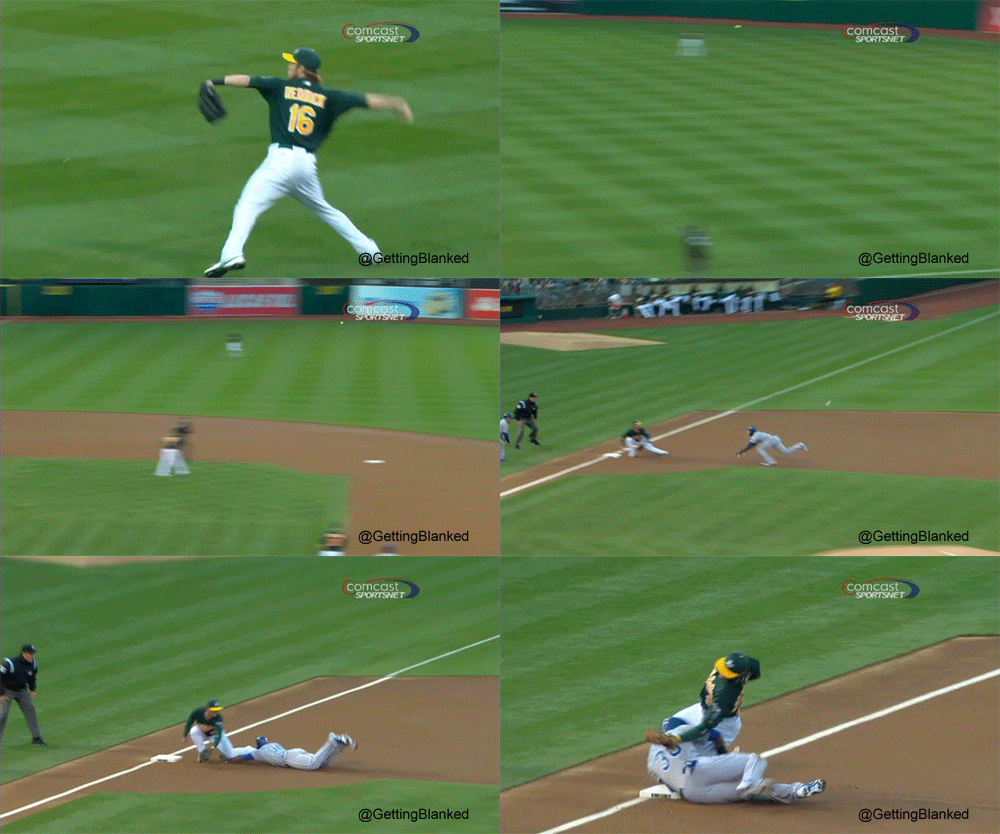
  • Speaking of ridiculous arm strength...THIS is why no one should ever test A's right fielder Josh Reddick:


  • Red Sox reliever Mark Melancon had a laughably poor outing against the Rangers on Tuesday night. With Boston already losing 8-2 in the eighth inning, the following sequence then occurred:
    -Mark Melancon enters the game.
    -Ian Kinsler doubles.
    -Elvis Andrus walks.
    -Josh Hamilton homers.
    -Adrian Beltre homers.
    -David Murphy walks.
    -Nelson Cruz homers.
    -Mark Melancon is removed from the game.
    That Hamilton homer was one of the deepest, like, ever in Fenway Park. Appropriately, Melancon's ERA now sits at 49.50. The former Yankees prospect may very well be an embedded mole sabotaging the Red Sox from within as part of an elaborate sting operation. Other members of Melancon's crack team of double agents: Crawford, Carl and Lackey, John.

  • This bit of news perfectly epitomizes the sad state of Minnesota Twins baseball:

    "In a stunning turn of events on Tuesday, Twins righthander Scott Baker went in to have surgery on his flexor pronator tendon but exited with Tommy John reconstructive elbow surgery."

  • And finally, the chronic erosion of one's love for baseball (and life in general) caused by wearing a Baltimore Orioles uniform over an extended period of time is illustrated by this heartbreaking chronological sequence of Robert Andino headshots:


Being an Oriole takes a toll on the soul.

Friday, March 30, 2012

MLB Season Preview: Minnesota Twins

The Twins are looking to rebound from last year's disastrous 99-loss season.

The M&M boys don't earn 40% of the Twins'
payroll to be in the lineup 40% of the time.
Offense: The fate of Minnesota's season--and future seasons--rests on stars Joe Mauer and Justin Morneau, who account for nearly 40% of the team's payroll. The Twins will likely look to protect Mauer's health by limiting his catching duties, which will hopefully help his declining offensive numbers. Morneau's career path may have been permanently altered by his concussion. The team desperately needs these two healthy, because the rest of the lineup is suspect after the departures of Michael Cuddyer and Jason Kubel. New additions Ryan Doumit and Josh Willingham can hit, but they have their own health issues. So does Denard Span, who played in just 70 games last year. Danny Valencia slumped to a .246 average one year after an impressive debut. The Twins hope that speedster Ben Revere and right-fielder/first baseman Chris Parmelee develop into everyday players.

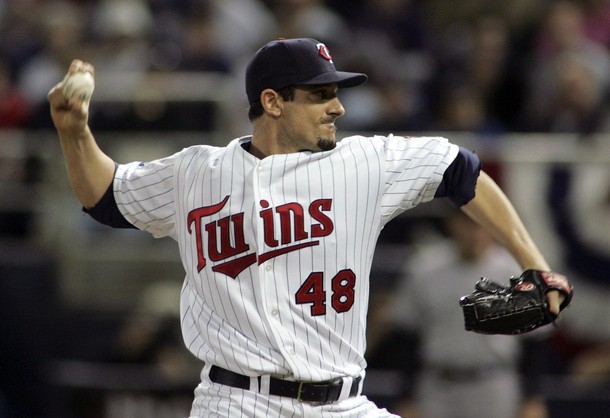
Ironically, Carl Pavano has become
one of baseball's most durable arms.
Pitching: There's still hope for Francisco Liriano. His outstanding spring provides hope that he can return to the ace-caliber pitcher he's always shown flashes of. And boy, do the Twins need him to bounce back, because the rest of the rotation has almost no upside. Scott Baker reached his ceiling last year (3.14 ERA); he's dealing with elbow tendinitis and has gotten pummeled this spring. Carl Pavano is a known entity at this point--he'll eat innings, and do so unspectacularly. Nick Blackburn and Jason Marquis barely qualify as back-of-the-rotation filler. Outside of Liriano, the rotation lacks upside. Glen Perkins is a bright spot in the bullpen, but the closer is still Matt Capps (4.25 ERA), who's still around as a reminder of why you don't trade a promising young catcher with six years of team control for a season-and-a-half of Matt Capps.

Ben Revere is very, very fast man.
Breakout Candidates: The Twins are prepared to give a lot of young players significant playing time in 2012 to see what they've got. Ben Revere has the best chance of breaking out. He hit .267 with 34 steals in 117 games last season and provides excellent defense in the outfield. If Chris Parmelee can somehow carve out regular at-bats, he could get a chance to prove his .355/.443/.592 line in 21 games last season wasn't a fluke (even though it basically was).

3 Key Questions: How healthy will Mauer and Morneau be? Will the Twins get Francisco Liriano The Ace or Francisco Liriano The Frustrating Enigma? And can you compete for a playoff spot relying on Scott Baker and Carl Pavano as two of your three best pitchers?

Best Case Scenario: Liriano returns to ace form, Morneau sheds his post-concussion symptoms, Mauer stays healthy, and the rotation is solid enough to carry the Twins to a second-place finish.

Worst Case Scenario: Morneau isn't the same player anymore, Mauer spends half the season in the trainer's room, Liriano is finished as an effective starter, Baker crashes back to earth, and another round of crippling injuries send the Twins back to last place.

Predicted Finish: With an injury-prone lineup and perfectly average starting pitching, the Twins look like a last-place team. If they stay healthy, there's potential for a higher finish, though the playoffs are pretty much out of the question.