Showing posts with label Bad Sports Journalism. Show all posts

Thursday, November 14, 2013

Trout, Cabrera, and the Elusiveness of "Value"

For the second consecutive year, Miguel Cabrera has won the American League MVP over the objectively superior candidate, Mike Trout. In the long run, this isn't really a big deal. Cabrera had great, MVP-worthy seasons. Trout at least finished second both times, and not eighth or something crazy like that. But what is a big deal is the questionable logic that influential baseball writers are resorting to in order to justify the Cabrera-over-Trout position.

The best example is an article written at FoxSports.com by Jon Paul Morosi. He's a member of the Baseball Writers' Association of America, meaning he gets to vote on these annual awards and will receive a Hall of Fame ballot in a few years. His article, titled "Miggy's MVP a good call  by voters," features the following sub-headline:
"Mike Trout had a superb season, but Miguel Cabrera led his team to the playoffs."
This is the crux of the Cabrera-over-Trout argument. Basically: how much "value" could Trout really have provided if his team didn't make the playoffs? Because the official BBWAA guidelines for this award are nebulous, Morosi is free to use this subjective argument. Here's how he explains himself in the article:
"In 2013, as in 2012, the question was not whether Cabrera or Trout deserved the honor. They both did. The issue, instead, was how each voter defined “value.” The official voting criteria empower us to choose the meaning of “value” for ourselves. Based on my interpretation, as one of the 28 BBWAA voters for this award, I ranked Cabrera first and Trout second."
Fine. But this is where it gets really good:
"Statistically, did Trout have the superior all-around season? Yes, he did."
I wish I could frame this quote and carry it around with me at all times. Let's see it again:
"Statistically, did Trout have the superior all-around season? Yes, he did."
Good lord, man. Morosi outright acknowledges that Trout had the better season. He's not even going to dispute that point. So now he's got to come up with a sound reason why the player who had the inferior all-around season deserves to be called the Most Valuable Player.
"Trout is a better defender than Cabrera, and he adds value through his baserunning. But MVP voters aren’t asked to fill out our ballots based on raw numbers. We must consider the context of each candidate’s performance. We are supposed to weigh the “value of a player to his team,” as the instructions suggest. And I believe a player is most valuable to his team when he helps it win."
As if Mike Trout doesn't help his team win. Good one, dude.
"In the baseball industry and among fans, team wins dominate – as they should. Boston hosted a duck boat parade for the Red Sox when they won the World Series. I’m still waiting for the first civic rally to honor an individual OPS title."
A few reactions to this moronic paragraph:
1. Who won the individual OPS title? Miguel Cabrera. So deriding that statistic kind of undermines the whole "Cabrera-for-MVP" thing.
2. The Boston Red Sox winning the World Series is a team accomplishment achieved in the postseason. The MVP award is an individual accomplishment achieved in the regular season. These two things have nothing in common.
3. Team wins are obviously important. But the MVP is an individual honor. Team wins are awarded to entire teams. The MVP is awarded to a single player. Why is this such a difficult concept to grasp?
"Trout’s performance was exceptional. But what was the true value of it? In August, while a gimpy Cabrera won AL Player of the Month honors and moved the Tigers to within range of a division title, Trout amassed an OPS of 1.090 and hit six home runs. He swiped six bases and finished with more walks than strikeouts. It was another crowd-pleasing display of Trout’s breathtaking ability.
But what impact did that month’s .590 slugging percentage have on the Angels’ 2013 season? It carried some significance, surely. It had value. But was it the most valuable? In my estimation, no. That distinction belonged to the man whose ability to play at an elite level, through pain, made certain his team sprayed champagne as AL Central champions for a third consecutive year."
Everyone got it? Trout had the better season, but it was mostly worthless because his team didn't make the playoffs. Well, maybe Morosi hasn't looked closely at the annual letter sent out by the BBWAA to the MVP voters, because its opening paragraph contains this critical sentence:
"The MVP need not come from a division winner or other playoff qualifier."
The official guidelines for the MVP award specifically note that the MVP winner doesn't have to make the playoffs. And yet, Morosi didn't vote for the candidate he himself acknowledged as the superior one just because that candidate didn't make the playoffs.

That position is fairly indefensible on its own. What makes it downright irresponsible is the fact that Morosi wrote a column three years ago, on the 2010 AL MVP race, in which he used the exact inverse of his 2013 voting philosophy to support his MVP choice. The obvious logical contradictions between the two articles suggest either hypocrisy or severe memory loss.

Back then, the MVP choice was between Josh Hamilton (who ended up winning) and, yet again, Miguel Cabrera. Both of them had great offensive seasons, but Hamilton's Rangers won their division while the Tigers finished in third place, leaving Cabrera out of the postseason. In other words, Cabrera in 2010 was ironically a lot like Trout in 2013 -- a worthy candidate whose MVP chances were crippled by not making the playoffs.

Based on the principles Morosi laid out in his Trout article, we would expect him to have supported Hamilton back in 2010, because he made the postseason and Cabrera didn't. And yet, Morosi wrote a column in September of 2010 titled "Cabrera has MVP edge over Hamilton." Here's how he justified that position back then:
"The BBWAA, of which I am a member, acknowledges that the definition of “value” is subjective. Each individual voter must decide. And while I am not part of the MVP electorate this year, I believe a player’s “value” is best defined as how difficult he would be for the team to replace."
Yeah -- this definition of "value" is entirely different from the one he used to disqualify Trout this year. In 2010, Cabrera's team finishing in third place and missing the playoffs didn't affect his value. In 2013, Trout's team finishing in third place and missing the playoffs rendered his season virtually useless. Cool stuff. Morosi elaborated:
"When Hamilton is hurt, manager Ron Washington can summon David Murphy, who would be a full-time player on many other teams. By comparison, how good would the Tigers be if they didn’t have their MVP candidate?"
One could easily apply this same logic to the Cabrera-Trout debate this year. When Cabrera was hurt and terrible in September, the Tigers were still good enough to win games and make the playoffs. The Angels would've been unspeakably bad without Trout keeping them somewhat respectable. The logic that Morosi used to support Cabrera in 2010 could easily be used in the same way to support Trout in 2013. So of course he just ignored that argument and came up with a new one that supported his desired conclusion.

Another one of his pro-Cabrera points in 2010 was this:
"Take away Hamilton, and the Rangers still have a very good lineup. Take away Cabrera, and Ryan Raburn is the potential cleanup man."
Again: one could say this same exact thing about Cabrera and Trout in 2013. Take Cabrera off the 2013 Tigers and they still would've had a very good lineup, with Torii Hunter, Prince Fielder, Victor Martinez, and Jhonny Peralta. Take Trout off the 2013 Angels and you're left with a sad bunch of guys led by the corpse formerly known as Josh Hamilton. Yet Morosi made no mention of this argument in his more recent MVP column, because the logic would have benefited the wrong player this time around.

Three years ago, Morosi made up a definition of "value" that justified his support for a player whose team finished in third place and missed the playoffs. This year, Morosi made up a whole new definition of "value" that justified his decision to withhold support from a player whose team finished in third place and missed the playoffs. Yes, the BBWAA lets individual voters determine the meaning of that nebulous word on their own, but that doesn't give guys like Morosi the license to keep moving the goalposts and inventing new criteria every single year.

The problem with Cabrera winning two MVPs over Trout isn't the "injustice" of that decision. They're both great players, and who really cares about a stupid award, anyway. The real problem is what these last two MVP races have revealed about some of the sport's most visible and influential writers. Those that are committed to portraying Cabrera as the more valuable player have been willing to resort to flimsy premises like "individual value is tied to team accomplishments" and "great offense renders great defense and base-running irrelevant." The intellectual inconsistency and basic misunderstandings inherent in these weak rationales undermine the credibility and authority of the writers who resort to them.

Friday, November 1, 2013

David Ortiz and Cooperstown's Double Standard

Based on what's been written in the wake of his third World Series title, it appears as though this latest round of postseason heroics has pushed David Ortiz over the hypothetical Hall of Fame threshold. He's certainly not a bad choice. In almost 2,000 career games, Ortiz has hit .287/.381/.549 with 431 home runs and a 139 OPS+. Remove his unspectacular stint with the Minnesota Twins and those numbers look even better. And in 82 career playoff games, he owns a .939 OPS, two walk-off home runs, and a host of other memorable clutch moments. But what makes Ortiz's case even more engrossing is his connection to performance-enhancing drugs.

Unlike Manny Ramirez and Rafael Palmeiro, Ortiz has never officially tested positive for a banned substance. He falls into the same category as Jeff Bagwell and Mike Piazza (and, technically, Barry Bonds and Roger Clemens), in that the evidence against him is purely circumstantial:

1. A New York Times report in 2009 claimed that Ortiz was one of the 104 players who tested positive for performance-enhancing drugs during "anonymous" survey testing in 2003, before the current testing system was installed. That famous list reportedly also implicates Manny Ramirez, Alex Rodriguez, and Sammy Sosa. Not the best company. It doesn't help that Ortiz was Ramirez's teammate for a number of years.

2. Ortiz's OPS with the Minnesota Twins, from 1997 to 2002, was .809. Since joining the Red Sox in 2003, his OPS has been .962.

3. Ortiz looked like toast in 2009, when he got off to a painfully slow start and hit just .238 for the season. It looked like he might retire at the beginning of 2010, when he hit .143 in April as a 34-year old. In the three years since then, he's recovered in a huge way to hit .311/.401/.571.

These are the indicators that the overly-suspicious baseball community has decided upon as the telltale signs of illicit drug use. They're all there: the unsubstantiated reports, the compromised teammates, the quantum leap in production, the late-30s career renaissance. There's far more "evidence" implicating Ortiz than there is against, say, Mike Piazza, and Piazza was rejected by the Hall of Fame voters last year purely based on skepticism and suspicion. For the sake of intellectual consistency, shouldn't Ortiz get the same treatment?

Spoiler alert: he won't. Ortiz isn't subject to the same level of scrutiny as other Hall candidates. And that tells you everything you need to know about how twisted this process has become.

The best illustration of this double standard comes from Jon Heyman, a CBS Sports analyst with a Hall of Fame vote. His Friday column covered Ortiz's case for Cooperstown, and performance-enhancing drugs was one of the key points he addressed. In the past, Heyman has proudly announced his refusal to vote for players even tangentially connected to steroids (not just Bonds and Clemens, but Jeff Bagwell and Mike Piazza too). So it was good to see the following paragraph, which suggested he would hold Ortiz to the same tough standard to which he has held others:

"Ortiz is no A-Rod, as anyone reasonably can conclude. But that doesn't mean he gets a free pass, either, not without a serious consideration of the facts. With even more accomplished players than Ortiz such as Barry Bonds, Roger Clemens and others omitted from Cooperstown to date, it wouldn't be right not to at least consider the case against Ortiz. A great nickname, way with words and penchant for maximizing the moment doesn't win Big Papi a free pass. So the case against must be considered."

Very reasonable. Heyman isn't letting Ortiz's narrative affect his broader evaluative method. He then goes on to acknowledge a few of the links between Ortiz and drugs:

"Ortiz was one of 104 players to fail MLB's 2003 steroid survey test ... Ortiz was a marginal player until he got [to] the Red Sox in his late 20s, then took a giant leap to become Manny Ramirez's co-equal runningmate, and he has remained great even into his late 30s after looking like he might be nearing the end at least a couple different times a half-decade ago ... A giant bear of a man, he once seemed like the nicest guy in the world, but more recently has shown occasional signs of surliness and one classic fit of temper ... He knows Manny well."

It's important to note at this juncture that these are all ridiculous reasons to exclude Ortiz from the Hall. One unconfirmed report, some statistical fluctuation, and "signs of surliness" aren't evidence of drug use. That's not the point here. The point is that Heyman -- a Hall of Fame voter -- has a well-established history of withholding his vote from players who have been loosely connected to drugs. Here, he appears to be willing to apply that tough standard to the eminently-lovable Ortiz. That's what's important -- intellectual consistency. Even if I don't agree with Heyman's Hall standard, at least he's got a philosophy that he wields fairly across the board. In his own words:

"... it isn't necessarily unreasonable to omit Ortiz based on this one serious mistake. Players who took steroids or even laced supplements gained an unfair advantage, and I have never voted for anyone linked to steroids."

Again, I disagree with this position, but it's hard not to respect Heyman for sticking to his ideological guns, even when faced with an appealing baseball character like Ortiz.

Except at the very end of this column, Heyman does a complete about-face that highlights the Ortiz double standard:

"Some Hall of Fame voters will exclude players with any link to steroids, no matter how strong that link is, but in this case it fairly boils down to one un-sourced report involving a test for survey purposes.

Is that enough to exclude? Not here it isn't.

Cooperstown it is."

I mean ... what? After all that, Heyman is endorsing Ortiz for the Hall? Here's how the logic of this column breaks down:

1. I, Jon Heyman, have never voted for anyone linked to steroids.
2. Here is a bunch of evidence linking David Ortiz to steroids.
3. I support David Ortiz for Cooperstown!

So much for a reasonably-applied standard. Heyman's voting principles are now completely compromised. Just a year ago, his official Hall of Fame ballot did not include Jeff Bagwell. It did not include Mike Piazza. Both of those players had twice the careers that Ortiz had, but Heyman did not vote for them because of unconfirmed reports and rumors about their drug use. Yet in Ortiz's case, Heyman is suddenly willing to acknowledge nuance and look past the unconfirmed reports and rumors. This confirms exactly what we have come to expect -- baseball writers aren't making Hall of Fame decisions based on reason and logic and sound criteria. They're voting on narratives and personal biases. Bagwell and Piazza? They never won a championship, did anything memorable, or played for great teams, so they probably used drugs. They're out. Ortiz? He's a fun dude with a cool nickname, some clutch moments, and three titles for a historic franchise, so he probably didn't use drugs. He's in.

This is not David Ortiz's fault. He may very well be a Hall of Famer, and his tenuous connection to drugs should not be a factor when the time comes to make that decision. It is encouraging to see an actual voter like Jon Heyman promoting that view. It would just be great if Heyman could provide other suspected users like Bagwell and Piazza with the same benefit of the doubt that Ortiz has apparently earned.

------------

There's a second aspect of the Ortiz double standard that isn't drug-related. It has to do with another designated hitter: Edgar Martinez. Martinez has been on the Hall of Fame ballot for four years now, and hasn't yet crossed the 40% threshold, suggesting that his chances of induction aren't good at all. But if Ortiz is now being considered a Hall of Famer, then the voters had better take a second look at Martinez, because the gap between these players is striking.

Martinez had the better slash line (.312/.418/.515), his on-base advantage trumping Ortiz's edge in power (.287/.381/.549). Martinez has the better OPS+ (147 to 138). They have similar career games played and plate appearance totals, yet Baseball Reference has Ortiz's career value at 44.2 WAR and Martinez's at 68.3, thanks in part to Ortiz's forgettable stint with Twins. Both were DHs, but Martinez actually spent less of his time there (74%) than Ortiz (86%). Fangraphs.com grades Ortiz as the inferior baserunner and defender. Martinez actually played some third base, which Ortiz probably can't even do in his own imagination. Granted, Ortiz has the postseason accomplishments, but ... what am I missing here? Until he tacks on a few more seasons of elite production, he can't be considered Martinez's equal.

So how can Jon Heyman support Ortiz for the Hall when he didn't vote for Martinez last year? Well, this is what he wrote about Edgar last January:

"Had that pretty slash line of .312/.418/.515. But since he was mostly a DH, I would have liked a bit more power, longevity or speed. Great, but pretty one-dimensional."

Reading that blurb now is devastatingly ironic considering Heyman's more recent endorsement of Ortiz. If he didn't vote for Martinez because he was a slow and one-dimensional DH without enough longevity, how can he possibly justify a future vote for Ortiz, who's an even-slower and even-more-one-dimensional DH with an even shorter career? Again, it's the same illogical approach discussed above. It clearly doesn't have anything to do with merit. It's because Martinez didn't have an outgoing personality or a badass nickname like "Big Papi" or the good fortune to play for great teams in three World Series. It's about narrative. Baseball writers love narrative -- they write it and promote it for a living -- so it's no surprise that narrative has become the most important means of judging a player's ultimate career value. This is not the objective analysis that baseball -- more rooted in statistics than any other sport -- deserves.

Based on Heyman's voting record with respect to Jeff Bagwell, Mike Piazza, and Edgar Martinez, there was absolutely no rational reason to expect him to support David Ortiz's candidacy as a one-dimensional DH with connections to performance-enhancing drugs. And yet he still wrote that column endorsing Ortiz. It's just another example of how broken Cooperstown's voting process really is. As long as narrative, not merit, determines its membership, the Hall of Fame's relevance as a record of baseball greatness will be undermined.

Monday, October 28, 2013

Some Shrewd Baseball Wisdom From FOX

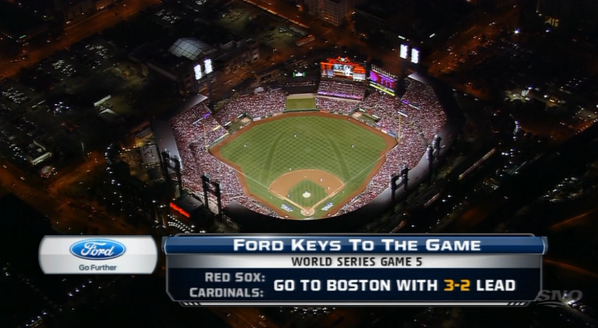
One of the pregame features of the Joe Buck/Tim McCarver baseball broadcast on FOX is called "Ford Keys to the Game." It's relatively self-explanatory -- it provides some broad goal each of the teams should be pursuing to best maximize their odds of winning, like "Get to the bullpen" or "No mistakes" or something else similarly obvious and/or cliche. It's usually a mindless exercise not even worth mentioning. But the "Keys to the Game" they rolled out before Monday's pivotal Game 5 in St. Louis represented a hilarious new low. With the series tied 2-apiece, here's the sage advice Buck and McCarver offered the Red Sox and Cardinals:


There you have it, folks: the key to winning the game is to win the game. But how exactly, you might ask? First, by winning the game, and second, by correctly advancing to the city where the next game will be played. Truly insightful, FOX.

Thursday, April 25, 2013

Joey Votto is Apparently Ruining Baseball

Or so Tom Verducci would like you to think.

Verducci is a fairly visible and well-known writer for Sports Illustrated who recently penned an article (which can be read in its entirety by clicking here) entitled "Virtue, and victory, no longer synonymous with patience at the plate." Alliteration aside, this title is clearly making no effort to disguise its own absurdity.

Verducci basically spends 1,400 words complaining about how extremely-patient hitters like Joey Votto are hurting baseball because their at-bats are too long, they strike out too much, and they're causing the recent decline in offense across the majors. Without copying-and-pasting the entire diatribe, there are a few notable or entertaining gems in the piece worth commenting on. Like this, for instance:

Welcome to the state of the art in hitting these days, where aggressiveness is disdained and passivity is exalted. The modern hitter is guided by the accepted wisdom in catchphrases such as "driving up pitch counts," "taking pitches" and "quality at-bats."

Particularly enjoyable in this paragraph is the way Verducci puts sarcastic quotes around legitimate baseball strategies, as if "quality at-bats" don't lead to "walks" and "hits" and "runs."

Verducci:
There is one serious flaw in this groupthink strategy. It isn't working. Hitters are striking out more than ever before in baseball history while runs, walks, hits and home runs have been on the decline for years.

It is now Verducci's job to convince the reader that this decline in offense has been caused by the baseball cancers known as "quality at-bats" and "driving up pitch counts." Spoiler alert: he fails to do this.

And while teams still preach the religion of driving up pitch counts to "get into the bullpen" of the other team, they may be pushing an outdated agenda. So fortified are major league bullpens these days, especially with hard throwers, that last year relievers posted an ERA more than half a run lower than starters and averaged almost one strikeout for every inning."

That last sentence there is worth a jaw-dropping double-take. "... last year relievers posted an ERA more than half a run lower than starters." I mean ... no kidding, man. It's almost like relievers ALWAYS have lower ERAs than starters because of the inherent nature of their job. It's almost like relievers are asked to get only two or three outs at a time while starting pitchers are expected to pitch six or seven innings. It's almost like many relievers are specialized to only face same-sided hitters -- lefties on lefties and vice versa. Saying that relievers posted a better ERA than starters last year is like saying, "hitters who bat leadoff have higher batting averages than hitters who bat ninth." That's some super sleuthing, Sherlock.

Verducci is right when he says that many bullpens are now fortified with hard throwers and elite strikeout relievers. But most teams only have one or two of those shutdown pitchers. Chances are that the reliever a team will likely face in the sixth or seventh inning is going to be a lot weaker than that day's starting pitcher. Driving up a starter's pitch count, tiring him, and knocking him out of the game as early as possible is just a good baseball strategy. The only exception is when a truly miserable starter is on the mound and you're better off just pulverizing him (a.k.a., whenever you're playing the Twins).

The proliferation of measurables in baseball is helping a generation of hitters turn offense into a passive aggressive pursuit. While batting average rightly has lost much of its inflated value, the flip side is that ubiquitous pitch counts, pitches per plate appearance, walks and on-base percentage are influencing how hitters go about their jobs.

The horror!

What we are left with is a sport in which games keep getting longer but with less and less action. The ball is not put in play on 81 percent of the pitches, an all-time record of inactivity. The knottiest issue for baseball is not the stadium issues of Oakland and Tampa Bay or the Biogenesis scandal; it's the increased lack of action in your average baseball game.

So we've arrived at the crux of the problem: Tom Verducci is bored watching baseball. Look, buddy, I don't know what to tell you. Presumably you knew what you were getting into with this sport. Baseball is slow. It always has been. Hitters taking more or less pitchers can't really change the sport's inherent nature. If your attention span is lacking, the NBA Playoffs will be on TV for the next, like, six months. That Pacers-Hawks series looks particularly riveting (hahaha nope).

Nobody swings 3-and-0 any more. You're supposed to take the pitch to drive up the pitch count and lengthen your at-bat, nevermind that it might be the best pitch the hitter sees. Last year major league hitters managed only 94 hits on 3-and-0 counts, or about one hit on a 3-0 pitch every 26 games. (They hit .348 when they did put 3-0 pitches into play). The 94 hits on 3-0 were down 24 percent in just a decade, down from 123 hits in 2002. So because hitters swing less often on 3-and-0, Werth gets criticized for doing something "wrong," even though the average big leaguer slugs .767 when he does put such pitches into play.

This article is like a scavenger hunt for all the different types of logical fallacies. The problem with Verducci's point here is selection bias. He wants hitters to swing at 3-and-0 pitches more often because those who do are hitting .348 and slugging .767. The assumption is that if more hitters swing 3-and-0, they too will hit .348 and slug .767. But obviously that's not the case. Presumably, hitters are already swinging at the most desirable 3-and-0 pitches, which is why that average and slugging percentage are so high. Logically, if they began swinging at more 3-and-0 pitches, they would be less successful and those impressive rates would drop.

Verducci then provides the centerpiece of his argument: a graph that shows how players are swinging at the first pitch just 26% of the time in 2013, down from 33% in 1988. It also depicts the rise in overall strikeout rates, from 14.7% to 20.2%, across the same time period. His reaction to this data:

Do the math: hitters are swinging at the first pitch less and less and striking out more and more.

No, there is no math. The logical error here? Verducci hasn't proven in any way that there's a correlation between "swinging at the first pitch" and "increased strikeout rate." Anyone can make a graph with two trends side-by-side and claim a correlation. With that method, I could claim that an increase in hot dog consumption at ballparks since 1983 is the reason behind the increased strikeout rate. Do the math!

You hear so much talk about "grinding out at-bats" and "making the pitcher throw more pitches" that you would think seeing a lot of pitches is a denominator to success. You would be wrong. There is no correlation between seeing more pitches and winning more games. Entering this week, only one of the six first-place teams ranked among the top 11 teams in pitches per plate appearance. Five of those 11 teams that saw the most pitches had losing records.

There might be no worse crime in sports analysis than using three weeks of baseball games to make broad, sweeping conclusions. The month of April would also have us believe that Buster Posey and Giancarlo Stanton are bad at baseball, but Coco Crisp is an MVP candidate and the Colorado Rockies are World Series favorites. It's three weeks! And you're citing first-place teams! Good lord.

Last year there were 13 teams that ranked above average in most pitches per plate appearance. Nine of those 13 teams did not make the postseason.

Come on, man. This is ridiculous. There is no ONE SACRED STATISTIC that correlates to baseball success. If there was -- I'm pretty sure we would know about it. Using this argument to discredit an entire school of thought about plate discipline is really weak. Of course seeing a lot of pitches doesn't guarantee a winning season by itself. The Red Sox and Twins both ranked within the top five in pitches-per-plate-appearance last year, but both were awful and missed the playoffs by a wide margin. Why? Because their patient approach at the plate failed miserably? No. Because they had the third- and fourth-worst pitching staffs in baseball.

The two pennant winners, San Francisco and Detroit, ranked 25th and 27th in pitches per plate appearance.

Again -- trying to prove a point using the eensy-weensy sample size of a singe postseason is cruelly misleading. The Detroit Tigers were pushed all the way to Game 5 in the first round by the Oakland Athletics, the team that happened to see the MOST pitches-per-plate-appearance in the majors. What if the A's had won that game? Would that lone result have ruined Verducci's entire narrative? Basically, if the point you're trying to make hinged on the result of a single baseball game, it's probably not a point worth pushing.

Oh, and the Tigers had Justin Verlander. The Giants had Matt Cain. What are we even doing here.

If there is one hitter who best personifies the modern passive aggressive approach it is [Joey] Votto. He has phenomenal patience, balance and hand-eye coordination. Last year he came to the plate 475 times and suffered the embarrassment of the one-pitch out only 19 times. This year Votto is off to a wildly efficient start. In 20 games he has reached base 49 times, including 25 times by way of a walk. His on-base percentage is a robust .500. According to the favored modern measurables, he is an offensive dynamo of historic proportions.

Joey Votto is getting on base a lot. His team, the Cincinnati Reds, ranks third in the majors in runs scored. Now there's a correlation you can believe in.

But that's not the whole story. Votto, who won the 2010 NL MVP Award when he hit 37 home runs, has become an extreme version of himself. He is swinging the bat less often with each passing year. No one should advocate Votto start chasing more pitches out of the strike zone, but it's interesting to see how Votto is letting more and more good pitches go by without attempting to swing. His percentage of swings at strikes has gone down four straight years: 74, 73, 69, 62, 60. Votto has told me the more pitches he sees, the more he believes the at-bat swings in his favor.

If Joey Votto says that seeing more pitches is a good thing, I'm inclined to believe that seeing more pitches is a good thing.

Now consider what Votto has done this year with runners on base. The Reds' number three hitter has come to the plate 51 times with runners on and produced zero extra-base hits. His slugging percentage with runners on is .188. Only twice this year has he driven in a teammate with a hit. But he has an awesome on-base percentage.

This obsession with tiny sample sizes is infuriating. Verducci is judging Votto on 51 plate appearances. Fifty-one. That's nothing. Any baseball player can look like Ted Williams or like a Double-A scrub in 51 plate appearances. Vernon Wells, whose OPS was .682 last year, and .660 the year before, is at .930 through 79 plate appearances this April. Mike Trout hit .220 in his first 135 plate appearances of his career. Meaningless.

What makes Verducci's point here even more hilarious is this: in 1,425 career plate appearances with runners on base, Joey Votto has hit like a god: .336/.455/.578. Last year, with runners on base, he was even better: .353/.510/.673 in 210 plate appearances. Joey Votto is awesome with runners on base. He's awesome with no one on base. He's awesome whenever he's wearing a baseball uniform (and maybe even when he isn't, though I don't have that kind of access). It took me like, five seconds to look up these numbers. Verducci apparently couldn't be bothered.

The problem is the state of the art isn't working. Few hitters are as good as Votto. More teams than ever deploy two batting coaches, not one. More ballparks have constructed multiple batting tunnels that almost never go empty from four hours prior to the game to the last out. Video is more abundant and portable than ever. More data is available. And yet the modern approach to hitting is failing. Pitchers are four years into a run of dominance and there are no signs that their run is abating, especially when the modern passive aggressive approach to hitting has become so ingrained.

Having read the entire article, at no point did Verducci convince me that the recent decline in offense can be explained by a new "passive-aggressive" ideology on plate discipline. In fact, Verducci is probably overstating the trends he's slamming. In 2002 (the year before "Moneyball" was published), hitters swung the bat, on average, 46.5% percent of the time. That percentage has dropped, like Verducci claims, but only down to 46.0% last year -- a decline by half of one percentage point. Similarly, hitters saw an average of 3.74 pitches-per-plate-appearance in 2002, and 3.83 last year. An increase, but again a slight one, by just a tenth of a point. So it's hard to see how this "passive-aggressive" ideology has taken over the game like Verducci seems to be claiming.

Yes, a slightly more patient approach at the plate across the sport is probably one of the factors behind the current low-run-scoring environment in baseball. But by no means is it a major one, or even the only one. Offense is down because drug testing ended the steroid era, and because pitchers are throwing harder than ever before, and because teams are putting a new premium on defensive value often at the expense of offense, and because bullpens are becoming more and more specialized, and because Yu Darvish and Stephen Strasburg and Craig Kimbrel exist. Joey Votto is certainly not one of the reasons why baseball is scoring fewer runs. On the contrary, Joey Votto is doing literally everything he can to generate more runs, and people who are actually paying attention know that he's gotten quite good at it, too.

Tuesday, April 23, 2013

Pujols vs. Mauer: A Question of RBIs

A week ago, MLB Network posed this intriguing question to two of its analysts: under their current contracts, which player would you rather have on your team -- Albert Pujols or Joe Mauer?

A year ago, you would've looked stupid just asking that question. Pujols, an all-time great hitter, had just signed a massive $240 million contract with the Angels; Mauer was coming off an injury-plagued season where he only played 82 games and hit three home runs. Pujols was the easy selection. Now, though? The choice might be equally obvious -- but with a different answer.

In fact, MLB Network's token "sabermetrics guy," Brian Kenny, had no trouble picking Mauer. Old-school traditionalist Harold Reynolds took Pujols without hesitation. And that disagreement perfectly encapsulates baseball's long-lasting bias towards perceived "run-producers."

Because Pujols racks up huge RBI totals, he gets labelled as a "run-producer," worthy of big bucks because of some innate ability to drive in runs. Because Mauer has never had a 100-RBI season, he doesn't get that special badge. He's just a good hitter who walks a lot -- not the guy you want with runners in scoring position. You need a proven "run-producer" in that situation.

Obviously, this is bogus. The primary goal of a baseball hitter is to not make outs. Joe Mauer is exceptionally good at not making outs. In fact, just last year, he was the best player in the American League at not making outs. His .416 on-base percentage led the league, beating out the guy who won the Triple Crown, and would have led all of baseball if not for The Walking Machine Known As Joey Votto.

In the past, Albert Pujols was even better than Mauer at not making outs (.414 career OBP compared to .405 for Mauer). But in 2011, his OBP was .366. In 2012, it dropped again to .343. Again: Mauer was at .416 last year, and has been above .400 in three of the past four years. And that's just one of the many reasons why I'd rather have Mauer over Pujols for the remainder of their contracts. Mauer is three years younger. Mauer can still catch, while Pujols is relegated to first base or DH. Pujols once had the durability advantage, but has dealt with a rash of injuries recently, including a nasty case of plantar fasciitis that has him limping around the baseball diamond like a beached whale at the moment. Pujols' other advantage, his power, has declined for three straight years. And most importantly, Pujols is under contract for the next NINE years, until he's 41 years old, for a grand total of $228 million. Mauer is under contract for the next six years, until he's 35 years old, for a total of $138 million.

So would you rather have the older, declining, injured player whose power and on-base percentage have taken an alarming dive, or the younger, less expensive player with elite on-base skills who can still do some catching? Oh -- and you have to pay the first guy $30 million when he turns 41 years old.

Harold Reynolds, of course, still wants Pujols. Because, you know, he's a "run-producer." Here's the justification he offered:

"But when you're paying that kind of money, the return is power. That's how you get that money. And that's where Joe's lacked at. Would you give Wade Boggs that money? No. Would you give Tony Gwynn that money? Rod Carew? They wouldn't get that money."

Boggs, Gwynn, Carew. They weren't "run-producers" or RBI guys. They were just Hall of Famers. Lame.

His next argument, which is by far the most entertaining:

"Now you're knocking Albert a little bit, but he also can DH ... "

Oh, Pujols can DH! What a gifted, talented human being! He can probably hit anywhere in the order, too!

" ... he's only missed eight games so far in this span of almost two years now, he's been in this contract ... "

First of all, it hasn't been "almost two years," it's been "one year and like three weeks." Secondly, Mauer only missed 15 games last year. Because he also played the most challenging defensive position in baseball.

Brian Kenny then admitted that Pujols has the power edge, but notes that in five of the last seven years, Mauer has finished within the top three in on-base percentage in the American League (and led the league last year).

Reynolds was incredulous:

"Leads the league in on-base? Come on, Brian. Seriously? He's got to drive in some runs."

Brilliant. Mauer, your .416 OBP is total crap because you only had 85 RBIs. Hey, Harold: HE PLAYED FOR THE MINNESOTA TWINS. They're all sorts of awful. The two guys hitting in front of Mauer last year (who should be the Twins' best on-base guys) were Denard Span and Ben Revere. Their OBPs were .342 and .333. Who was hitting ahead of Pujols? Oh yeah -- MIKE TROUT.

On a related note: right now, Brandon Phillips has the second-most RBIs in baseball. But Phillips isn't a "run-producer" or even an elite hitter. Why so many RBIs? Because two of the players hitting ahead of him in the Reds lineup are Shin-Soo Choo and Joey Votto, who both currently have on-base percentages over .500. FIVE HUNDRED. Phillips isn't naturally good at accumulating RBIs; he's just always hitting with men on base. RBIs are a function of opportunity. It shouldn't be too surprising that Pujols had 20 more RBIs than Mauer when one of them was in a lineup with Mike Trout and the other was in a lineup with Denard Span and Ben Revere.

Reynolds continued by trying to discredit Mauer's positional flexibility:

"Out of the 242 games so far, he's caught 136. You can't say that's catcher. He's been DH-ing a lot."

Hilarious use of the DH argument. With Pujols: "He's so awesome, he can even DH!" With Mauer, it's a negative: "He only played HALF his games at catcher -- he's just a DH!"

No, Mauer isn't a full-time catcher anymore, but he's played that position in over half of his games over the past two years. That's extremely valuable.

When Brian Kenny accused Reynolds of undervaluing on-base percentage, he pretty much lost it again:

"It's undervalued if you're scoring runs. Other than that, big deal, I'm gonna walk Joe Mauer."

This logic is bizarre. "It's undervalued if you're scoring runs." But ... Mauer does score runs. He finished second in runs on the Twins despite their terribleness. "I'm gonna walk Joe Mauer." Okay, you do that, but I can't condone freely giving Mauer a 1.000 OBP as a good baseball strategy. Pretty sure he'd score even more runs if you did that.

Harold Reynolds analyzes baseball in individual terms. If Pujols has more RBIs than Mauer, Pujols is the better player. If Mauer isn't scoring runs, his on-base skills aren't valuable. For whatever reason, he can't seem to understand the differences in context between the Angels lineup and the Twins lineup. Because of that mistake, he'd be willing to pay a declining power hitter $228 million until he turns 41 rather than pay an elite on-base guy $138 million until he turns 35. Okay then.

As a final note: for his career, Mauer has hit .343/.460/.497 in 1,300 plate appearances with runners in scoring position. If that isn't worthy of "run-producer" status, then what is?

Saturday, January 12, 2013

The Cult of Jack Morris

"I think Jack Morris is one candidate where you just got to overlook the statistics."
-Bill Madden, Hall of Fame voter

"I know the stats zealots don’t think Morris is a Hall of Famer because his rankings in their new-fangled ratings fall below their standards. But they don‘t have a formula for intestinal fortitude or determination."
-Murray Chass, Hall of Fame voter

"Statistics are important. There's no arguing that. The problem with stats is, they don't measure grit. Morris had plenty of that."
-Bob Sansevere, Pioneer Press

"When did we decide that earned-run average was more important than wins?"
 -Jack Morris


It is impossible to look at Jack Morris's career and make an objective, rational case that he belongs in the Baseball Hall of Fame.

His 3.90 ERA would rank dead last among Hall of Fame pitchers. His 39.3 Wins Above Replacement ranks 150th all-time at his position. His strikeout-to-walk ratio was a dismal 1.78, good for 424th all-time, a few slots behind Dontrelle Willis and Barry Zito. His adjusted-ERA (ERA+) was just 105, meaning he was an above-average pitcher for his career. Not a great one deserving of Cooperstown enshrinement.

Yet two-thirds of this year's Hall of Fame voters cast a ballot for him anyway. They weren't voting for Jack Morris The Pitcher. They voted for Jack Morris The Legend, a folk creation based entirely on exaggerating memories and distorting facts. The Legend feeds on false narratives to stay alive. Let's debunk a few of them.

Narrative 1. "Jack Morris was the most dominant pitcher of his era."
For this to become true, all you'd have to do is kidnap Nolan Ryan, Roger Clemens, Steve Carlton, and Bert Blyleven.

Morris made 527 career starts. He put his team behind in 344 of them. He allowed four or more runs in 244 of them (more than any other AL pitcher in the DH era). These are not things that "dominant" pitchers do.

Narrative 2. "Jack Morris had the most wins of the 1980s."
This is the "statistic" used to support the "most dominant pitcher of his era" claim. There are so many things wrong with this statement.
1) Wins don't say anything about the quality of pitchers.
2) The rest of the top five in "pitcher wins from the 1980s" is Dave Stieb, Bob Welch, Fernando Valenzuela, and Charlie Hough. Not one of those four guys is in the Hall of Fame, or even came close. It's almost like ... wins don't say anything about the quality of pitchers.
3) Morris also led the 1980s in "most hits allowed," "most runs allowed," and "most home runs allowed." Leading the decade in wins was a function of durability and good run support, not pitching skill. Dave Stieb, for instance, had a better ERA (3.32 to 3.66) and ERA+ (126 to 109) during the 1980s. He just played for an inferior team. He was the better pitcher.
4) "The 1980s" is no more meaningful than any random ten-year sample. Here are a few pitchers who led baseball in wins during other ten-year periods:
1977-1986: Ron Guidry
1984-1993: Frank Viola
2000-2009: Andy Pettitte

Narrative 3. "Jack Morris made fourteen Opening Day starts, fewer than only Tom Seaver."
No one, anywhere, has ever used "Opening Day Starts" as a pro-Hall of Fame argument until now. It's meaningless trivia. Brad Radke made nine Opening Day starts for the Minnesota Twins in his career. He dropped off the ballot last year after receiving precisely 0.3% of the vote. "Fourteen Opening Day Starts" is the perfect example of a writer first deciding that Morris is a Hall of Famer and then seeking out arguments to justify that position, instead of the other way around. "Fourteen Opening Day Starts." Please.

Narrative 4. "Jack Morris was a big-game pitcher, and one of the baseball's best postseason starters."
Morris's postseason ERA was 3.80, nearly identical to his career regular season ERA of 3.90. If he's interested in seeing what a real postseason ace looks like, he should go check out Curt Schilling's page on BaseballReference.com.

Narrative 5. "Jack Morris threw one of the greatest postseason games ever."
He did. He threw a ten-inning shutout in the 1991 World Series, leading the Twins to a 1-0 win and thus the championship. But on its own, it isn't enough to call Morris a Hall of Famer. Nine other pitchers have thrown a shutout in Game 7 of the World Series, including non-Hall of Famers like Ralph Terry (who also won 1-0), Bret Saberhagen, and Johnny Podres. If one dominant postseason game was enough, then Don Larsen would have been inducted into the Hall a long time ago.

Narrative 6. "Jack Morris was the #1 starter for three World Series-winning teams."
He may have started Game 1 of the World Series for three championship teams. But not once was he the best pitcher on a championship team.

1984 Detroit Tigers
Morris: 3.60 ERA, 109 ERA+, 2.3 WAR, 7th in Cy Young voting
Dan Petry: 3.24 ERA, 121 ERA+, 3.3 WAR, 5th in Cy Young voting

1991 Minnesota Twins
Morris: 3.43 ERA, 125 ERA+, 4.1 WAR, 4th in Cy Young voting
Scott Erickson: 3.18 ERA, 135 ERA+, 4.3 WAR, 2nd in Cy Young voting

1992 Toronto Blue Jays
Morris: 4.04 ERA, 101 ERA+, 2.5 WAR, 5th in Cy Young voting
Jimmy Key: 3.53 ERA, 115 ERA+, 3.6 WAR
Juan Guzman: 2.64 ERA, 154 ERA+, 5.2 WAR

In each of his three World Series-winning seasons, Morris was was the second- (or third-) best pitcher on his own team. In fact, in both '84 and '91, Morris finished behind a teammate in the Cy Young Award voting.

Narrative 7. "Numbers don't tell the whole story. You had to see Jack Morris pitch to know how great he was."
This argument comes from the older writers who claim "if you saw him with your eyes, you'd understand." But again: baseball writers who saw Morris pitch were the people giving out Cy Young votes. They were the ones who decided that Morris wasn't the best pitcher on his own team during two of his three championship seasons. In 1984, they awarded the Cy Young to Willie Hernandez, who was not only another teammate of Morris's -- he was a relief pitcher.

Across his entire career, Morris received a GRAND TOTAL of four first-place Cy Young votes. Four. Dave Stieb got five in 1982 alone. Seems like the baseball writers who saw Jack Morris pitch knew exactly how great he was.

Just how great? Below is a table pitting Morris against 20 similar pitchers from around his time period, comparing their career Wins Above Replacement, ERA, adjusted-ERA+, whether or not they won a Cy Young Award, and their single best performance in Hall of Fame voting (by percentage). Note the complete lack of Cooperstown support for any of these pitchers, with a lone exception -- Morris, ironically one of the least qualified candidates listed:

Pitcher
WAR
ERA
ERA+
Cy Young?
Best HoF %
Rick Reuschel
64.6
3.37
114
No
0.4
Kevin Brown
64.5
3.28
127
No
2.1
David Cone
58.2
3.46
121
Yes
3.9
Bret Saberhagen
56.0
3.34
126
Yes (2)
1.3
Dave Stieb
53.5
3.44
122
No
1.4
Jerry Koosman
53.1
3.36
110
No
0.9
Frank Tanana
52.6
3.66
106
No
0.0
Orel Hershiser
48.0
3.48
112
Yes
11.2
Jimmy Key
46.1
3.51
122
No
0.6
Ron Guidry
45.4
3.29
119
Yes
8.8
Dwight Gooden
45.1
3.51
111
Yes
3.3
Dennis Martinez
45.1
3.70
106
No
3.2
Frank Viola
43.7
3.73
112
Yes
0.4
Vida Blue
41.3
3.27
108
Yes
8.7
Bob Welch
39.9
3.47
106
Yes
0.2
Tom Candiotti
39.3
3.73
108
No
0.4
JACK MORRIS
39.3
3.90
105
No
67.7
John Candelaria
37.4
3.33
114
No
0.2
Charlie Hough
34.8
3.75
106
No
0.8
Fernando Valenzuela
34.2
3.54
104
Yes
6.2
Jose Rijo
33.0
3.24
121
No
0.2

Besides Morris, not one of these pitchers was ever seriously considered for the Hall. Most of them fell off the ballot entirely, without any fanfare, after only a year or two. The 67.7% support he earned from the voters this year is utterly inexplicable and undeserved given how quickly these better-or-equal pitchers were tossed aside.

Next year will be his final go-around on the ballot. Maybe he'll get in, maybe he won't. Maybe he'll be treated kindly by the Veterans' Committee down the road. All I know is that if Jack Morris gets into the Hall of Fame, Kevin Brown deserves to get in twice.