Showing posts with label World Series. Show all posts

Monday, October 28, 2013

Some Shrewd Baseball Wisdom From FOX

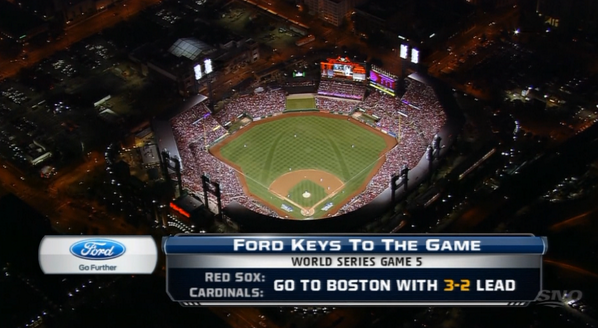
One of the pregame features of the Joe Buck/Tim McCarver baseball broadcast on FOX is called "Ford Keys to the Game." It's relatively self-explanatory -- it provides some broad goal each of the teams should be pursuing to best maximize their odds of winning, like "Get to the bullpen" or "No mistakes" or something else similarly obvious and/or cliche. It's usually a mindless exercise not even worth mentioning. But the "Keys to the Game" they rolled out before Monday's pivotal Game 5 in St. Louis represented a hilarious new low. With the series tied 2-apiece, here's the sage advice Buck and McCarver offered the Red Sox and Cardinals:


There you have it, folks: the key to winning the game is to win the game. But how exactly, you might ask? First, by winning the game, and second, by correctly advancing to the city where the next game will be played. Truly insightful, FOX.

Saturday, October 26, 2013

Pinch-Hitting is Still Allowed, Right?

Just a few moments ago, in the top of the ninth inning in Game 3, Red Sox manager John Farrell let his pitcher hit in a tie game. As in, with Brandon Workman (a pitcher) due up against elite closer Trevor Rosenthal, with one out in the ninth inning of a tie game, Farrell chose to allow his pitcher to bat rather than use a pinch-hitter. Now, some quick reminders:

A) pinch-hitting is a legal strategy in National League baseball
B) it was a tie game
C) Brandon Workman is a rookie pitcher with zero career at-bats in his professional career
D) it was a tie game in the World Series
E) rookie pitchers with zero at-bats aren't good at hitting
F) it was a tie game in the ninth inning in the World Series

By letting Workman hit against Rosenthal, Farrell was literally throwing away an out. The rules of baseball granted him three outs in the ninth inning, and he refused that offer. "Nah, I'm good with two, thanks." There are only two hypothetical scenarios where letting Workman "hit" in a tie game in the ninth makes an ounce of sense:

1. The Red Sox had no pitchers left and Workman was their last hope.
2. The Red Sox had no hitters left and therefore couldn't replace Workman with anyone.

Did the Red Sox have a pitcher left? They actually had three. And one of them was Koji Uehara, only one of the three most dominant pitchers in the league this year.

Did the Red Sox have a hitter left? Well, Mike Napoli, for one. Otherwise known as this team's starting first baseman for the entire season.

What makes this decision even more mind-boggling is the events in the bottom of the ninth. Workman began the inning (obviously, after the huge price Farrell paid to keep him eligible). He struck out Matt Adams. Then Yadier Molina singled. And then ... JOHN FARRELL TOOK BRANDON WORKMAN OUT OF THE GAME.

AAAHHHHHHHHHHHHHHHHHH

In the top of the inning, Farrell decided that keeping Workman on the mound was of such paramount importance, so critical to his team's chances of winning, that he let him "bat" against Rosenthal, instead of pinch-hitting Mike Napoli and bringing in Uehara. Then in the bottom of the inning, all it took was a one-out single to convince Farrell that Workman no longer offered any value and it was time to use Uehara.

This begs the question: if Farrell was going to remove Workman after just one measly baserunner anyway -- if his leash was that short to begin with -- why was it so important that he remain in the game? If he was willing to use Uehara in the ninth all along, why not pinch-hit for Workman (with Mike Napoli!) and have Uehara start the ninth with a clean inning? There was no logic here. This was a stupendously stupid in-game decision by someone who's being paid millions of dollars by a premier sports franchise to make good in-game decisions.

After the game, Farrell said this:

"In hindsight having Workman bat against Rosenthal was a mismatch."

Wait a second -- you needed hindsight to realize that your pitcher batting against a closer who throws 100 miles per hour was a mismatch???

The Red Sox technically lost Game 3 on a bizarre obstruction call. They really lost it the moment their manager let a pitcher hit in the top of the ninth of a tied game in the World Series -- with a great hitter available to pinch-hit and a great reliever ready to take the mound -- and then removed him from the game anyway after facing just two more hitters. Awful awful awful.

Monday, May 20, 2013

Remembering the Bizarre 2010 Giants (Or What's Left of Them)

The 2010 San Francisco Giants will always be one of the flukiest teams to ever win a major sports championship. I know this to be true because their starting lineup from Game 5 of the World Series, when they clinched the title against Cliff Lee and the Texas Rangers, looked like this:

November 1, 2010

RF Andres Torres
2B Freddy Sanchez
C Buster Posey
LF Cody Ross
3B Juan Uribe
1B Aubrey Huff
DH Pat Burrell
SS Edgar Renteria
CF Aaron Rowand

As a reference point, here's San Francisco's current lineup from a game just a few days ago against Colorado:

May 18, 2013

CF Angel Pagan
2B Marco Scutaro
3B Pablo Sandoval
C Buster Posey
RF Hunter Pence
1B Brandon Belt
LF Gregor Blanco
SS Brandon Crawford
P Tim Lincecum

Remarkably, just two and a half years later, only one player from that Game 5 lineup in 2010 is still starting for the Giants today: the mythical prepubescent creature known as Buster Posey. That's amazing, and a testament to how utterly random that 2010 lineup really was. Comparatively: today's Red Sox still have three starters from their 2007 championship team, which won the World Series three years before the Giants did (their names are Dustin Pedroia, David Ortiz, and Jacoby Ellsbury). The Phillies still have four from their 2008 championship (Ryan Howard, Chase Utley, Jimmy Rollins, Carlos Ruiz). And the Yankees still have four from 2009 (Derek Jeter, Alex Rodriguez, Mark Teixeira, and Robinson Cano). But the 2010 Giants -- the most recent of all these champions -- are already left with just one.

Even more amazingly: not only are most of the 2010 Giants no longer with the franchise; many of them are completely out of baseball altogether, or headed that way (again, less than three years later). There exists an assumption that a championship-winning team will have multiple young, elite hitters still in the prime of their careers. The 2010 Giants, though, were mostly an assembly of mediocre or even downright-terrible veterans on the downside of their careers who somehow collectively caught lightning in a bottle for a few months. A closer look at that Game 5 lineup:

RF Andres Torres. Before 2010, the 32-year old Torres had never once played even a full half-season in the majors. Yet that year, he led off for the Giants, played in 139 games, hit 16 homers, stole 26 bases, and posted a .823 OPS. In the three subsequent years since 2010, Torres' OPS totals have plummeted back down to .643, .664, and now .578. Andres Torres has been an above-average MLB starter in exactly one season since arriving in the majors in 2002; it happened to come in 2010 for the World Series champions. This will be a recurring theme.

2B Freddy Sanchez. Acquired in a trade in mid-2009, Sanchez hit .292 as a 32-year-old second baseman for the 2010 Giants. After Game 5 of the World Series, his major league career only lasted for 60 more games before chronic injuries forced him out of baseball. It's as if Freddy Sanchez's body let him play just long enough for the Giants to win the 2010 championship before it ultimately gave out.

C Buster Posey. The only player from that Game 5 lineup who's still starting for the Giants.

LF Cody Ross. Cody Ross hit cleanup in Game 5 of the World Series for the Giants just two months after he was cut by the Florida Marlins. That's all you need to know about the 2010 Giants to understand what their deal was. At least Ross is still a useful platoon outfielder today.

3B Juan Uribe. Only played two seasons with the Giants, and hit 24 home runs in 2010. Since leaving the team after that year, he's hit a grand total of eight home runs, with an OBP of .279, and has assumed the mantle of Perhaps The Most Useless Player In Baseball.

1B Aubrey Huff. One of these things is not like the other:
Aubrey Huff in 2009: .241/.310/.384
Aubrey Huff in 2010: .290/.385/.506
Aubrey Huff in 2011: .246/.306/.370
So Aubrey Huff was unabashedly terrible at baseball in 2009 and 2011, but was briefly infused with hitting talent for a random isolated season in 2010. Because why not. Like Freddy Sanchez, Huff is now basically retired from the game.

DH Pat Burrell. Burrell spent all of 2009 and the beginning of 2010 with the Tampa Bay Rays. His stats with that team: .218/.311/.361. That's a .625 OPS. The Giants picked him up in the middle of 2010, and for the rest of the year he hit .266/.364/.509. That's a .872 OPS, which is quite a bit higher than .625. A year later, he retired from baseball.

SS Edgar Renteria. From 2008 through 2010, Edgar Renteria's OPS was a dismal .676. But in Game 5 of the 2010 World Series, Edgar Renteria hit a game-winning three-run homer off of Cliff Lee and was later named World Series MVP. Yep. Like several of his former teammates, Renteria has been out of baseball since 2011.

CF Aaron Rowand. Wasn't a good baseball player in 2010 and he hasn't played baseball since 2011. So basically, a perfect fit to be the center-fielder for this championship team.

It's unlikely we'll ever see something like this happen again. Somehow, a random assembly of on-the-brink veterans, mediocre bench players, and desperate waiver wire pickups happened to end up on the same team at the same time for a very short period of time, and happened to win a championship. Some were awful players who happened to have career seasons (or half-seasons) at the exact right time; others were just awful players who happened to hit game-winning home runs against opposing aces. Only two of them were under the age of 30; only one of them is still starting for the Giants. And most impossibly of all, six of the nine players in that Game 5 starting lineup are now completely out of baseball, less than three years after clinching the World Series. In other words -- a lineup that was good enough to win a baseball championship in 2010 wasn't good enough to play professional baseball in 2013. That doesn't make any sense. And neither do the 2010 San Francisco Giants.
Monday, October 29, 2012

It's That Time of Year Again

"Did the Oakland Athletics win the World Series? No? Aha, 'Moneyball' has failed yet again!"

Some people actually think like this, including a national columnist for CBS Sports named Danny Knobler, who gave a recent article this gem of a title: "Whether the Giants or Tigers win, Moneyball loses" (this was a few days ago, when the World Series was still in doubt). Click here for a link, if you have sadistic tendencies and wish to read the whole thing (I've just taken relevant excerpts). It goes on to say:

"Two games in, we don't yet have a winner of this World Series, but we already have a loser. It's not the Tigers (yet, anyway). It's Moneyball. If the Giants continue this fun run they're on, Moneyball loses, because if there's one team in the game that's more old school and less Moneyball than anyone else, it's the Giants. Unless it's the Tigers. If the Tigers become the first team since the 1996 Yankees to overcome a two games to none deficit (since then, eight teams have tried but failed), then Moneyball loses, too. And don't think some defenders of old-school scouting aren't watching and celebrating."

There are so very many things wrong with these statements, the most fundamental of which is drawing any kind of meaningful conclusions from the World Series participants. What if the A's make the World Series next year? Would that instantly validate 'Moneyball' strategies as the only way to build a baseball team? No! The playoffs are unequivocally, preposterously random. The Giants wouldn't have gotten to the Series without winning six straight elimination games, four of which were on the road. One loss in those six games and they never make it. The Tigers wouldn't have gotten there without playing in a god-awful division; they didn't even have one of the 10 best records in baseball. If you want to draw conclusions about "right" or "wrong" ways to build baseball teams, use the larger sample size of regular season results. Saying that 'Moneyball' doesn't work because "anti-Moneyball" teams got to the World Series in one random year is like saying that Duke and UConn are bad basketball programs because they lost in the first round of the NCAA Tournament last year.

Now, we get to the really juicy stuff:

"For almost a decade now, ever since the Michael Lewis book that sold plenty of copies and sold plenty of fans on the idea that the A's won games because of a better use of computers, the old school/new school debate has been baseball's hottest."

Is that the worst sentence ever written? I mean...it's certainly up there, right? If you read/saw Moneyball and came away from that book/movie and thought it was about "how the A's won games because of a better use of computers"...man, I don't even know.

For the rest of this article, Knobler operates under the premise that Moneyball was about a baseball team eschewing old-school scouts in favor of computers and advanced statistics. In a micro sense, that's true. But really, that premise is wrong. The Moneyball philosophy was about a low-payroll team trying to find market inefficiencies in order to field a competitive roster. At the time, Beane's scouts were overvaluing certain attributes (speed, defense, bunting) and undervaluing others ("bad-body" athletes, on-base skills, advanced statistics). Beane responded accordingly. As markets shifted to compensate, those inefficiencies changed over time. The landscape is completely different today! Billy Beane's team in 2012 was built on speed and defense, skills he might have scoffed at a decade ago! But writers like Knobler can't seem to understand that Beane and other progressive front offices aren't ideologically wedded to stuff like sabermetrics and on-base percentage. Those were tools used in the execution of a broader strategy, NOT the strategy itself. The tools have changed. Why am I wasting my time.

"The divide within the game never was as great as it was portrayed. The A's and other 'Moneyball teams' rely on scouting (without it, the A's never sign Yoenis Cespedes). The Tigers and Giants and other 'old-school' teams hire smart young guys who can analyze the numbers coming out of their computers."

Yes! Exactly! This is reasonable! Every front office uses a variety of different methods, ranging all across the "Baseball Ideas" spectrum. Because it would be silly not to use as many strategies to gather as much information as possible. Why does the rest of this article exist, then?

"But if it's not black and white, there are quite a few variations of gray, with the Tigers and Giants at one end of the scale and Moneyball as a concept at the other."

Knobler: "So the divide within the game was exaggerated, a balance of ideas exists, and it's not black-and-white." [realizes he now has nothing more to say and his article is effectively over] "Oh no wait, it's actually very polarizing, and let me explain why..."

"While the Tigers front office uses statistics as part of the evaluation process, 'it's not going to make the decision for us,' Dombrowski said. 'For some teams, it does.'

Giants general manager Brian Sabean said the same thing. The Giants front office wants all the information it can get, but would never make or reject a possible deal simply because of something they saw in the numbers."

There's two ways of looking at these comments.
1. Who in the heck bases their decision-making solely on numbers?
2. Who in the heck never uses numbers in their decision-making?

There obviously has to be a balance between statistics and scouting in front offices, a balance that Knobler has already admitted exists, yet ignores. Suggesting that executives in 'Moneyball' front offices are robots who pour data into Excel spreadsheets and make their decisions based on the numbers their computers spit out is preposterous. It's a straw man argument. I'm surprised that Dombrowski is playing along with this crap. Then again, this is the same guy who decided it would be a great idea if he could get Delmon Young to be his DH and hit in the 5-hole.

"Most decisions both these teams make come out of a strong belief about a player by one scout or another.

'You can't eliminate the human element of the game,' said Scott Reid, who has long been in charge of Dombrowski's pro scouting staff."

Because if it were up to Billy Beane, baseball wouldn't have a human element. It wouldn't even be a human game. Ideally, it wouldn't be "played" so much as "simulated" between opposing computer programs that could reduce the entire season to 0.074 seconds, with the "winner" receiving some terse congratulatory handshakes before retiring to his mother's basement for the winter.

"Scott Reid has worked with Dombrowski for 20 years. Dick Tidrow has been with Sabean for nearly that long, and Paul Turco has been with him even longer. They're exactly the type of guys who were most offended by the portrayal of scouts in Moneyball."

That's so weird, because Hollywood is usually so good about portraying real-life people and events with stunning accuracy.

"They're exactly the type of guys who are most satisfied to see a 2012 World Series involving two teams that lean the other way. 'We've always tried to stay up with the times,' Reid said. 'The sabermetric stuff has been great for the game. It's great for the fans. But it's information based on past performance. It does sometimes verify what your eyes and your scouting people are seeing.'

Ohmygod ohmygod ohmygod. "Sabermetric stuff"--or, "numbers," to the rest of us nerds--DOES verify what your eyes are seeing. That's what numbers do. That's why they exist. To quantify and record what our eyes see, because our minds can't remember every single data point. Eyewitness testimony absolutely has its uses. It's also unreliable because its subject to the whims and biases and other shortcomings of the brain. Numbers attempt to remove that human flaw and just record facts. But apparently they're worthless because all they're based on is "past performance." What good could they possibly do?!

"But when there are conflicts, the Tigers and Giants are more likely to trust their eyes and their scouts.

This year, the eyes are winning."

No, my eyes lost. They had to read this garbage.

Wednesday, October 24, 2012

3 Keys to the World Series

1. Barry Zito's Left Arm
Here's a misleading statement: Game 1 of the World Series will be a matchup of two former Cy Young winners. One of them is Justin Verlander, but the other is Barry Zito. Barry Zito, Game 1 starter for the San Francisco Giants in the World Series. This guy didn't even make the Giants' playoff roster when the Giants won it all two years ago. Zito's fastball is slower than the majority of Justin Verlander's pitches, and that isn't hyperbole. His fastball averaged 83.7 miles per hour this year, the slowest in baseball except for R.A. Dickey, who throws knuckleballs for a living. Verlander's changeup averaged 86.7 mph and his slider averaged 84.6 mph. Barry Zito isn't very good at pitching.

The cool thing about baseball is that Barry Zito might still beat Justin Verlander despite everything we know about these two pitchers. Imagine this actually happened. People would still claim that you can predict this sport! They would look very silly!

Fun Fact About Barry Zito: He made only made $1 million less than Justin Verlander in 2012. That wasn't a clerical error!

A Second, Almost-As-Fun Fact About Barry Zito: Take a gander at this post-Game 7 celebration photo:


That sleazy, hairy man with an 84-mph "fastball" on the far right? Barry Zito. Immediately to his left? Barry Zito's wife. What's up with that?

2. Delmon Young's "Glove"
Games 1 and 2 of the World Series will be played in San Francisco (because, if you remember, Melky Cabrera's testosterone helped win the All-Star Game), as well as potential Games 6 and 7. In the Giants' National League park, there won't be a DH, leaving ALCS MVP Delmon Young with nowhere to play. Because Tigers manager Jim Leyland has some kind of obsession with Young, he'll probably stick him in left field, which--and I can't stress this enough--would be a good thing for an audience searching for comic relief, but a bad thing for the Tigers' chances of winning baseball games. Left field at AT&T Park is very spacious. Among players who had at least 220 innings in left field (Young had 226, presumably as part of some cruel social experiment), Delmon Young was the worst defender of them all. Worse than well-known corpses like Bobby Abreu and Raul Ibanez and Jason Bay. A visual representation of Young's defensive skills:


You'd better hit like Barry Bonds if you field fly balls like that. Unfortunately, Delmon Young is the closest thing to the opposite of Barry Bonds. He walked 20 times all year. ALL YEAR. Barry Bonds was intentionally walked more than 20 times in 15 different seasons. Young swung the bat a greater percentage of the time than any other player in baseball (More than Josh Hamilton! Almost 60% of the time!). Only Alexei Ramirez had a lower walk rate than Young. Etc etc.

The point is: regardless of the fact that the Yankees couldn't get him out, Delmon Young is a bad hitter, and certainly isn't worth taking a massive defensive penalty in left field for a few games. The Tigers have a number of solid outfield options, including Andy Dirks and Quintin Berry and Avisail Garcia. Any of them would be a better World Series left fielder than Delmon. We're going to see Delmon out there anyway. So strap in.

Fun Fact About Delmon Young: He's walked 145 times in his six-plus-year career. Barry Bonds once walked 232 times in a single season.

3. Buster Posey's Bat
Buster Posey is probably going to win the National League MVP award, even though he looks like a 12-year-old in a Giants jersey who happened to wander into the Giants dugout while his parents were buying him a Pepsi:


Despite being his team's best hitter, Posey actually hasn't done much in the postseason so far. He has eight hits in 12 postseason games, and didn't have an extra-base hit against the Cardinals in the NLCS. He's a crucial lineup cog for the Giants. In front of him, Angel Pagan, Marco Scutaro, and Pablo Sandoval have been wreaking havoc, so he'll have plenty of chances to hit with runners on base. If he doesn't come through in those situations, he's followed in the lineup by Hunter Pence, who has shown no ability to knock runners in (except apparently when a pitch breaks his bat, hits the shards three times, and squirts away from the shortstop into the outfield). The Giants are leaning heavily on Barry Zito, so obviously they'll need to score some runs. Posey needs to be a huge part of that.

Fun Fact About Buster Posey: He's the only player currently in the Giants' starting lineup who also started for the team in the 2010 World Series. That 2010 lineup: Andres Torres, Freddy Sanchez, Posey, Pat Burrell, Cody Ross, Aubrey Huff, Juan Uribe, Edgar Renteria. It's amazing that the Giants have completely turned over every offensive position except catcher since 2010, yet they're back in the World Series.

So, Who Wins?
Head says Tigers, heart says Giants. The Tigers have a more powerful lineup and a better rotation that's rested and ready to go, but they also have the onus of Delmon Young. The Giants have the better bullpen, defense, and more speed, but the onus of Barry Zito. I'll pick the Tigers to win in six. But the team with Buster, The Freak, The Panda, SCU-TA-RO, Vogelsong, and the Enigma Known As Barry Zito is just a lot more fun.