Imagine the Detroit Tigers and Texas Rangers are playing Go Fish. They both happen to have the same two cards in their respective hands: a seven and a ten. If they don't trade with each other, then neither team can get a pair and their cards will be worthless. But if the Tigers send their seven to the Rangers, and the Rangers send their ten to the Tigers, then both parties would have a pair and be better off.
That's the simple beauty of the Prince Fielder for Ian Kinsler swap that was finalized earlier in the week: mutual benefit. We typically think of trades as zero-sum games: upgrading one area of a roster demands a downgrade in another, and one team's improvement requires another team's decline. But in this case, a trade made two rosters unequivocally better off than they were before.
The Tigers and Rangers matched up so well for this trade because both were dealing with a significant logjam at different positions. For the Tigers, their issue was at the corner infield spots. They were committed to Fielder at first base for seven more years (and $168 million), and with Victor Martinez locked in as the designated hitter, Miguel Cabrera was stuck playing third base. There were a few major problems with this configuration that made it unacceptable:
1. Playing third almost certainly took a toll on Cabrera's health last season.
2. Playing Fielder and Cabrera at the corners every day makes for a truly miserable defensive infield.
3. Shoehorning Cabrera in at third blocked the Tigers' elite hitting prospect, Nick Castellanos, another third baseman.
4. The huge financial obligation to Fielder -- the source of this logjam in the first place -- may have prevented the Tigers from making other significant moves, like re-signing the reigning Cy Young winner, Max Scherzer.
The Rangers, meanwhile, had a similar positional bottleneck. Theirs was in the middle infield. They had awarded large extensions to shortstop Elvis Andrus and second baseman Ian Kinsler, keeping both under contract for the next four or five years, minimum. But those two commitments left no spot for top prospect Jurickson Profar, who's also under team control for the rest of the decade. Without a trade, the Rangers may have been forced to permanently move either Kinsler or Profar to the outfield. Not only would that have been a vastly inefficient use of resources -- it also may have kept the Rangers from signing the good-hitting outfielder that they need.
So the Tigers needed to trade a corner infielder and the Rangers needed to trade a middle infielder. It just so happened that each team also had a need for the asset that the other team was trying to dump. The Tigers didn't have a second baseman after Omar Infante's free agency, and could have used a defensive upgrade there. The Rangers had a gaping hole at first base -- they just gave 500 plate appearances to Mitch Moreland, who hit .232 with a .299 OBP. The solution, then, was too simple: the Rangers sent Ian Kinsler to the Tigers in exchange for Prince Fielder (along with $30 million to offset some of the difference between their contracts).
Immediately, both teams are in a much better place. The Tigers can now move Cabrera back to first base, protecting his health. They're a lot more flexible at third base: they can use Castellanos there, or sign a free agent like Stephen Drew. Either way, that's a significant defensive upgrade. So is the addition of Kinsler at second. Suddenly, the Tigers have a more-than-competent defensive infield. And they saved money in the process. Instead of paying Fielder $168 million over the next seven years, they'll pay Kinsler about $62 million over the next four and send $30 million to Texas. That's upwards of $70 million saved, which can be used toward a Max Scherzer extension or a free agent like Drew, Carlos Beltran, Shin-Soo Choo, or a closer. So the Tigers protected their star's health, upgraded at second base, drastically improved their infield defense, opened up third base for their best hitting prospect, and gained some long-term financial flexibility. Giving up Prince Fielder's hefty contract was certainly worth all that good stuff.
The trade had a similar impact on the Rangers. Which is the better infield: Elvis Andrus, Ian Kinsler, and Mitch Moreland, or Elvis Andrus, Jurickson Profar, and Prince Fielder? Exactly. Upgrading from Moreland to Fielder is significant, and the presence of Profar means that losing Kinsler almost doesn't even matter. Plus, they're not paying the sticker price for Fielder. Though he's owed $168 million over the next seven years, the Tigers are assuming $30 million of that total, along with the $62 million contract that the Rangers once owed Kinsler. So ultimately, the trade will only add about $76 million to the Rangers' existing financial commitments. In exchange, they made a huge upgrade at first base for a discounted price, opened up second base for their top prospect, and kept left field open for a potential free agent signing, like Jacoby Ellsbury. They dealt from their position of strength to address their most glaring weakness.
The Tigers had a square peg and round hole; the Rangers had a round peg and square hole. They just swapped pegs, and both teams got better. But the trade does not come without risk -- especially for Texas. Although Prince Fielder is just 29 years old and one of the most durable players in the game, his 2013 season was alarmingly subpar: a .279/.362/.457 line with 25 home runs, roughly comparable to what Adam Lind and Mike Napoli did. Because Fielder is a miserable defender and baserunner, his bat is the only source of his value. If 2013 was indicative of a larger trend, and Fielder really is in the midst of a steep offensive decline, then he's useless dead weight who's owed $138 million over the next seven years. In that scenario, he's about to become the most undesirable contract in baseball.
The Rangers are gambling that Fielder's down season was just an aberration, perhaps influenced by his divorce. The promise of a move to hitter-friendly Arlington offers additional hope for a return to his former self. If the Rangers are right, they just got one of the game's most elite and durable sluggers at less-than-full price. If Fielder really is declining, then they just acquired one of the most toxic assets in the sport, and what looks like a win-win deal today could eventually be perceived as one of the most lopsided trades ever.
Showing posts with label Detroit Tigers. Show all posts
Showing posts with label Detroit Tigers. Show all posts
Saturday, November 23, 2013

Friday, October 18, 2013
Chrysler Disapproves of Your Steroid Use
A Chrysler commercial titled "Road to Greatness," featuring Miguel Cabrera, has been airing throughout the MLB playoffs. But it's not just trying to sell you a car -- it's also sending a subliminal message about baseball morality:
So, two things stand out. First, when the voice-over says, "The road to greatness is the same for everyone -- no rest stops, no fast lanes, and definitely no short cuts," this image of a guy holding up a sign appears:


So, two things stand out. First, when the voice-over says, "The road to greatness is the same for everyone -- no rest stops, no fast lanes, and definitely no short cuts," this image of a guy holding up a sign appears:

What looks like a Chinese character is probably supposed to be an asterisk. Not coincidentally, the image appears exactly when the voice-over emphasizes the phrase "no short cuts" and the music suddenly becomes ominous. So this has to be a judgmental jab at steroid cheaters like Barry Bonds and Mark McGwire, who apparently have foregone their chance at "greatness" by taking artificial "shortcuts." According to the supreme moral arbiter known as ... Chrysler. How this is relevant is beyond me.
The message is confirmed later in the commercial, in a far more obvious way. The voice-over continues: "It's a road paved with hardship ... and crafted by hard work. That is how true greatness is made." During that last phrase, this image scrolls by:

Very subtle. Roger Maris' home run record was "true greatness," achieved through "hardship" and "hard work." Cheating asterisks Barry Bonds and Mark McGwire, on the other hand, just popped a bunch of short-cutting homer-pills to set their records. No hard work or greatness to be found there.
This tiresome moral lecture is bad enough. But what's truly maddening is the placement of Miguel Cabrera and the Detroit Tigers as the centerpiece of the sermon. The Tigers probably wouldn't even be in the ALCS this year if not for Jhonny Peralta's massive three-run home run in Game Four of the ALDS. Yet Peralta was named in the same Biogenesis drug scandal as the much-maligned Ryan Braun and Alex Rodriguez. He served a 50-game suspension for taking banned substances JUST THIS SUMMER. So yeah, as long as Cabrera and the Tigers are benefiting from Peralta's postseason production, it's hard to take this hypocritical moral indignation -- imported from Detroit! -- too seriously.
On top of that: Chrysler thought it would be a good idea to make a preachy car commercial with Miguel Cabrera as its star ... when Cabrera has a DUI and several other alcohol-related incidents on his record. Here are a few paragraphs from his Wikipedia page:
In the early morning of October 3, 2009, police were called to the Cabrera's home and took Cabrera in for questioning. Cabrera had come home at 6:00am, after a night of drinking at the nearby Townsend Hotel, and got in an argument with his wife. He was seen later that day at a game at Comerica Park, with scratches on his face. Cabrera told reporters that the scratches came from his dog and refused to discuss the matter further. It was later reported he had a blood alcohol level of .26 when tested, which is over three times Michigan's legal limit.
On January 21, 2010, it was reported that Cabrera spent three months in an alcohol abuse treatment center to help him recover from his addiction. He said at the time he had not drunk alcohol since he was taken into custody in October 2009, and that he would continue his treatment into spring training and the regular season.
Television station WXYZ had obtained a police report from an incident the preceding August, in which Cabrera was involved in a verbal altercation with diners at a restaurant inside the Townsend. Witnesses say Cabrera threatened to fight the group outside and indicated that he had a gun. Restaurant employees asked Cabrera to leave and police were called. There was no weapon in Cabrera's vehicle and Cabrera told team officials he did not own one. Cabrera then told team officials he had been dealing with personal issues and got upset, and the diners ended up dropping the matter.
Cabrera was arrested in Florida on suspicion for drunk driving and resisting arrest on February 16, 2011.
Chrysler pretentiously lecturing baseball players on taking "shortcuts" and questioning their "true greatness" is one thing. But doing so while championing a drunk driver as the legitimate standard of greatness, and then using his image to sell CARS, of all things? Talk about undermining your own moral high ground. And hey, speaking of "shortcuts" -- didn't Chrysler get a multi-billion dollar bailout from the federal government just, like, a few years ago? Was that not a "shortcut"?
But hold up, this is getting off track. Let's get back to Chrysler's message, because we cant afford to lose sight of what's really, truly important here: those baseball players who took those drugs that one time.
Monday, October 29, 2012
It's That Time of Year Again
"Did the Oakland Athletics win the World Series? No? Aha, 'Moneyball' has failed yet again!"
Some people actually think like this, including a national columnist for CBS Sports named Danny Knobler, who gave a recent article this gem of a title: "Whether the Giants or Tigers win, Moneyball loses" (this was a few days ago, when the World Series was still in doubt). Click here for a link, if you have sadistic tendencies and wish to read the whole thing (I've just taken relevant excerpts). It goes on to say:
"Two games in, we don't yet have a winner of this World Series, but we already have a loser. It's not the Tigers (yet, anyway). It's Moneyball. If the Giants continue this fun run they're on, Moneyball loses, because if there's one team in the game that's more old school and less Moneyball than anyone else, it's the Giants. Unless it's the Tigers. If the Tigers become the first team since the 1996 Yankees to overcome a two games to none deficit (since then, eight teams have tried but failed), then Moneyball loses, too. And don't think some defenders of old-school scouting aren't watching and celebrating."
There are so very many things wrong with these statements, the most fundamental of which is drawing any kind of meaningful conclusions from the World Series participants. What if the A's make the World Series next year? Would that instantly validate 'Moneyball' strategies as the only way to build a baseball team? No! The playoffs are unequivocally, preposterously random. The Giants wouldn't have gotten to the Series without winning six straight elimination games, four of which were on the road. One loss in those six games and they never make it. The Tigers wouldn't have gotten there without playing in a god-awful division; they didn't even have one of the 10 best records in baseball. If you want to draw conclusions about "right" or "wrong" ways to build baseball teams, use the larger sample size of regular season results. Saying that 'Moneyball' doesn't work because "anti-Moneyball" teams got to the World Series in one random year is like saying that Duke and UConn are bad basketball programs because they lost in the first round of the NCAA Tournament last year.
Now, we get to the really juicy stuff:
"For almost a decade now, ever since the Michael Lewis book that sold plenty of copies and sold plenty of fans on the idea that the A's won games because of a better use of computers, the old school/new school debate has been baseball's hottest."
Is that the worst sentence ever written? I mean...it's certainly up there, right? If you read/saw Moneyball and came away from that book/movie and thought it was about "how the A's won games because of a better use of computers"...man, I don't even know.
For the rest of this article, Knobler operates under the premise that Moneyball was about a baseball team eschewing old-school scouts in favor of computers and advanced statistics. In a micro sense, that's true. But really, that premise is wrong. The Moneyball philosophy was about a low-payroll team trying to find market inefficiencies in order to field a competitive roster. At the time, Beane's scouts were overvaluing certain attributes (speed, defense, bunting) and undervaluing others ("bad-body" athletes, on-base skills, advanced statistics). Beane responded accordingly. As markets shifted to compensate, those inefficiencies changed over time. The landscape is completely different today! Billy Beane's team in 2012 was built on speed and defense, skills he might have scoffed at a decade ago! But writers like Knobler can't seem to understand that Beane and other progressive front offices aren't ideologically wedded to stuff like sabermetrics and on-base percentage. Those were tools used in the execution of a broader strategy, NOT the strategy itself. The tools have changed. Why am I wasting my time.
"The divide within the game never was as great as it was portrayed. The A's and other 'Moneyball teams' rely on scouting (without it, the A's never sign Yoenis Cespedes). The Tigers and Giants and other 'old-school' teams hire smart young guys who can analyze the numbers coming out of their computers."
Yes! Exactly! This is reasonable! Every front office uses a variety of different methods, ranging all across the "Baseball Ideas" spectrum. Because it would be silly not to use as many strategies to gather as much information as possible. Why does the rest of this article exist, then?
"But if it's not black and white, there are quite a few variations of gray, with the Tigers and Giants at one end of the scale and Moneyball as a concept at the other."
Knobler: "So the divide within the game was exaggerated, a balance of ideas exists, and it's not black-and-white." [realizes he now has nothing more to say and his article is effectively over] "Oh no wait, it's actually very polarizing, and let me explain why..."
"While the Tigers front office uses statistics as part of the evaluation process, 'it's not going to make the decision for us,' Dombrowski said. 'For some teams, it does.'
Giants general manager Brian Sabean said the same thing. The Giants front office wants all the information it can get, but would never make or reject a possible deal simply because of something they saw in the numbers."
There's two ways of looking at these comments.
1. Who in the heck bases their decision-making solely on numbers?
2. Who in the heck never uses numbers in their decision-making?
There obviously has to be a balance between statistics and scouting in front offices, a balance that Knobler has already admitted exists, yet ignores. Suggesting that executives in 'Moneyball' front offices are robots who pour data into Excel spreadsheets and make their decisions based on the numbers their computers spit out is preposterous. It's a straw man argument. I'm surprised that Dombrowski is playing along with this crap. Then again, this is the same guy who decided it would be a great idea if he could get Delmon Young to be his DH and hit in the 5-hole.
"Most decisions both these teams make come out of a strong belief about a player by one scout or another.
'You can't eliminate the human element of the game,' said Scott Reid, who has long been in charge of Dombrowski's pro scouting staff."
Because if it were up to Billy Beane, baseball wouldn't have a human element. It wouldn't even be a human game. Ideally, it wouldn't be "played" so much as "simulated" between opposing computer programs that could reduce the entire season to 0.074 seconds, with the "winner" receiving some terse congratulatory handshakes before retiring to his mother's basement for the winter.
"Scott Reid has worked with Dombrowski for 20 years. Dick Tidrow has been with Sabean for nearly that long, and Paul Turco has been with him even longer. They're exactly the type of guys who were most offended by the portrayal of scouts in Moneyball."
That's so weird, because Hollywood is usually so good about portraying real-life people and events with stunning accuracy.
"They're exactly the type of guys who are most satisfied to see a 2012 World Series involving two teams that lean the other way. 'We've always tried to stay up with the times,' Reid said. 'The sabermetric stuff has been great for the game. It's great for the fans. But it's information based on past performance. It does sometimes verify what your eyes and your scouting people are seeing.'
Ohmygod ohmygod ohmygod. "Sabermetric stuff"--or, "numbers," to the rest of us nerds--DOES verify what your eyes are seeing. That's what numbers do. That's why they exist. To quantify and record what our eyes see, because our minds can't remember every single data point. Eyewitness testimony absolutely has its uses. It's also unreliable because its subject to the whims and biases and other shortcomings of the brain. Numbers attempt to remove that human flaw and just record facts. But apparently they're worthless because all they're based on is "past performance." What good could they possibly do?!
"But when there are conflicts, the Tigers and Giants are more likely to trust their eyes and their scouts.
This year, the eyes are winning."
No, my eyes lost. They had to read this garbage.
Wednesday, October 24, 2012
3 Keys to the World Series
1. Barry Zito's Left Arm
Here's a misleading statement: Game 1 of the World Series will be a matchup of two former Cy Young winners. One of them is Justin Verlander, but the other is Barry Zito. Barry Zito, Game 1 starter for the San Francisco Giants in the World Series. This guy didn't even make the Giants' playoff roster when the Giants won it all two years ago. Zito's fastball is slower than the majority of Justin Verlander's pitches, and that isn't hyperbole. His fastball averaged 83.7 miles per hour this year, the slowest in baseball except for R.A. Dickey, who throws knuckleballs for a living. Verlander's changeup averaged 86.7 mph and his slider averaged 84.6 mph. Barry Zito isn't very good at pitching.
The cool thing about baseball is that Barry Zito might still beat Justin Verlander despite everything we know about these two pitchers. Imagine this actually happened. People would still claim that you can predict this sport! They would look very silly!
Fun Fact About Barry Zito: He made only made $1 million less than Justin Verlander in 2012. That wasn't a clerical error!
A Second, Almost-As-Fun Fact About Barry Zito: Take a gander at this post-Game 7 celebration photo:

2. Delmon Young's "Glove"
Games 1 and 2 of the World Series will be played in San Francisco (because, if you remember, Melky Cabrera's testosterone helped win the All-Star Game), as well as potential Games 6 and 7. In the Giants' National League park, there won't be a DH, leaving ALCS MVP Delmon Young with nowhere to play. Because Tigers manager Jim Leyland has some kind of obsession with Young, he'll probably stick him in left field, which--and I can't stress this enough--would be a good thing for an audience searching for comic relief, but a bad thing for the Tigers' chances of winning baseball games. Left field at AT&T Park is very spacious. Among players who had at least 220 innings in left field (Young had 226, presumably as part of some cruel social experiment), Delmon Young was the worst defender of them all. Worse than well-known corpses like Bobby Abreu and Raul Ibanez and Jason Bay. A visual representation of Young's defensive skills:


Here's a misleading statement: Game 1 of the World Series will be a matchup of two former Cy Young winners. One of them is Justin Verlander, but the other is Barry Zito. Barry Zito, Game 1 starter for the San Francisco Giants in the World Series. This guy didn't even make the Giants' playoff roster when the Giants won it all two years ago. Zito's fastball is slower than the majority of Justin Verlander's pitches, and that isn't hyperbole. His fastball averaged 83.7 miles per hour this year, the slowest in baseball except for R.A. Dickey, who throws knuckleballs for a living. Verlander's changeup averaged 86.7 mph and his slider averaged 84.6 mph. Barry Zito isn't very good at pitching.
The cool thing about baseball is that Barry Zito might still beat Justin Verlander despite everything we know about these two pitchers. Imagine this actually happened. People would still claim that you can predict this sport! They would look very silly!
Fun Fact About Barry Zito: He made only made $1 million less than Justin Verlander in 2012. That wasn't a clerical error!
A Second, Almost-As-Fun Fact About Barry Zito: Take a gander at this post-Game 7 celebration photo:
That sleazy, hairy man with an 84-mph "fastball" on the far right? Barry Zito. Immediately to his left? Barry Zito's wife. What's up with that?
2. Delmon Young's "Glove"
Games 1 and 2 of the World Series will be played in San Francisco (because, if you remember, Melky Cabrera's testosterone helped win the All-Star Game), as well as potential Games 6 and 7. In the Giants' National League park, there won't be a DH, leaving ALCS MVP Delmon Young with nowhere to play. Because Tigers manager Jim Leyland has some kind of obsession with Young, he'll probably stick him in left field, which--and I can't stress this enough--would be a good thing for an audience searching for comic relief, but a bad thing for the Tigers' chances of winning baseball games. Left field at AT&T Park is very spacious. Among players who had at least 220 innings in left field (Young had 226, presumably as part of some cruel social experiment), Delmon Young was the worst defender of them all. Worse than well-known corpses like Bobby Abreu and Raul Ibanez and Jason Bay. A visual representation of Young's defensive skills:
You'd better hit like Barry Bonds if you field fly balls like that. Unfortunately, Delmon Young is the closest thing to the opposite of Barry Bonds. He walked 20 times all year. ALL YEAR. Barry Bonds was intentionally walked more than 20 times in 15 different seasons. Young swung the bat a greater percentage of the time than any other player in baseball (More than Josh Hamilton! Almost 60% of the time!). Only Alexei Ramirez had a lower walk rate than Young. Etc etc.
The point is: regardless of the fact that the Yankees couldn't get him out, Delmon Young is a bad hitter, and certainly isn't worth taking a massive defensive penalty in left field for a few games. The Tigers have a number of solid outfield options, including Andy Dirks and Quintin Berry and Avisail Garcia. Any of them would be a better World Series left fielder than Delmon. We're going to see Delmon out there anyway. So strap in.
Fun Fact About Delmon Young: He's walked 145 times in his six-plus-year career. Barry Bonds once walked 232 times in a single season.
3. Buster Posey's Bat
Buster Posey is probably going to win the National League MVP award, even though he looks like a 12-year-old in a Giants jersey who happened to wander into the Giants dugout while his parents were buying him a Pepsi:
Despite being his team's best hitter, Posey actually hasn't done much in the postseason so far. He has eight hits in 12 postseason games, and didn't have an extra-base hit against the Cardinals in the NLCS. He's a crucial lineup cog for the Giants. In front of him, Angel Pagan, Marco Scutaro, and Pablo Sandoval have been wreaking havoc, so he'll have plenty of chances to hit with runners on base. If he doesn't come through in those situations, he's followed in the lineup by Hunter Pence, who has shown no ability to knock runners in (except apparently when a pitch breaks his bat, hits the shards three times, and squirts away from the shortstop into the outfield). The Giants are leaning heavily on Barry Zito, so obviously they'll need to score some runs. Posey needs to be a huge part of that.
Fun Fact About Buster Posey: He's the only player currently in the Giants' starting lineup who also started for the team in the 2010 World Series. That 2010 lineup: Andres Torres, Freddy Sanchez, Posey, Pat Burrell, Cody Ross, Aubrey Huff, Juan Uribe, Edgar Renteria. It's amazing that the Giants have completely turned over every offensive position except catcher since 2010, yet they're back in the World Series.
So, Who Wins?
Head says Tigers, heart says Giants. The Tigers have a more powerful lineup and a better rotation that's rested and ready to go, but they also have the onus of Delmon Young. The Giants have the better bullpen, defense, and more speed, but the onus of Barry Zito. I'll pick the Tigers to win in six. But the team with Buster, The Freak, The Panda, SCU-TA-RO, Vogelsong, and the Enigma Known As Barry Zito is just a lot more fun.
Tuesday, October 16, 2012
One of the Many Benefits of Being Justin Verlander
It's fairly common practice for baseball's elite starting pitchers to get more favorable ball/strike calls from umpires. This is especially true for Justin Verlander, the best pitcher in baseball. As you might imagine, Justin Verlander is already a very good pitcher without getting the benefit of the doubt from umpires, because he is Justin Verlander, someone who has won the Most Valuable Player Award as a pitcher, which is a very difficult thing to do. So when Justin Verlander does get a favorable strike zone from the umpire--regardless of whether or not he needs it--well, there's not much you can do as a hitter except go through the formalities of your official at-bat and forget about acquainting yourself with first base.
On Tuesday night, Verlander carried his Detroit Tigers to a 3-0 series lead on the New York Yankees by pitching into the ninth inning and only allowing three hits and one run. He also did not walk anybody. This is an impressive feat, because even though the Yankee are currently mired in an epic offensive slump, they are still the Yankees, and they tend to take a lot of walks regardless of other factors. Below is the strike zone Verlander got from the home plate umpire, depicted from the catcher's perspective; the red squares are called strikes, green squares are balls. Circled are the pitches that were called strikes by the umpire, but were in reality, as we can see, out of the strike zone:
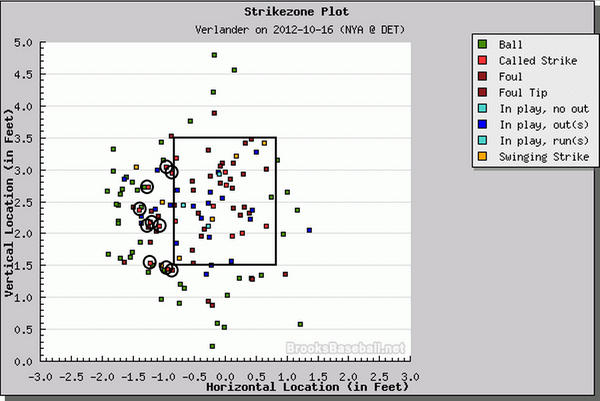
Seven of the nine Yankees facing Verlander were batting left-handed, and thus were standing on the right-hand side of the above image. On top of having to contend with Justin Verlander, which is difficult enough on its own, they had to contend with a home plate umpire who consistently called pitches several inches off the outside part of the plate as strikes. That is, as they say, a tall order. Below is an example of how this challenge manifested itself: a seventh-inning at-bat between Verlander and Raul Ibanez, the latter of whom represented the tying run for the Yankees with two outs:
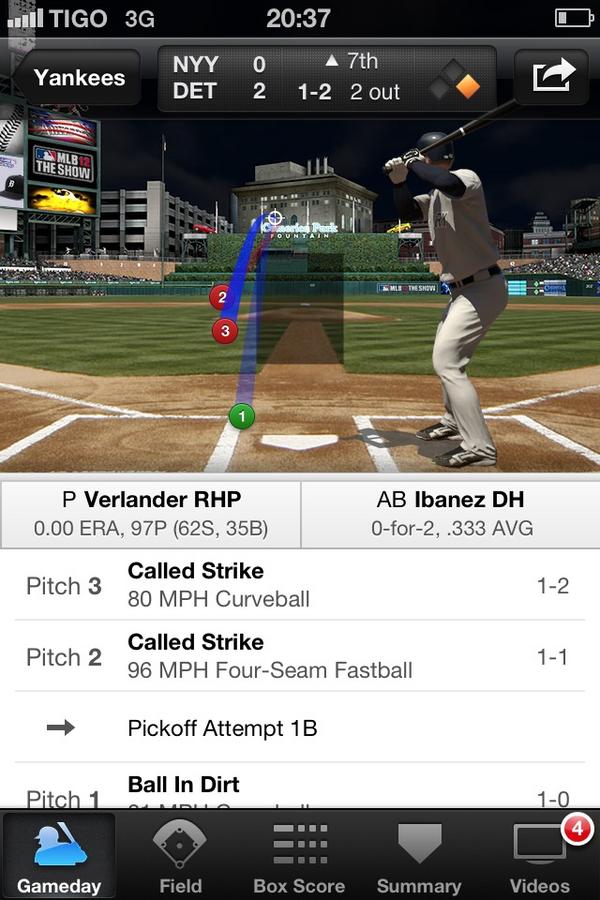
The first pitch, as the image shows, was some sort of breaking pitch in the dirt that Ibanez laid off of, making the count 1-0. Ibanez could then expect to be thrown a fastball in the zone--a potentially tasty pitch for a dead-red fastball hitter like Ibanez. Verlander did throw a fastball, but at this point he knew he did not have to actually throw it as a strike for it to be called a strike. He threw two pitches Ibanez couldn't do anything with, a fastball and a curveball off the plate, and both are called as strikes. The count is suddenly 1-2 even though Ibanez would see it as 3-0. Ibanez would ground out weakly to first to end the inning.
Did the starter opposite Verlander, Phil Hughes, reap the same benefits of an expanded strike zone? Not really. In fact, the opposite. Below is Hughes' strike zone. The circled green dots are pitches thrown by Hughes that were within the strike zone, but were nevertheless called as balls by the umpire:
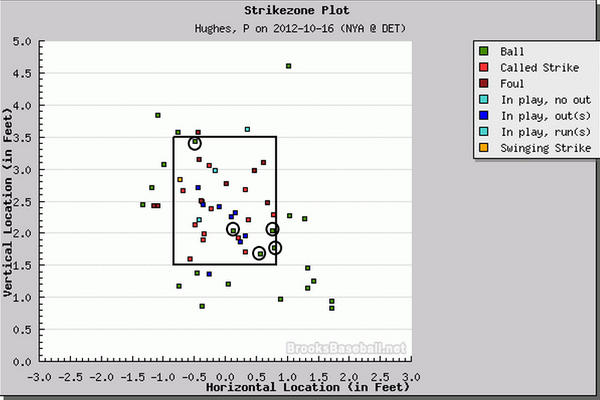
So based on this, five of Hughes' 61 pitches (8%) were balls that should have been called strikes. Verlander was not squeezed in the same way: another brief skim of his strike zone above shows that just one of his 132 pitches (0.7%) was a ball that should have been a strike. Conversely, 10 of Verlander's pitches that were off the plate were called strikes anyway. Not once did Hughes get a call like that in his favor.
While Justin Verlander was getting called strikes several inches off the edge of the plate, Phil Hughes threw one pitch almost down the middle of the strike zone that was called a ball. This is not to say that Verlander is actually a worse pitcher than we think, or that Hughes is a better pitcher than we think. This is just to say that the home plate umpire can sometimes make the job a little easier for the Justin Verlanders of the world, an advantage they hardly even need, and the home plate umpire can sometimes make the job a little tougher for the Phil Hugheses of the world, a disadvantage they hardly they can afford.
Friday, October 12, 2012
Verlander and Cabrera
Would the Tigers still have beaten the Athletics in their five-game playoff series without Miguel Cabrera?
Probably. He reached base six times in five games, driving in one run and scoring another.
Would the Tigers still have beaten the Athletics in their five-game playoff series without Justin Verlander?
Almost certainly not. He threw 16 innings (including a complete-game shutout in the deciding Game 5 on the road), allowed one run in the series, and basically got the Tigers two of their three victories by himself.
I still believe Miguel Cabrera was more valuable to the Tigers than Justin Verlander over the course of the entire regular season, and he should finish higher on the MVP ballot because of that.
But in a few weeks, Cabrera will win the MVP over Mike Trout. And writers who voted for Cabrera will defend their decision by claiming "Cabrera carried his team," which is what real MVPs do. At that point, I will think back to this Detroit/Oakland playoff series, and I will wonder, "Did Cabrera carry Verlander, or was it Verlander who carried Cabrera?" And I think I know the answer to my question.
Wednesday, October 10, 2012
Twitter Reacts To What Happened Last Night
Every once in a while, baseball has one of THOSE nights. Last year, it was Game 162, and the David Freese Game in the World Series. This year, it was last night. Because it is impossible to capture with words what happened in the wee hours of Wednesday night and Thursday morning, here are some select real-time reactions from Twitter that do a much better job of showcasing raw emotion and shock than postgame recaps or SportsCenter segments.
First: Orioles-Yankees, Game 3, around midnight.
Second: Tigers-Athletics, Game 4, around 1 A.M.
First: Orioles-Yankees, Game 3, around midnight.
Just keep it tied until Raul bats again.
— Mike Axisa (@mikeaxisa) October 11, 2012
RAOOOOOOOOOOOOOOOOOOOOOOOOOOOOOOOOOOOOOOOOOOOOOOOOOOOOOOOOOOOL
— Mike Axisa (@mikeaxisa) October 11, 2012
Oh my God.
— David Cameron (@DCameronFG) October 11, 2012
RAAAAAAAAAAAAAAAAAAUL
— Mike Axisa (@mikeaxisa) October 11, 2012
Move over David Freese.
— David Cameron (@DCameronFG) October 11, 2012
RAUAHAHAHAHA
— Mike Axisa (@mikeaxisa) October 11, 2012
I just...Raul Ibanez...I...what?...Raul Ibanez.
— Paul Swydan (@Swydan) October 11, 2012
I am dead. I just died.
— Craig Calcaterra (@craigcalcaterra) October 11, 2012
+.827 WPA. Raul Ibanez just had the fifth biggest playoff game in baseball history. With two at-bats.
— Mike Axisa (@mikeaxisa) October 11, 2012
I hate everything, but especially Raul Ibanez
— Jonathan Bernhardt (@jonbernhardt) October 11, 2012
So cool! #Raul
— Phil Hughes (@PhilHughes65) October 11, 2012
The best part is Raul just trotting to first, no smile or anything, like "Yeah, I know, what of it?"
— Bloggie McBlogger (@yagottagotomo) October 11, 2012
Raul Ibanez hit .197 with no homers against lefthanders in the regular season.
— Adam Ronis (@AdamRonis) October 11, 2012
Before 5 minutes ago, Raul Ibanez hasn't hit a HR off a lefty since July 26, 2011. And even that one was off Barry Zito..
— Bret Sayre (@dynastyguru) October 11, 2012
Baseball is so weird.
— Productive Outs (@ProductiveOuts) October 11, 2012
Ibanez becomes 1st player in postseason history w/2 HR in a game he didn't start
— Alex Speier (@alexspeier) October 11, 2012
Orioles 0-3 in extra innings against the Yankees, 16-0 in extra innings against everyone else
— Jeff Sullivan (@LookoutLanding) October 11, 2012
So the Yanks have 2 wins all year when trailing after 7, and in both, Ibanez had both the game-tying AND game-winning hits.
— Tristan H. Cockcroft (@SultanofStat) October 11, 2012
Kuroda's best quotation of the year. Said Ibanez's performance seemed like it was something out of "a cartoon."
— Jack Curry (@JackCurryYES) October 11, 2012
Nick Swisher could be heard from the shower yelling "EXCITEMENT OVERLOADDDDD!!!!"
— Daniel Barbarisi (@DanBarbarisi) October 11, 2012
Orioles: "Seriously? Raul Ibanez? That doesn't make any sen-" /look in mirror "oh right"
— Jeff Sullivan (@LookoutLanding) October 11, 2012
One to ring to Raul them all.
— Matt Sussman (@suss2hyphens) October 11, 2012
Second: Tigers-Athletics, Game 4, around 1 A.M.
Can the A's pinch-hit Raul Ibanez here? Not totally sure of how baseball rules work.
— Bill Barnwell (@billbarnwell) October 11, 2012
! ! ! ! ! ! ! ! ! ! ! ! ! ! ! ! ! ! ! ! ! ! ! ! ! ! ! ! ! ! ! ! ! ! ! ! ! ! ! ! ! ! ! ! ! ! ! ! ! ! ! ! ! ! ! ! ! ! ! ! ! ! ! ! ! ! ! ! ! !
— King Kaufman (@king_kaufman) October 11, 2012
AND THERE WILL BE A GAME FIVE
— The Outside Corner (@Outside_Corner) October 11, 2012
SWEEEEEET MOTHER OF GOD
— Jason Wojciechowski (@jlwoj) October 11, 2012
Coco Crisp! Redemption!
— Daniel Moroz (@CamdenCrazies) October 11, 2012
Bob Melvin > Philip Seymour Hoffman
— SportsPickle (@sportspickle) October 11, 2012
joke's on you guys, Valverde still has a dance for this
— Jeff Sullivan (@LookoutLanding) October 11, 2012
The American League is batting 1.000 for walk-offs tonight.
— Mike Baumann (@MJ_Baumann) October 11, 2012
God I love this game.
— Mike Axisa (@mikeaxisa) October 11, 2012
That was fun. Anyone know if there's a game tomorrow? <checks schedule> HELL YEAHFour more games on Thursday, but they'll have to work hard to top this.
— Rany Jazayerli (@jazayerli) October 11, 2012
Thursday, October 4, 2012
Why Mike Trout Should Be The MVP
Let me preface this by saying: Miguel Cabrera is awesome. He won the Triple Crown, he's going to the Hall of Fame, and he's either the best or second-best hitter in baseball (depending on what you think of Joey Votto). That's amazing. So I don't mean to disparage him when I say that he's not the American League's Most Valuable Player this year. I'm saying that, as good as Cabrera has been, Mike Trout has been even better, which perhaps starts to describe how truly epic the Angels outfielder's season has been.
Miguel Cabrera is the best hitter in baseball. Mike Trout is the best player. He's almost Cabrera's equal at the plate (more on that later...) and is miles better than Cabrera at every other facet of the game. Advanced metrics like Wins Above Replacement can quantify Trout's advantage in value over Cabrera. I don't even think that angle of the pro-Trout argument is necessary. Common sense says that Mike Trout should win the American League MVP, and it really should be unanimous.
But a lot of people disagree. So here are the most popular MVP arguments made for Cabrera and against Trout, and why most of them are either misleading or complete bogus.
"Cabrera won the Triple Crown, so he deserves the MVP."
No, he doesn't. Winning the Triple Crown is an awesome historical achievement. It's also three arbitrary statistics pulled out of a hat and given a cool name. What if the three statistics were Runs, Stolen Bases, and Spectacular Home-Run-Robbing Catches? Then Mike Trout would have just won the "Triple Crown." It hasn't been done in a long time? Since 1967, you say? Sure, then my counter would be: Mike Trout just became the first player EVER to hit 30 home runs, score 125 runs, and steal 45 bases. If one wants to play the 'historical' card, well, it works both ways.
Now, it is relevant that Cabrera put up great numbers in the Triple Crown categories: a .330 batting average, 44 home runs, and 139 RBIs. But the MVP is an individual award, and two of those statistics are poor evaluators of individual value. Batting average counts all hits as the same, doesn't include sacrifices or walks, and only counts double plays as one out. RBIs are dependent on opportunity, luck, and where a batter hits in the lineup. These statistics, while mainstream, just aren't the best way to determine value.
And if people cite Cabrera's advantage in RBIs over Trout (139 to 83) as evidence of his superior baseball skills, well, those people should be flogged. Cabrera hit in the middle of the order while Trout hit in the leadoff spot ahead of the Angels' worst hitters. If you're going to look at RBIs, then you're obligated to also look at runs scored. Trout led the league in that category with 129 in 139 games played. Either you consider both RBIs and runs, or you thrown them both away. It makes no sense to immortalize RBIs as part of the Triple Crown and ignore runs. They're the two sides of the same statistical concept.
"Cabrera made the playoffs, and Trout didn't."
Reaching the playoffs is a team accomplishment, not an individual one, so it doesn't have much of a place in a debate over an individual award like the MVP. Is it Trout's fault that the Angels had a terrible bullpen, or that Ervin Santana had a thing for giving up home runs, or that Mark Trumbo forgot how to hit after the All-Star Break?
Anyway, here's the best part. The Angels went 6-14 without Trout on the roster; in other words, they were on pace for 48.6 wins over a full season, which obviously would have been the worst record in baseball. The Angels called up Trout from the minor leagues on April 28th, and from that day on they went 83-59. Over a full season, that that's a 94.6-win pace, which would've been good enough to make the playoffs. I'm obviously not saying that Trout alone was responsible for that massive swing in win total, but traditionalists often ask themselves the following hypothetical question when deciding on an MVP: "Where would Team X be without Player Y?" Well, we kind of know the answer in this case. Look at the difference between the two Angels teams.
But on the most simple level? Cabrera's Tigers finished with 88 wins in the easiest division in baseball. Trout's Angels finished with 89 in the toughest division in baseball. The fact that Cabrera is going to the postseason instead of Trout is completely attributable to a poorly-constructed divisional system with an unbalanced schedule. The Angels are better than the Tigers. Cabrera supporters simply can't make any claim that involves playoffs.
"Cabrera carried his team."
The worst argument of them all. A) it's subjective, B) it's completely un-provable, C) it implies that Trout didn't do the same, and worst of all D) it implies that Cabrera had no help. Are we completely ignoring the fact that the Tigers also had the best pitcher in baseball, Justin Verlander, and one of the best hitters in baseball, Prince Fielder? Did they not do any carrying of their own? What about Detroit's 3.10 team ERA in the final month of the season, 2nd best in the American League? Did that have nothing to do with the team's late-season run at the division title?
"Cabrera helped his team win a division title."
The Tigers get to play in the AL Central. Its second-place team was the White Sox, who won 85 games, which would've been good enough for only a 4th-place finish in the other two AL divisions. It's the only division in baseball that had three teams win less than 45% of their games. Detroit got to play dozens and dozens of games against the Twins, Royals, and Indians, three of the worst pitching teams in baseball. Perhaps one of the most unimpressive, meaningless titles that can be bestowed on any team is "2012 AL Central Champions."
"Cabrera was better than Trout when it mattered most: September."
It's true that Cabrera was a better hitter than Trout over the final month. He hit .333/.395/.675. But Trout wasn't exactly a slouch: he hit .289/.400/.500 over the same period (and his OBP was better than Cabrera's, so he was still committing fewer outs). And this is implying that all value is derived from hitting, which isn't true; even when Trout's slumping, he's providing value with his legs and glove. That's not the case for Cabrera.
Then there's the assumption that games in September somehow "matter more" than games in other, inferior months. Nope. Wins in, say, May and July (months when Trout was a better hitter than Cabrera) count just the same as wins in September. Just ask the Angels: they essentially missed the playoffs because of a bad stretch in April.
"Trout didn't play in April, so Cabrera played more games."
This is the converse of the previous argument. You shouldn't be able to make both claims simultaneously. You can't say "September counts way more than every other month!" while also saying, "Trout didn't play in April, so he can't win!" Totally incongruous. Either the months all count the same or they don't.
Cabrera did play in more games than Trout. Trout still came to the plate 639 times, compared to 697 for Cabrera. Plus, Cabrera had a lower on-base percentage than Trout (.393 to .399) and grounded into more double plays (28 to 7), so whatever small advantage he has in playing time is totally nullified by the extra outs he made. Cabrera did play roughly 100 more innings in the field, but Trout was such a better defender in his innings at a more important position that the difference barely matters.
Finally, in 2010, Josh Hamilton won the MVP even though he played in only 133 games. That was 17 games fewer than the second-place finisher, but voters agreed that Hamilton was so much better in his fewer games that he merited the award. Who finished second that year? Miguel Cabrera. It's not like there's no precedent.
"Cabrera changed positions so that the Tigers could sign Prince Fielder, helping his team win."
Heck, if Cabrera didn't change positions for Fielder, what would that say about him? No, hang on, that's not the point. People are suddenly heaping credit on Cabrera for what they perceive as selflessness when he moved to third base to allow Prince Fielder to play first. They've even gone so far as to credit Cabrera with the value Fielder brought to the team, as if Cabrera was solely responsible for signing him and paying his salary. No, the Tigers wanted Cabrera to DH; he didn't consider himself a DH and wanted to move to third instead. The Tigers let him. This created an offensive hole at DH (ughh Delmon Young, the worst) and a defensive liability at third. The Tigers probably would have won more games if Cabrera had been a DH and the team had gotten a defensively sound third baseman to help the pitching staff prevent runs.
I'm not trying to detract from Cabrera; his personal value is obviously greater as a third baseman rather than a DH. This whole angle is just hopeless flawed. Thirty times this year, Trout moved off center field so that his manager could field a better team. No one recognizes that or gives him credit for it. There's just no evidence to suggest that Cabrera is any more of a "team player" or "selfless" than Trout. This is stupid, we're done with this one.
"Cabrera deserves it. Trout can win Rookie of the Year; he has a whole career to win MVPs."
Awards aren't given out based on career achievement or whose turn it is. They're based on merit, and Trout is the more deserving candidate. Hey voters, if you think Cabrera "deserves" an MVP, why didn't you give it to him last year?
Cabrera, 2012: .330/.393/.606/1.033, 166 OPS+
Cabrera, 2011: .344/.448/.586/.999, 179 OPS+
Cabrera's 2011 was in some ways better than his 2012. The only thing that's better this year is the sexy stats: the home runs and RBIs, probably because Cabrera now has Austin Jackson in front of him and Prince Fielder behind him. So Cabrera maybe should have won the MVP last year, but the voters thought that his teammate, ace Justin Verlander, was more valuable. He won the MVP instead. This year, Verlander is having basically the exact same season, but everyone is falling over themselves to crown Miguel Cabrera king of the world. If everyone decided Verlander was the more valuable Tiger just last year, and Verlander basically just repeated last year's season, why has Cabrera suddenly leapfrogged Verlander in terms of value? I will tell you why: because of home runs and RBIs. Cabrera didn't have enough to win the MVP in 2011, and now he has enough to win in 2012. Home runs and RBIs. They're all anyone cares about. It wasn't fair to 2011 Miguel Cabrera and it isn't fair to 2012 Mike Trout.
"Picking Trout over Cabrera puts too much stock into Wins Above Replacement."
No one's saying that the leader in Wins Above Replacement (a rough measurement of a player's all-around value) should automatically win the MVP. That's a straw man argument. WAR just backs up what we observe: that Mike Trout is the most valuable player in the league because he impacts every facet of the game at the highest level.
WAR is just one small piece of the vast pie of evidence supporting Trout's case. It is, however, one of the most delicious. There are two different ways of calculating WAR, but both methods have Trout at the top of this year's leaderboard (with either 10.4 or 10.7 WAR; no other player had more than 8). Baseball Reference.com has Trout's 10.7 WAR season as tied for the 20th-best season by a position player in baseball history (tied with Willie Mays in 1964 and Ted Williams in 1946). The only players in baseball history who have had better single seasons: Ruth, Hornsby, Yastrzemski, Bonds, Gehrig, Ripken, Wagner, Cobb, Mantle, Morgan, and Mays. And Trout didn't even play a full season. WAR could be overstating Trout's value a little, or even a lot, and 2012 would still rank as a historically elite season.
You don't need WAR to prove Trout is the most valuable player in baseball. It's just the icing on the cake.
"Cabrera was so much better offensively than Trout that baserunning and defense don't matter."
Of all the arguments here, this is the one that's most reasonable. A Cabrera supporter could claim that the superior offensive player should get the nod because there's no exact measurement of Trout's 'baserunning' or 'defensive' value, so we can't be sure.
This is still wrong, because the argument can be made that Trout was just as good a hitter--and perhaps a better hitter--than Miguel Cabrera this year.
First of all, their triple-slash lines are closer than one would expect: .330/.393/.606 for Cabrera compared to .326/.399/.564 for Trout. Cabrera's advantage comes in the slugging department, giving him 377 total bases compared to Trout's 315, but Trout closes that gap with his 49 stolen bases.
Another way to compare the two players at the plate is to look at adjusted-OPS, or OPS+, which takes a player's on-base-plus-slugging% and adjusts it to account for league and park factors. An OPS+ of 100 is league average; every point over or under that represents a percentage point better or worse than average. When you adjust for the fact that Cabrera played his home games in a park slightly favorable to offense, while Trout played his home games in a ballpark that suppresses offense, the American League leaders in OPS+ this year looks like this:
1. Mike Trout: 171
2. Miguel Cabrera: 166
However, a lot of people don't like obscure context-neutral statistics when it come to MVP voting. So there's another very simple metric that includes context, called RE24. An article about it was recently posted at Fangraphs.com. RE24 is the difference in run expectancy between the beginning and end of a hitter's at-bat. For example, when a hitter comes to the plate with runners on first and third with two outs, teams are expected to score an average of 0.33 runs in that situation. So a three-run home run would give the hitter a +2.67 bonus in RE24. It works in the opposite way if a hitter detracts from his team's run expectancy, thus losing points. It might seem like Cabrera would lap the field in RE24 because he has so many RBIs, hits for so much power, and is acknowledged as "the last player you'd want to face with men in scoring position."
The American League leader in RE24 is Mike Trout (+56.52 runs). Cabrera ranks fifth (+45.18) after Edwin Encarnacion, Prince Fielder, and Joe Mauer.
Again: this isn't taking baserunning into account, or defense, or position, or competition, or ballpark. This is just a straight-up measurement of how much better-than-average a player is at helping his team score runs. Trout comes out better than Cabrera.
Now throw in the fact that Trout is a 21-year-old rookie center fielder, who is probably the best baserunner and best defensive player in the sport, who plays in a pitcher's park, in the toughest division in baseball, for a team that instantly transformed from a loser into a winner when he was called up, and....why are we still having this discussion?
Wednesday, October 3, 2012
How They Did It: The 2012 Detroit Tigers
Everyone thought it would be easy sledding for the Tigers this season. They had run away with the division last year, and they added Prince Fielder to an already-potent lineup. As it turns out, the Tigers had an up-and-down season and trailed the Chicago White Sox for most of the summer. But they got hot at the right time and overtook Chicago in the last two weeks, clinching the AL Central for the second consecutive season. The Tigers haven't been a very good team for most of the year, so how did they stay in the race and then pounce at the exact right time?
1. The Top of the Lineup: Miguel Cabrera was obviously the engine that drove this offense thanks to an OPS over 1.000 and 44 home runs. He also got help from two key parts of the lineup. One was the leadoff spot, thanks to Austin Jackson. If/when Miguel Cabrera wins the Triple Crown, he can thank Jackson for getting on base at a .376 clip, a massive improvement over last year's .317 OBP, providing Cabrera with more RBI opportunities. The other key was, of course, Cabrera's primary protection in the cleanup spot: Prince Fielder, who put up a typically fantastic offensive season. The rest of the Tigers' offense was mediocre; Jackson, Cabrera, and Fielder were essential.
2. Justin Verlander: He's the best pitcher in baseball and it's no accident that his two best seasons have coincided with Detroit's back-to-back division titles. His numbers are almost identical--only very slightly worse--than 2011; he just isn't getting MVP consideration again because his win-loss record isn't as gaudy as last year. Verlander once again led the league in innings and strikeouts with a stellar 2.64 ERA. It would be difficult to prove that Miguel Cabrera is definitely more valuable to the success of the Tigers than Verlander.
3. A Strong Rotation: It wasn't just Verlander in the Tigers' pitching staff. Max Scherzer struggled to open the year, but he's been an ace since July and leads the league in strikeout rate. Doug Fister has been his usual self when healthy; when not, rookie Drew Smyly has been there to provide solid innings. And midseason trade acquisition Anibal Sanchez has given the Tigers 12 starts and a solid 3.74 ERA, including a 2.43 ERA during their September run at the division.
There are probably six teams in the American League that are better than the Tigers, and two of them didn't even make the playoffs. Detroit benefited greatly from the weakness of the AL Central (dozens of games against the Twins, Royals, and Indians). This team failed to even reach 90 wins over the course of the season because it lacks in depth, especially in the lineup. But the Tigers will always be a dangerous playoff team because of their roster construction: it's very top-heavy.
You can make the argument that Detroit has both the best hitter and the best pitcher in baseball. Between Justin Verlander, Miguel Cabrera, and Prince Fielder, no team has a better trio of players. Then throw in Austin Jackson, three more solid starters, and one or two good bullpen arms, and suddenly the weakness of the rest of Detroit's roster doesn't really matter. Tigers GM Dave Dombrowski has emphasized the acquisition of high-upside players regardless of cost, and the impact of that decision is clear.
What makes Dombrowski's strategy unique is that he doesn't have one set method of executing it. His modus operandi is simply to acquire the players with the highest upside, and he's achieved that end through every possible variety of roster construction. He's not afraid of paying big bonuses in the draft, which is how he got Justin Verlander. He's not afraid of trading away a gigantic haul of prospects, which is how he got Miguel Cabrera. He's willing to spend big dollars on the free agent market, which is how he got Prince Fielder. He's not afraid of dealing off established contributors (Curtis Granderson, Edwin Jackson) in exchange for exciting, unproven young players, which is how he got Austin Jackson and Max Scherzer. He's made deadline trades before, which is how he got Doug Fister and Anibal Sanchez. Dombrowski isn't shy about pursuing any means to achieve his end.
The downside to this course of action is Detroit's payroll. A massive chunk of it is devoted to just a few guys, which is why the rest of the roster lacks in quality. But it's hard to argue that this strategy doesn't work after back-to-back AL Central titles.
Detroit's Formula: Good starting pitching and an elite top of the lineup, achieved through the acquisition of elite players by any means.
San Francisco's Formula: Healthy starting pitching, dominant bullpen, and a lineup built for home-field advantage achieved through strong pitching development and the revitalization of declining veterans' careers.
Washington's Formula: Healthy and elite starting pitching, dominant bullpen, and balanced lineup achieved through homegrown talent and superb talent evaluation.
Cincinnati's Formula: Healthy starting pitching, dominant bullpen, and balanced lineup achieved through homegrown talent and low payroll.
Tuesday, October 2, 2012
This is the Problem
This might shock you, but the General Manager of the Detroit Tigers, Dave Dombrowski, thinks Miguel Cabrera should be the MVP. When making his case, he had this to say about advanced statistics like Wins Above Replacement that prefer Mike Trout over Cabrera:
"You can use WAR stats and all of that, but when people used to talk about most valuable player, it used to be, ‘Take that player away from the club and see where that club would be.’ You take Miguel Cabrera out of our lineup right now, and you see where we would be.”
That's literally exactly what WAR is.
This is Wikipedia's definition of WAR, with the most relevant part in bold:
"Wins Above Replacement, commonly known as WAR, is a non-standardized sabermetric baseball statistic that is used to show how many more wins a player would give a team as opposed to a "replacement level", or minor league/bench player at that position."
This is the problem with people who discount WAR when it prefers Mike Trout over Cabrera. They throw it away without even trying to understand what it actually is. Even General Managers of baseball teams.
Friday, September 28, 2012
This Is Bad Logic
ESPN.com had the following poll up on its website:

"Hi, 41% of ESPN.com visitors who took this poll. I have a scenario for you. Pretend Miguel Cabrera finishes the season with 43 home runs, okay? Now, if Josh Hamilton ends up with 42, Cabrera would win the Triple Crown, so he would be your MVP, right? Okay. So if Hamilton finishes with 44 home runs, Cabrera would not win the Triple Crown, so he wouldn't be your MVP, right? All right. Do you not realize that Cabrera's value was exactly the same in both scenarios? Do you not realize that you changed your mind about Cabrera's worthiness for MVP based on a couple extra home runs hit by another player not even in the conversation for MVP? Do you not realize the complete absurdity of using Josh Hamilton's home run total or Joe Mauer's batting average to determine an MVP race between Miguel Cabrera and Mike Trout?" At this point, my head would implode and the conversation would end abruptly.
I'm concerned for the future of this country when I see that all but a few states are colored green, meaning they don't understand this logic. Anyway, the 41% aren't the only ones who are wrong. The 30% are wrong too, for picking Cabrera over Trout. The 41% are just wrong AND stupid. The 29%, though? Those guys are groovy. Alaskans, Californians, Utahns, and Mississippians have always been my kind of people.
Wednesday, September 26, 2012
How To Make Yourself Look Like An Idiot
Baseball is being seized by an increasingly contentious debate over who should win the American League's Most Valuable Player award. The dividing lines aren't this clear, but for the most part, the "new-school" baseball blogging community prefers Mike Trout of the Angels, while "old-school" sportswriters and analysts for majors sports organizations and newspapers favor Miguel Cabrera of the Tigers. The argument should, by all rights, be settled with this succinct line of logic:
Miguel Cabrera has been a slightly better hitter than Mike Trout in 2012. However, hitting is only one of baseball's three dimensions, and Trout has a sizable advantage in the other two (baserunning and defense). Cabrera's small edge in hitting is not enough to overcome Trout's massive edge when it comes to baserunning and defense. The award is not titled 'Most Valuable Hitter,' But 'Most Valuable Player.' Trout is the MVP.
There are a whole bunch of advanced statistics and metrics that can actually prove the above statement numerically, but truthfully those shouldn't be necessary. These are very simple concepts about the nature of baseball that we're dealing with.
Yet apparently some people can't grasp them. This includes this man:
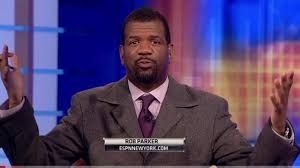
His name is Rob Parker. He was a sports journalist for The Detroit News, and now works for ESPN, where he appears on a number of different debate shows. On Wednesday afternoon, ESPN aired a segment where Rob Parker argued for several minutes over who should win the AL MVP. He sided with Cabrera. His opponent was another ESPN analyst, Keith Law. Keith Law is one of the most respected baseball writers on the Internet. He provides advanced statistical analysis, evaluates minor league prospects, and unlike Parker, actually worked in baseball, for the Toronto Blue Jays as the Special Assistant to the General Manager. Law sided with Trout in the MVP debate. Some evidence that this actually took place:
After the segment, Rob Parker took to Twitter and made an absolute fool out of himself:
"Watch the damn game"? Keith Law watches 'the damn game' for a living. I'm positive he watches 'the damn game' more than Rob Parker. He watches 'the damn game' so well that ESPN pays him to write columns, hold chats, and host podcasts on a daily basis. Of course, ESPN also pays Rob Parker, so maybe that does rob him of some credibility.
"That's why the A's haven't won jack"? I'm assuming he means that the A's emphasis on statistical analysis is the reason why they haven't 'won jack.' Well...I'm positive that every single team in baseball focuses on statistical analysis. That's how, you know, players are evaluated and teams are run. How else would you do it? Also, Parker chose a terrible time to accuse the A's of not winning jack. Because even though ESPN ranked them as the second-worst team in baseball entering the season, and even though their Opening Day payroll was the second-lowest in baseball, the Oakland Athletics are currently on track to make the postseason. Hey, just for the heck of it:
2012 Wins by the "Can't Win Jack" Oakland Athletics: 87
2012 Wins by the "We've Got the Obvious MVP, Miguel Cabrera" Detroit Tigers: 82.
I'm assuming Rob Parker is also referring to the Moneyball-Era Athletics when he said the team hasn't 'won jack.' Right. Except for the fact that between 1999 and 2006, despite microscopic payrolls, the Athletics finished either first or second in their division every single year. Their lowest win total in those seasons was 87. But don't forget--the A's haven't won jack. All they did was set the AL record for consecutive wins in 2002.
It gets worse.
Maybe Rob Parker doesn't understand how movies work?
On a serious note, the one thing I don't understand most of all is this: why are you automatically a nerdy, statistics-worshiping, pocket-protecting, loveless-guy-with-glasses-and-a-laptop-in-your-mom's-basement if you support Mike Trout for MVP? You don't need obtuse computer-generated stats to argue his case. He's just so obviously the best all-around player in baseball that anything said to the contrary sounds foolish.
In fact, going off that point, I'm utterly confused why old-school guys like Rob Parker aren't falling over themselves to kiss Mike Trout's feet and champion him as the MVP. Because Trout is the exact kind of player that classic sportswriters and journalists love to write hyperbolic pieces about in every major newspaper and on every major website. He's the perfect baseball player. His frame is big enough and strong enough that he can effortlessly hit the ball out of the park the other way, yet he's still fast enough to play a great center field and never get caught stealing. He's always causing havoc on the basepaths, setting things up for teammates, energizing his team. He does "all the little things" that the old school adores: stealing a bag, laying down a bunt, making a diving catch, robbing a home run, outrunning a double play, scoring from second on a single, stretching doubles into triples, playing at 110% intensity at all times. The baseball writers love preaching about how valuable and selfless and throwback-y all that stuff is and how it's massively under-appreciated and how it can never be accurately captured by dumb statistics churned out of computers by basement-dwelling 'stat-nerds' who don't watch the game.
Yet now that the numbers and computers and 'stat-nerds' all support this point of view? That yes, Mike Trout's all-around play is worthy of the Most Valuable Player award? All the Rob Parkers of the world have jumped ship. They've done a complete about-face to champion Miguel Cabrera, who in the past they would have scorned because he can't play defense or run fast or do "all the little things." It's as if the old school is terrified of holding the same point of view as the new school, for fear of turning into glasses-wearing, laptop-using stat-nerds. To heck with the actual right answer.
Why does it matter what Rob Parker says on Twitter? He's probably just being provocative on purpose to generate buzz or something. Why care? I can't really say it better than Brandon McCarthy, who might actually know something about the subject considering he's a real-life pitcher for the can't-win-jack Oakland Athletics and his career was turned around when he embraced advanced statistics:
Want another reason? Rob Parker has a vote for the Baseball Hall of Fame. Keith Law doesn't. If that doesn't tell you something's messed up, nothing will.
Miguel Cabrera has been a slightly better hitter than Mike Trout in 2012. However, hitting is only one of baseball's three dimensions, and Trout has a sizable advantage in the other two (baserunning and defense). Cabrera's small edge in hitting is not enough to overcome Trout's massive edge when it comes to baserunning and defense. The award is not titled 'Most Valuable Hitter,' But 'Most Valuable Player.' Trout is the MVP.
There are a whole bunch of advanced statistics and metrics that can actually prove the above statement numerically, but truthfully those shouldn't be necessary. These are very simple concepts about the nature of baseball that we're dealing with.
Yet apparently some people can't grasp them. This includes this man:
His name is Rob Parker. He was a sports journalist for The Detroit News, and now works for ESPN, where he appears on a number of different debate shows. On Wednesday afternoon, ESPN aired a segment where Rob Parker argued for several minutes over who should win the AL MVP. He sided with Cabrera. His opponent was another ESPN analyst, Keith Law. Keith Law is one of the most respected baseball writers on the Internet. He provides advanced statistical analysis, evaluates minor league prospects, and unlike Parker, actually worked in baseball, for the Toronto Blue Jays as the Special Assistant to the General Manager. Law sided with Trout in the MVP debate. Some evidence that this actually took place:
FYI: I'll be on SportsCenter at 4:15pm today. Imma destroy stat man Keith Law over who should b AL MVP -- Trout or Cabrera. Not even close.
— Rob Parker (@RobParkerESPN) September 26, 2012
After the segment, Rob Parker took to Twitter and made an absolute fool out of himself:
To all the stat-geeks that follow @keithlaw: please put ur calculators down and watch the damn game. That's why the A's haven't won jack."Stat-geeks"? Who are they? People in baseball who value statistics? That's EVERYONE WHO WATCHES BASEBALL. It would be impossible to for baseball--or any sport--to exist without statistics. I'm sure Rob Parker cited Miguel Cabrera's home run total and batting average to support his argument. Those are stats. Heck, the final score of every game is a statistic. The best part about this is the fact that Parker appears most frequently on an ESPN show titled "Numbers Never Lie." Ha. Irony.
— Rob Parker (@RobParkerESPN) September 26, 2012
"Watch the damn game"? Keith Law watches 'the damn game' for a living. I'm positive he watches 'the damn game' more than Rob Parker. He watches 'the damn game' so well that ESPN pays him to write columns, hold chats, and host podcasts on a daily basis. Of course, ESPN also pays Rob Parker, so maybe that does rob him of some credibility.
"That's why the A's haven't won jack"? I'm assuming he means that the A's emphasis on statistical analysis is the reason why they haven't 'won jack.' Well...I'm positive that every single team in baseball focuses on statistical analysis. That's how, you know, players are evaluated and teams are run. How else would you do it? Also, Parker chose a terrible time to accuse the A's of not winning jack. Because even though ESPN ranked them as the second-worst team in baseball entering the season, and even though their Opening Day payroll was the second-lowest in baseball, the Oakland Athletics are currently on track to make the postseason. Hey, just for the heck of it:
2012 Wins by the "Can't Win Jack" Oakland Athletics: 87
2012 Wins by the "We've Got the Obvious MVP, Miguel Cabrera" Detroit Tigers: 82.
I'm assuming Rob Parker is also referring to the Moneyball-Era Athletics when he said the team hasn't 'won jack.' Right. Except for the fact that between 1999 and 2006, despite microscopic payrolls, the Athletics finished either first or second in their division every single year. Their lowest win total in those seasons was 87. But don't forget--the A's haven't won jack. All they did was set the AL record for consecutive wins in 2002.
It gets worse.
I've watched that Billy Beane movie 20 times and the A's never won the World Series. Stats so lame, they couldn't add a Hollywood-ending.
— Rob Parker (@RobParkerESPN) September 26, 2012
Maybe Rob Parker doesn't understand how movies work?
Where's my pocket protector, glasses, laptop and another date-less night? I wanna fit in. LolHaha! Get it? Because only nerds who use newfangled "statistics" have vision problems and use computers! Classic. Classic Rob.
— Rob Parker (@RobParkerESPN) September 26, 2012
On a serious note, the one thing I don't understand most of all is this: why are you automatically a nerdy, statistics-worshiping, pocket-protecting, loveless-guy-with-glasses-and-a-laptop-in-your-mom's-basement if you support Mike Trout for MVP? You don't need obtuse computer-generated stats to argue his case. He's just so obviously the best all-around player in baseball that anything said to the contrary sounds foolish.
In fact, going off that point, I'm utterly confused why old-school guys like Rob Parker aren't falling over themselves to kiss Mike Trout's feet and champion him as the MVP. Because Trout is the exact kind of player that classic sportswriters and journalists love to write hyperbolic pieces about in every major newspaper and on every major website. He's the perfect baseball player. His frame is big enough and strong enough that he can effortlessly hit the ball out of the park the other way, yet he's still fast enough to play a great center field and never get caught stealing. He's always causing havoc on the basepaths, setting things up for teammates, energizing his team. He does "all the little things" that the old school adores: stealing a bag, laying down a bunt, making a diving catch, robbing a home run, outrunning a double play, scoring from second on a single, stretching doubles into triples, playing at 110% intensity at all times. The baseball writers love preaching about how valuable and selfless and throwback-y all that stuff is and how it's massively under-appreciated and how it can never be accurately captured by dumb statistics churned out of computers by basement-dwelling 'stat-nerds' who don't watch the game.
Yet now that the numbers and computers and 'stat-nerds' all support this point of view? That yes, Mike Trout's all-around play is worthy of the Most Valuable Player award? All the Rob Parkers of the world have jumped ship. They've done a complete about-face to champion Miguel Cabrera, who in the past they would have scorned because he can't play defense or run fast or do "all the little things." It's as if the old school is terrified of holding the same point of view as the new school, for fear of turning into glasses-wearing, laptop-using stat-nerds. To heck with the actual right answer.
Why does it matter what Rob Parker says on Twitter? He's probably just being provocative on purpose to generate buzz or something. Why care? I can't really say it better than Brandon McCarthy, who might actually know something about the subject considering he's a real-life pitcher for the can't-win-jack Oakland Athletics and his career was turned around when he embraced advanced statistics:
Those are the words of an 'expert debater'. One who's employed by the biggest sports media company in the country. Embarrassing
— Brandon McCarthy (@BMcCarthy32) September 26, 2012
Want another reason? Rob Parker has a vote for the Baseball Hall of Fame. Keith Law doesn't. If that doesn't tell you something's messed up, nothing will.
Wednesday, September 19, 2012
A Note About the AL MVP Race
On Tuesday night, Miguel Cabrera announced his assault on the Triple Crown. His two home runs gave him 40 on the season, which trails Josh Hamilton by two. His six RBIs give him a commanding lead in that category, 129 to 123 over Hamilton. Cabrera also leads the AL batting race with a .333 average, six points better than Mike Trout's .327.
So if Cabrera out-homers Josh Hamilton over the next two weeks, while maintaining his lead in the RBI and batting average departments, he will win the first Triple Crown since Carl Yastrzemski did it in 1967. If this happens, it seems as though Cabrera will be a mortal lock to win the MVP over Mike Trout. That's how historic this achievement would be.
However, there's another statistical achievement in play that should be considered. BaseballReference.com tracks the history of single-season Wins Above Replacement figures. WAR, unlike the Triple Crown, is an all-encompassing statistic that does its best to quantify a player's all-around value--offense, defense, baserunning--in one simple number. This stands in direct contrast to the Triple Crown, which, despite its aura, only measures home runs, runs batted in, and batting average.
In the history of baseball, only 19 players have ever accumulated 10 WAR in a season. It's the holy grail of the statistic. If you're interested, those players are:
Babe Ruth
Rogers Hornsby
Carl Yastrzemski
Barry Bonds
Lou Gehrig
Cal Ripken Jr.
Honus Wagner
Ty Cobb
Mickey Mantle
Willie Mays
Joe Morgan
Stan Musial
Ted Williams
Robin Yount
Lou Boudreau
Jimmie Foxx
Eddie Collins
Alex Rodriguez
Sammy Sosa
That's 16 Hall of Famers, plus three more (Bonds, Rodriguez, Sosa) who may one day get there.
This year, a 20th player joined this exclusive group. He currently sits at 10.3 WAR and the season isn't even over yet. The player isn't Cabrera. It's Mike Trout.
Cabrera could win the Triple Crown by a landslide and it still wouldn't matter. Not only has Trout has been the most valuable player in baseball this year; he's achieved a season of dominance that only 19 Hall of Fame-caliber players have ever achieved before. And he's done it in only 125 games so far, thanks to missing the first month of the season through no fault of his own.
Trout is the MVP. Any other result would be a joke.
Saturday, June 2, 2012
Jose Valverde is a Winner
Tigers closer Jose Valverde entered the ninth inning of Saturday's game against the Yankees with the responsibility of protecting a one-run lead. The erratic right-hander was just as Valverdian as ever, blowing the save without surrendering a hit. He managed to do that by hitting two batters, walking two others, and allowing three stolen bases while only throwing 13 of his 29 pitches for strikes.
And because of a game-winning sacrifice fly by Omir Santos in the bottom of the inning, Valverde earned the win. Because of all the players who could've been given the credit for Detroit's victory on Saturday, Jose Valverde is the most deserving.
And because of a game-winning sacrifice fly by Omir Santos in the bottom of the inning, Valverde earned the win. Because of all the players who could've been given the credit for Detroit's victory on Saturday, Jose Valverde is the most deserving.
Thursday, April 12, 2012
Stop Talking Up the Tigers, And Other Tidbits
- There's something about the Detroit Tigers that has everyone all in a tizzy. They're ranked #1 in the Power Rankings for ESPN.com, FoxSports.com, and CBSSports.com. That last website has accompanied Detrot's ranking with this bit of sickening hyperbole:
1. Tigers. Evidently the Doug Fister injury was just to give everyone else a chance to stay close.
The Tigers do have the best chance of making the postseason out of all 30 teams, given their weak division. However, they are not the best team in baseball. They have three legitimate stars that cloud everyone's judgment: Justin Verlander, Miguel Cabrera, and Prince Fielder. But for the Tigers to win 96 games last season, they needed remarkably good health (outside of Brennan Boesch) and career seasons (or half-seasons) from Verlander, Cabrera, Victor Martinez (now out for months), Jhonny Peralta, Alex Avila, Delmon Young, Doug Fister, and Jose Valverde.
Every single one of those players (except, well, Cabrera) will experience natural regression to the mean this season (and Martinez will regress all the way to zero, considering he may not suit up until the playoffs). Also, most of the Tigers' rivals in the AL Central will be stronger in 2012 than they were in 2011. Prince Fielder and full seasons from Fister and Young can't possibly make up this gap by themselves. So the question is: can the Tigers make up for the expected regression through improvement in other areas?
That means: if you think the Tigers are the best team in baseball, you are betting on Austin Jackson, Brennan Boesch, Ryan Raburn, Max Scherzer, Rick Porcello, and Drew Smyly. I'm not ready to do that.
If I were ranking the best teams in baseball, the Tigers would likely come in sixth, after the Rangers, Yankees, Rays, Cardinals, and Angels. They're comparable, I think, to the Red Sox and Diamondbacks. Good teams, but not among the best in baseball, like everyone seems to think.
In the words of Charles Barkley: I may be wrong, but I doubt it. - While everyone's been fawning over the Tigers, the most impressive team for me has been the Cardinals, and it's not particularly close. Gone are Pujols and LaRussa; Chris Carpenter is out indefinitely; and Adam Wainwright is coming off Tommy John surgery. None of it has mattered in their 5-2 start. Their offensive stars so far:
David Freese: .429/.448/.750, 3 HR, 10 RBIs
Lance Berkman: .375/.565/.625, 6 BBs
Carlos Beltran: .320/.393/.680, 3 HR
Rafael Furcal: .407/.467/.593
Yadier Molina: .304/.385/.739
Freese looks like a star. Beltran looks like a steal. The Cardinals have the best offense in the National League, and the starting pitching has been impressive even without Carpenter. They look like the favorites in a muddled National League.
- What are the Reds doing with Aroldis Chapman? They're clearly in win-now mode given the Votto and Phillips extensions, but the highest-ceiling pitcher on the roster is wasting away in middle relief. He seemed to put his command issues behind him during an outstanding spring, yet he was still bumped to the bullpen in favor of the relic formerly known as Bronson Arroyo. He struck out five Cardinals in two scoreless innings on Wednesday. When will he get another chance at starting? There's no in-between for Dusty Baker: either he's pushing Mark Prior to 130 pitches per start, or he's limiting Aroldis Chapman to five innings a week out of the pen.
- The team with the worst ERA in the National League? The Giants. Even after Barry Freaking Zito threw a complete-game shutout against the Rockies at Coors Field. The main culprit here is Tim Lincecum, who has been brutally shelled early on. His fastball has averaged under 91 mph, and he hasn't located it well, either. Given how miserable San Francisco's offense is (gotta love that Emmanuel Burriss/Brandon Crawford double-play combo), there's no way the Giants make the playoffs without Lincecum at his best.
- Johnny Damon signed with the Cleveland Indians, and his contract allows him to opt out on a specified date after Grady Sizemore returns. If he wasn't already perceived as a mercenary looking to bolster his Cooperstown chances with a few extra hits, he must be now.
Tuesday, March 27, 2012
MLB Season Preview: Detroit Tigers
Coming off an ALCS appearance and now armed with Prince Fielder, the Tigers are the heavy favorites in the AL Central.
Offense: Of course, any discussion of the Tigers' lineup (which ranked 4th in runs scored last year) begins and ends with the powerful duo of Miguel Cabrera and Prince Fielder. Fielder will more than compensate for the lost offense of Victor Martinez, who is out for the season, and Brennan Boesch could have a big year hitting in front of the two sluggers. Fielder doesn't come without warning flags though: Detroit's Comerica Park could deflate his numbers, as could the transition from the NL to the AL (Cabrera himself struggled with the switch). The rest of Detroit's lineup is solid, though there are some concerns. The fluky batting averages of Alex Avila (.295!) and Jhonny Peralta (.299!!!) won't be repeated. Delmon Young is being relied on to keep up his power surge and provide Fielder with lineup protection, but no good has ever come from relying too much upon Delmon Young. Austin Jackson simply can't be hitting leadoff again with a .317 OBP. But much of this is nitpicking--the Tigers will score runs in bunches. As an aside, the infield defense will be absolutely atrocious; Fielder, Cabrera, Peralta, and Ryan Raburn could be a historically-bad unit.
Pitching: Not much needs to be said about defending AL MVP Justin Verlander. He'll continue to dominate, though last season's ultra-high pitch count and the poor defense behind him could cause some regression. Speaking of regression--hello, Doug Fister. Fister posted an impossible 57-5 K/BB ratio after being traded to Detroit, and his 1.79 ERA will return to reality (though the Tigers will benefit from having him for a full season now). Max Scherzer and Rick Porcello are two more righties who could both suffer from that porous infield defense, but they should eat innings effectively. The fifth starter could be a revolving door of minor league guys like Andy Oliver or Drew Smyly. If top prospect Jacob Turner eventually cracks the rotation, he could make an immediate impact. In the bullpen, Jose Valverde won't go 49-for-49 in save opportunities again, but Octavio Dotel was added to a very solid group of arms.
Breakout Candidates: You can bet that Brennan Boesch will be seeing a ton of fastballs over the plate with Cabrera and Fielder hitting behind him. Everything is set up for him to have a career year entering his age-27 season. He was in the midst of a .283/.341/.458 campaign with 16 homers last year before getting hurt.
3 Key Questions: How much will Verlander, Avila, Peralta, and Valverde regress from their career seasons? Which pitcher out of the Fister/Scherzer/Porcello group steps up behind Verlander? And what kind of video game numbers will Cabrera and Fielder be putting up?
Best Case Scenario: Defense be damned: Fielder and Cabrera hit like Ruth and Gehrig, Boesch and Raburn break out, Delmon Young returns to 2010 form, Austin Jackson finds the strike zone, and Verlander dominates the postseason to carry Detroit to the World Series.
Worst Case Scenario: Fielder struggles to adjust to AL pitching, Cabrera keeps fielding grounders with his face, Jackson and Young continue being out machines, the rotation is burned by horrendous defense, Valverde melts down, and the Tigers improbably miss the playoffs after being ambushed in the Central by the Indians.
Predicted Finish: No division race is as clear-cut as this one: it's Tigers or bust. Plus, they clearly have the money and the win-now determination to make a midseason acquisition if they need to (like Fister last year). I think they'll struggle more than people expect them to, and the Indians will give them a run for their money, but they'll end up in first place.
 |
| Cabrera and Fielder aren't being paid for their speed or agility. |
 |
| Justin Verlander can strike you out with his eyes. |
 |
| Brennan Boesch is an ideal name for a power-hitter. Boesch. |
3 Key Questions: How much will Verlander, Avila, Peralta, and Valverde regress from their career seasons? Which pitcher out of the Fister/Scherzer/Porcello group steps up behind Verlander? And what kind of video game numbers will Cabrera and Fielder be putting up?
Best Case Scenario: Defense be damned: Fielder and Cabrera hit like Ruth and Gehrig, Boesch and Raburn break out, Delmon Young returns to 2010 form, Austin Jackson finds the strike zone, and Verlander dominates the postseason to carry Detroit to the World Series.
Worst Case Scenario: Fielder struggles to adjust to AL pitching, Cabrera keeps fielding grounders with his face, Jackson and Young continue being out machines, the rotation is burned by horrendous defense, Valverde melts down, and the Tigers improbably miss the playoffs after being ambushed in the Central by the Indians.
Predicted Finish: No division race is as clear-cut as this one: it's Tigers or bust. Plus, they clearly have the money and the win-now determination to make a midseason acquisition if they need to (like Fister last year). I think they'll struggle more than people expect them to, and the Indians will give them a run for their money, but they'll end up in first place.
Subscribe to:
Posts (Atom)