Curt Schilling is in serious danger of being lost in the shuffle on an increasingly-crowded Hall of Fame ballot. After a disappointing debut last year (he was supported by fewer than 40% of the writers), he now has to contend for votes with newcomers Greg Maddux, Tom Glavine, and Mike Mussina, with Randy Johnson, Pedro Martinez, and John Smoltz all set to join the field next year, and Roger Clemens still hanging around. Schilling's low career win total (216) may force him to wait for years at the back of this growing queue for induction. But even among this distinguished company, he still clearly stands out as a pitcher worthy of a plaque in Cooperstown.
What Schilling lacked in quantity (only 216 wins and 3,261 innings), he made up for in quality. Few Hall of Famers can match the efficiency of his production. His career WHIP of 1.14 ranks 47th all-time, ahead of all the other greats on this year's ballot (Clemens, Maddux, Glavine, and Mussina). His strikeout rate of 8.6 per nine innings ranks as the 12th-best mark among all non-active pitchers. And because he walked fewer than two batters per nine innings for his career, he retired with the best strikeout-to-walk ratio in modern baseball history (4.38). This ability to maximize strikeouts while limiting baserunners helped Schilling post a career 3.46 ERA and 127 ERA+ (both of which are better than the career marks of Glavine and Mussina) across 20 seasons that spanned the entirety of the Steroid Era.
Schilling also enjoyed one of the most impressive peaks of any pitcher in recent memory. During the full decade between 1995 and 2004, he posted a 3.25 ERA and 1.07 WHIP in about 212 innings per season. He threw 64 complete games during this stretch, the most in baseball, and struck out more than 300 hitters three times, a feat equaled only by Randy Johnson, Nolan Ryan, and Sandy Koufax. He didn't win a Cy Young but finished as the runner-up in the voting three times, losing to teammate Randy Johnson (twice) and Johan Santana. These ten seasons were worth a total of about 60 Wins Above Replacement, roughly the value of Andy Pettitte's entire 18-year career.
Schilling's stellar regular season production is augmented by his work in the postseason, which is almost unmatched in baseball history. He made a total of 19 playoff starts (133.1 innings) and allowed two runs or fewer in 16 of them (with a 2.33 ERA overall). Five times, Schilling started a postseason elimination game; his ERA in those starts was 1.37 and his team won all five of them. That includes his outing in Game 7 of the 2001 World Series, as well as his famous "bloody sock" performance in Game 6 of the 2004 ALCS. Schilling won three titles, earned a World Series MVP award, and saw virtually all of his numbers improve drastically in the playoffs relative to the regular season. If anyone's Hall of Fame candidacy deserves a boost from glory won in October, it's Schilling.
Ultimately, the only way to nitpick his career is to point out that it wasn't as good as Greg Maddux's or Roger Clemens'. But that's not exactly fair, because nobody besides Maddux and Clemens can meet that impossible standard. Schilling comfortably belongs to the elite tier occupied by the likes of Mike Mussina and Tom Glavine -- not historically dominant, yet still markedly better than the average Hall of Famer. Schilling accumulated 80 WAR in his career, a total achieved by only 20 pitchers in the Hall of Fame. He had a decade-long run of excellence at the height of the most hitter-friendly era in history. He is one of only 16 pitchers with at least 3,000 career strikeouts. And few players can claim to match his impact on the outcomes of multiple playoff series and championships. If that isn't a Hall of Fame career, then really, what is?
My Ballot So Far:
1. Barry Bonds
2. Roger Clemens
3. Greg Maddux
4. Jeff Bagwell
5. Frank Thomas
6. Mike Mussina
7. Tom Glavine
8. Curt Schilling
Showing posts with label Curt Schilling. Show all posts
Showing posts with label Curt Schilling. Show all posts
Wednesday, December 25, 2013

Thursday, January 3, 2013
Cooperstown Candidate: Curt Schilling
Continuing a series examining the candidates eligible for induction into the Baseball Hall of Fame. The writers' ballots have been submitted and the Class of 2013 will be announced in early January.
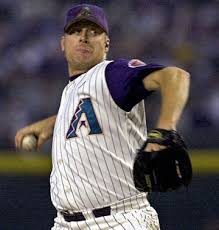 The most visible flaw in Curt Schilling's Hall of Fame case is that he wasn't as good as Randy Johnson. Or Roger Clemens, or Greg Maddux, or Pedro Martinez.
He had the misfortune of playing at the same time as arguably four of the ten best pitchers of all time. One of them was even his teammate for several years in Arizona. His career statistics don't measure up to theirs. How could they?
But Clemens, Johnson, Maddux, and Martinez put most Hall of Famers to shame. If they are the standard, then Cooperstown would be mighty short on starting pitchers. Schilling's numbers don't have to be as prolific as theirs.
Instead, compare him to three more appropriate contemporaries: Tom Glavine, John Smoltz, and Roy Halladay. Like Schilling, those three don't measure up to Clemens and company, yet are still considered to be safe Hall of Fame choices.
ERA WAR Strikeouts Innings
Halladay: 3.31 Glavine: 76.8 Schilling: 3,116 Glavine: 4,413.1
Smoltz: 3.33 Schilling: 76.1 Smoltz: 3,084 Smoltz: 3,473
Schilling: 3.46 Smoltz: 65.9 Glavine: 2,607 Schilling: 3,261
Glavine: 3.54 Halladay: 62.3 Halladay: 2,066 Halladay: 2,066
Curt Schilling clearly belongs on this tier of starting pitchers: not an inner-circle all-time great, but still worthy of the Hall of Fame. And he's got the peak performance, career accolades, and postseason heroics to prove it.
1. Peak. Common perception of Schilling's body of work is hurt by the fact that his seven best seasons were divided into two separate stretches.
The peak of his career is considered to be between 2001 and 2004. His ERA across those four seasons was 3.11 and he averaged 228 innings and 252 strikeouts per year. In three of those seasons, he finished with more than 20 wins and was the runner-up for the Cy Young Award (losing twice to teammate Randy Johnson and once to Johan Santana -- no shame there).
But across the three seasons from 1996 to 1998, Schilling was equally dominant. His cumulative ERA was 3.13 and he averaged 235 innings and 267 strikeouts per year (leading the league in the latter category twice).
Schilling is perceived to be an "up-and-down" player because his best seasons were not simultaneous. It's true that his performance fluctuated. But it mostly fluctuated between "outstanding" and "merely excellent." And those outstanding seasons were easily worthy of the Hall of Fame even if they weren't bunched together neatly.
2. Career. Schilling's most notable career accomplishment is his strikeout total: 3,116. That makes him one of only 16 pitchers to reach the 3,000 strikeout milestone. The other 15 are all legends (10 Hall of Famers plus Randy Johnson, Roger Clemens, Greg Maddux, Pedro Martinez, and John Smoltz). Schilling also had three seasons with at least 300 strikeouts. Only Randy Johnson, Nolan Ryan, and Sandy Koufax equaled that feat.
Not only was Schilling a strikeout pitcher -- he rarely walked anyone, either. In seasons with at least 80 innings pitched, he never had a walk rate above 3.1 per nine innings (comparatively, all-time strikeout king Nolan Ryan's lowest-ever walk rate was 3.3 per nine innings).
Schilling's ability to rack up strikeout totals and limit walks was historically great. He owns the best career strikeout-to-walk ratio in modern baseball history: 4.38. He led the league in that category five times. Unsurprisingly, his WHIPs were very low; twice he led the league with sub-1.00 marks. His career WHIP was 1.14, which would put him in the top 20 among all Hall of Fame starting pitchers.
3. Postseason. Schilling's regular season record is Cooperstown-worthy on its own. It's his playoff performance that really pushes him into "no-doubt" territory.
Five times Schilling took the ball in a postseason elimination game, a win-or-go-home situation. He led his team to a victory all five times. One of those times was in Game 7 of the 2001 World Series, when he pitched the Arizona Diamondbacks to a championship and shared MVP honors with Randy Johnson. Another one of those times was the famous "bloody sock" game against the New York Yankees in Game 6 of the 2004 ALCS, when Schilling pitched through a loose tendon in his ankle to help facilitate the greatest playoff comeback of all time.
Nearly all of his postseason numbers are better than his regular season ones, despite the superior competition and ramped-up pressure on that stage. In 133.1 postseason innings (19 starts), his ERA was 2.33 (down from 3.46 in the regular season). His WHIP, remarkably, was 0.97 (down from 1.14). His strikeout-to-walk ratio was 4.80 (up from 4.38). If there's credit to be given to transcendent playoff performers, then he deserves it most.
Schilling has achieved greatness on all three possible levels: career, single-season, and single-game. What's more, he did all of it between 1988 and 2007, pitching during the heart of the Steroid Era when offensive levels were at their crazy height. Consider that context and his 3.46 career ERA looks even better. To that point, his career adjusted-ERA (ERA+) was 127 (27% above average), identical to Bob Gibson and Tom Seaver. Curt Schilling is the only (non-Clemens) pitcher on this ballot worthy of a Hall of Fame vote -- and yes, that includes Jack Morris.
My Ballot, As of Now
1. Barry Bonds
2. Roger Clemens
3. Mike Piazza
4. Craig Biggio
5. Jeff Bagwell
6. Mark McGwire
7. Edgar Martinez
8. Tim Raines
9. Curt Schilling
Out: Sammy Sosa, Lee Smith, Rafael Palmeiro, Fred McGriff
Subscribe to:
Posts (Atom)