The Hall of Fame's voting process has numerous problems, but perhaps the most pressing one is the growing number of deserving names on an increasingly-crowded ballot. There are at least 15 candidates that warrant discussion this year, but the baseball writers are limited to voting for a maximum of just ten. Because of that restricting rule, there will inevitably be a handful of worthy players at the bottom of the ballot who won't get the support they deserve. The following four players, for instance, will all fall significantly short of election to the Hall of Fame in 2014 -- but each of them has a strong case for induction.
Tim Raines
Raines had two elite skills that made him one of the best players of the 1980s and a productive player into the 1990s. The first was his ability to get on base, which he did at a career .385 rate, better than some of his more notable peers at his position (including Carl Yastrzemski, Willie Stargell, and Jim Rice). The second was his baserunning ability: he stole at least 70 bases six different times and led the league in that category four of those times. He has the fifth-most career steals ever (808), and perhaps more impressively, he was only caught 146 times. That 84.7% success rate ranks as the second-best ever among all base-stealers with at least 300 attempts.
And though he was a historically-good baserunner, Raines was not a stereotypical slap hitter. He hit 430 career doubles, more than Willie Stargell or Mike Schmidt. With a career OPS+ of 123, his offensive production was comparable to that of Ernie Banks and Paul Molitor. From 1981 to 1987, he hit .310/.396/.448 while averaging 72 steals, 79 walks, and 103 runs scored per season. The result of all this production: a career worth almost 70 Wins Above Replacement. The only left fielders with significantly more WAR than Tim Raines are Barry Bonds, Ted Williams, Rickey Henderson, and Carl Yastrzemski.
Perhaps the best way to visualize the value of Raines' career is a straight-up comparison to another corner outfielder who was elected to the Hall of Fame on the first ballot: Tony Gwynn. Unlike Raines, Gwynn earned glory with a .338 batting average, eight batting titles, and over 3,000 hits. But their total production is eerily similar. Gwynn had a career .388 OBP and reached base 3,955 times; Raines had a .385 OBP and reached base 3,977 times in a similar number of games. Gwynn had a seemingly large edge in total bases, but that statistic does not include walks, hit by pitches, or net stolen bases. If you factor in those numbers, Raines actually gained more bases in his career (5,805) than Gwynn (5,267).
Raines is the second-best leadoff hitter of all time and one of the best left fielders and base-stealers ever. He can be reasonably compared to Tony Gwynn, a first-ballot Hall of Famer. But only half of the BBWAA electorate voted for him last year. That needs to change.
Edgar Martinez
There are only 18 players in baseball history with a career batting average over .300, career on-base percentage over .400, and career slugging percentage over .500 (in a minimum of 8,000 plate appearances). Edgar Martinez is one of them, thanks to his .312/.418/.515 line. Additionally: among all hitters in baseball history with at least 2,000 games played, Edgar Martinez has the 12th-best on-base percentage. Of the 11 players with a higher OBP, nine are already in the Hall of Fame and the other two (Barry Bonds and Frank Thomas) should be headed there. Martinez ranks ahead of hitters like Stan Musial, Mel Ott, Manny Ramirez, and Albert Pujols in this category.
He was also one of the best hitters in baseball for over a decade. Between 1990 and 2003, the only players who got on base at a higher rate than Martinez were Barry Bonds and Frank Thomas. He had eleven seasons with an OBP over .400, leading the league in that category three times. His career OPS of .933 is tied for the 33rd-best mark ever, higher than Hank Aaron's and Frank Robinson's. His career OPS+ of 147 is equal to Mike Schmidt's and Willie McCovey's. Martinez was indisputably one of the best hitters of his era and one of the 30 or 40 best hitters of all time.
Yet support for his Hall of Fame candidacy hasn't budged upwards since his debut on the ballot four years ago. The reason is both singular and obvious: he was a designated hitter. He provided no defensive (or baserunning) value, and was therefore a "one-dimensional" player. While this is a valid counter-argument, it's just not enough to keep Martinez out of the Hall. First of all: his "one-dimensional" career still produced 68 Wins Above Replacement, roughly the same value provided by Eddie Murray and Ernie Banks. Second: Paul Molitor is already in the Hall despite having spent almost half of his career at DH, and Frank Thomas is about to get in despite having spent over half of his career at DH; those precedents should help Martinez's case. And third: the Hall has already inducted five relief pitchers, which are even more specialized and "one-dimensional" than designated hitters. A hitter as good as Martinez just belongs in the Hall, regardless of what position he did or didn't play.
Larry Walker
Like Edgar Martinez, Larry Walker is one of the 18 members of the career .300/.400/.500 club. The proud owner of a .313/.400/.565 batting line, Walker also owns the 16th-best OPS of all time, just a shade behind Frank Thomas and Stan Musial. He has the 11th-most WAR among all right fielders and the top ten are all in the Hall of Fame. He was a complete all-around player with 230 career stolen bases at a 75% success rate, seven Gold Gloves in right field, and an elite throwing arm. During his extended peak between 1994 and 2004, his OPS was 1.036 and he won three batting titles. In 1997, he earned the MVP award by hitting a ridiculous .366/.452/.720 with 49 homers, 33 steals, 130 RBIs, 143 runs scored, 409 total bases, and a league-leading 9.8 WAR. Despite all these remarkable achievements, he is unlikely to ever make the Hall of Fame.
Walker's candidacy -- and entire career -- is compromised in the eyes of some because he spent the heart of his playing days in mile-high Coors Field before the humidor was installed. Like most other Colorado Rockies of the era, Walker's numbers were therefore inflated by the hyper-friendly offensive environment in which he played. Roughly 31% of his career plate appearances came at Coors, and his cumulative numbers there look like they belong in a video game: a .381 batting average, .462 on-base percentage, and .710 slugging percentage. That's Babe Ruth with a higher batting average. Because those numbers look so utterly cartoonish, many Hall voters can't take Walker's case seriously.But that's not really fair, for a number of reasons:
1. Walker's career numbers away from Coors are still very good (.282/.372/.501, equivalent to or better than the overall numbers of right fielders like Reggie Jackson and Al Kaline).
2. Walker had seasons in which his stats away from Coors were just as good as his home stats (in his 1997 MVP campaign, for example, his home OPS was 1.169 and his road OPS was 1.176).
3. Walker played two full seasons in Coors after the humidor was installed, and his numbers there were still elite even after the change: a 1.124 home OPS in 2002 and a 1.021 home OPS in 2003.
4. Walker's context-neutral statistics, which adjust for the inflation caused by Coors, are still excellent. His 141 OPS+ is in the same neighborhood as Vladimir Guerrero (140) and Reggie Jackson (139). Baseball Reference's neutralized batting line for Walker (putting his numbers into the context of an average offensive environment) is .294/.378/.530. Still Hall of Fame numbers, especially for a five-tool right fielder.
5. Perhaps most importantly, the Hall has never used home-road splits as an excuse to keep players out. Hitters like Jim Rice, Carl Yastrzemski, Billy Williams, and Chuck Klein all benefited from their friendly home ballparks, but all have plaques in Cooperstown. Excluding Walker from Cooperstown because of Coors Field would be inconsistent. He should be in.
Mark McGwire
Only nine players in baseball history have a higher career OPS (.982) than Mark McGwire. Only ten players have a higher career OPS+ (163). Only seven have a higher career slugging percentage (.588). Only nine hit more home runs (583). And no one has ever hit home runs at a higher rate (one per 10.6 at-bats). It's easy to marginalize McGwire's career because he has admitted using performance-enhancing drugs, and he may be in risk of falling off the ballot this year entirely. But his achievements cannot be overlooked.
As a 23-year-old rookie in 1987, he led the league in home runs (49) and slugging percentage (.618) along with a .987 OPS. From 1988 to 1991, he only hit .233 but still managed to be valuable by averaging 32 homers and 90 walks per season. In 1992, he led the league in slugging percentage and OPS+, but two injury-plagued years followed. Then, from 1995 to 2000, he was unstoppable. His cumulative line across those six seasons was .289/.442/.706 with a 192 OPS+ and an average of 53 homers and 113 walks per season. He broke Roger Maris' single-season record for home runs, with 70; he also hit 65, and 58, and 52. Then he abruptly fell off a cliff in 2001, and retired. The career was short -- not even 2,000 games or 8,000 plate appearances. However, he achieved a degree of offensive dominance that has hardly ever been matched in the history of the sport. He will never be in the Hall of Fame, but like Tim Raines, Edgar Martinez, and Larry Walker, his on-the-field record suggests he belongs regardless of whether or not the baseball writers actually put him there.
Showing posts with label Larry Walker. Show all posts
Showing posts with label Larry Walker. Show all posts
Tuesday, January 7, 2014

Monday, September 16, 2013
On Vladimir Guerrero, and Hall of Fame Exclusivity
(This post is operating under the premise that Vladimir Guerrero will eventually be elected to the Hall of Fame by the BBWAA. It's impossible to prove that assumption true, because he won't even be ballot-eligible until 2017. But Sport Illustrated's Hall of Fame guru Jay Jaffe predicted that Guerrero will build up enough support to make the Hall eventually, and most people would probably agree, so we'll go from there.)
Vladimir Guerrero finally retired from baseball last Friday, having gone two years without appearing in a major league game. He's 38 years old with zero healthy knees, so this news didn't exactly come as a surprise. Guerrero's next stop, in all likelihood, will be Cooperstown. And he has the career accomplishments to deserve that honor. But if he does get inducted, it will be just another indictment of the Hall of Fame's comically-inconsistent voting patterns.
First, a quick glance at Vlad's career. Somewhat notably, he was perhaps the last good player that the Montreal Expos ever had. His six full seasons with that now-defunct franchise were phenomenal: he averaged a .995 OPS and .600 slugging percentage between 1998 and 2003. In 2002, he was tantalizingly close to joining the exclusive 40-40 club, when he stole 40 bases and hit 39 home runs. In 2004, he signed with the Angels in free agency. Not coincidentally, the Montreal Expos would cease to exist about a year later.
With his new team, the Los Angeles Angels, Guerrero maintained his torrid offensive pace for four additional seasons. That included an MVP Award in 2004, when he hit .337/.391/.598 with 39 home runs and a league-leading 124 runs scored. After 2007, however, his production finally began to tail off as injuries sapped his playing time. His final four seasons were subpar by his lofty standards -- yet his batting averages in those years were all still above .290. Guerrero is often thought of strictly as a power hitter, but his freakish batting average ability was Tony Gwynn-like.
Guerrero's career was relatively short (only 15 seasons with more than 90 games played), so he isn't making the Hall based on longevity. What he does have, however, is an outstanding ten-year peak between those six years in Montreal and first four in L.A. From 1998 to 2007, Vlad's cumulative line was .327/.394/.586, with a .980 OPS, 151 OPS+, and 52.6 WAR. He averaged 35 homers, 35 doubles, 187 hits, and 16 steals per season. During that stretch, the only outfielders who were better offensively than Guerrero were Barry Bonds and Manny Ramirez. His consistency was remarkable: during that decade, he never hit below .307, slugged below .547, or had an OPS below .934.
And it's not like Vlad lacks for cumulative longevity stats. Despite a career that didn't even reach 10,000 plate appearances, he still had 2,590 hits (top 100 all-time), 4,506 total bases (top 50), and 449 home runs (top 40). He was a nine-time All-Star whose teams were successful basically everywhere he went. He garnered MVP votes in 12 different seasons, winning the award in 2004. If you combine Vlad's ten elite seasons with his solid career numbers, and factor in his uniquely intimidating persona, you understand why he's headed to Cooperstown.
Here's the thing, though. If Vladimir Guerrero is widely accepted as a Hall of Famer, then I have a hard time understanding why Larry Walker, Gary Sheffield, and Bobby Abreu are not.
More specifically, I fail to see how a voter could support only one of those four guys and not the other three. They're so similar statistically that to me, they're a package deal. Either all four of them are in, or they're all out. The notion that Vlad somehow belongs on a higher tier than Walker, Sheffield, and Abreu just isn't supported by facts. For instance, here's how the four players are ranked by career Wins Above Replacement, according to both Baseball Reference and Fangraphs:
Baseball Reference
1. Larry Walker (72.6)
2. Bobby Abreu (60.4)
3. Gary Sheffield (60.4)
4. Vladimir Guerrero (59.9)
Fangraphs
1. Larry Walker (69.0)
2. Gary Sheffield (62.5)
3. Bobby Abreu (58.6)
4. Vladimir Guerrero (58.6)
I'd imagine that most people would object to how those players are ordered. Quibble with the exact order, sure, but the point is that the careers of Walker, Sheffield, and Abreu are at the very least on par with Guerrero's. Here's a case-by-case examination.
Vlad vs. Larry Walker
Walker's been on the ballot for three years and (spoiler alert) he's not getting into the Hall. Yet he did everything that Vlad did -- hit for average, hit for power, stole bases, had a great arm, won an MVP, and had a nearly identical career OPS+ (141 for Walker, 140 for Vlad). And he even did some things that Vlad didn't -- he drew more walks, won Gold Gloves in right field, and was an excellent baserunner (Guerrero was actually terrible in that regard). Both Baseball Reference and Fangraphs see Walker as having about 13 more WAR than Guerrero, and that's completely believable. How can somebody vote for Guerrero but leave Walker off the ballot?
Vlad vs. Gary Sheffield
Sheffield has reached the 500 home run plateau, but has an uphill climb to get into the Hall thanks to connections to performance-enhancing drugs and a poor personal reputation. Based solely on his performance, however, his career has a lot in common with Guerrero's. The numbers say that Sheffield's defense was horrible, much worse than Guerrero's, but Sheffield made up some of that deficit by accumulating almost two thousand more plate appearances than Guerrero. So it's unclear who had the more valuable career. Who had the better peak? Again, it's very close:
Guerrero, 1998-2007: .327/.394/.586, 151 OPS+
Sheffield, 1996-2005: .303/.417/.552, 154 OPS+
Sheffield has the advantage when it comes to longevity (he tops Guerrero in every meaningful career statistic), and their peaks were similar. Penalize Sheffield for his defense (and connection to performance-enhancing drugs, if that floats your boat), but how big is the gap between these two players, really? Big enough to put one in the Hall of Fame and leave the other one out? Hardly.
Vlad vs. Bobby Abreu
Out of this foursome of late-1990s/early-2000s right fielders, Abreu feels like the one that doesn't belong. The truth is that Abreu is one of the most underrated players of this generation. Remember Guerrero's ten-year peak from 1998 to 2007, in which he hit .327/.394/.586 and produced 52.6 WAR? Well, from 1998 to 2007, Bobby Abreu hit .302/.411/.505 and produced 51.3 WAR. His problem was that his skills -- on-base ability, doubles-hitting, baserunning -- weren't as flashy as Vlad's home runs and bullet throws. Guerrero was likely the better player, but Abreu was much, much closer than anyone thinks. So ushering Guerrero into the Hall while simultaneously dismissing Abreu's case out of hand is wholly unfair.
The point here is not to diminish Guerrero's accomplishments, or claim that he isn't worthy of the Hall of Fame. Quite the opposite. The point is to hold Guerrero up as a Hall of Fame standard, and then apply that standard consistently to honor all of the players who performed at that elite level. Why Guerrero, but not Walker, Sheffield, or Abreu? Drawing an arbitrary line somewhere between those players is the definition of unnecessary nitpicking. Sometimes, baseball's obsession over maintaining an 'exclusive' (and therefore, somehow, more 'meaningful'?) Hall of Fame results in the exclusion of worthy candidates. If the voters maintain the trajectory they're on, then the future Hall will claim that the best right fielders of this generation were Vladimir Guerrero and Ichiro. That version of the Hall of Fame isn't as interesting, as complete, or as accurate as the hypothetical one that also includes Walker, Sheffield, and maybe even Abreu.
I would like to see Vladimir Guerrero in the Hall of Fame. Not only because he deserves it, but also because his induction might open the door for some of his equally worthy peers.
Monday, January 7, 2013
Cooperstown Candidate: Larry Walker
If his candidacy was based solely on his accomplishments on the baseball field, Larry Walker would be an easy Hall of Fame selection.
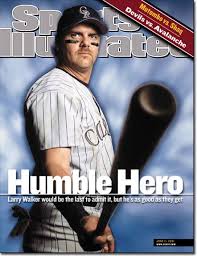 He was the ultimate three-dimensional player, excelling at the plate, in the field, and on the basepaths. He was an excellent right fielder (his great arm helped him with seven Gold Gloves) and baserunner (he had 230 steals). His career line was fantastic: .313/.400/.565, along with 383 home runs. Among players with at least 1,000 games played, his career slugging percentage ranks 12th-best all-time and his career on-base-plus-slugging ranks 15th-best. He is one of the 21 players ever to retire with a career batting average over .300, a career on-base percentage over .400, and a career slugging percentage over .500. And he stands as the only member of that club with both 300 home runs and 200 steals.
Basically, Walker took Edgar Martinez's hitting tool and added speed and defense in right field. That's a tremendous baseball player. His Wins Above Replacement total reflects that fact -- he racked up almost 70 WAR in his career, placing him within the top ten all-time among right fielders.
Walker's peak was outstanding, too. He had an eleven-year stretch of excellence between 1994 and 2004, during which he hit a cumulative .331/.422/.614 with an OPS+ of 148. Shrink that down to his six best seasons, between 1997 and 2002: he hit a cumulative .353/.441/.648, won three batting titles, and averaged 30 homers per year with an OPS+ of 157. He won an MVP award for his best season, in 1997, when he hit a stunning .366/.452/.720 with an OPS+ of 178. He led the league in home runs (49), total bases (409), on-base-plus-slugging (1.172), and Wins Above Replacement (9.6), and he threw in 149 runs and 33 stolen bases for good measure. He nearly repeated that season in 1999 and 2001, but in fewer games. Walker enjoyed a decade of excellence, a half-decade of elite play, and two or three seasons of outrageous dominance.
His obstacle to getting into the Hall of Fame isn't his performance -- it's the perception that his performance was artificially enhanced. But not by steroids. The culprit here is Coors Field, where he played his home games with the Colorado Rockies for the majority of his career. That mile-high ballpark inflates offensive numbers more effectively than steroids ever could, and it shows in Walker's stats:
Walker at Coors: .381/.462/.710, 154 home runs (2,501 plate appearances)
Walker everywhere else: .282/.372/.501, 229 home runs (5,529 plate appearances)
The difference is startling. It's the best ammunition that Walker's detractors have. But he shouldn't be disqualified from Cooperstown consideration because of the Coors Factor, for several reasons.
1. His road numbers were still excellent. Walker's career OPS away from Coors Field was .873. That's better than the career OPS of several high-profile right fielders in the Hall of Fame, like Al Kaline, Tony Gwynn, Reggie Jackson, Roberto Clemente, and Dave Winfield.
2. Walker's context-neutral numbers were excellent, too. His career OPS+, which adjusts for the offensive inflation caused by Coors, was 141 (41% better than average). In other words, not as good as Frank Robinson (154), but comparable to Reggie Jackson (139) and better than Al Kaline (134) and Tony Gwynn (132).
3. Walker wasn't always worse on the road. In his 1997 MVP season, his home OPS was 1.169, and his road OPS was a sliver better at 1.179. It's not like inferior road numbers were an absolute for Walker.
4. There are precedents in the Hall of Fame. In the past, baseball writers haven't really had concerns about significant home/road splits. Members of the Boston Red Sox have benefited from Fenway Park's offense-friendly dimensions for decades. Carl Yastrzemski (career home OPS of .904 compared to .779 on the road) and Jim Rice (.920 at home, .789 OPS on the road) stand out as prime examples. Both are in the Hall. In the spirit of consistency, Walker shouldn't be held to a different standard than everyone else (especially when his non-Coors OPS was up at .873).
Sure, Walker isn't a slam-dunk Hall of Famer like many of the other players on the ballot. But most of the baseball writers have unfairly discarded his case simply because of the ballpark he played in. They've incorrectly assumed that Coors transformed Walker from a decent player into a star -- when in reality, Coors transformed Walker from a star into Babe Ruth:
Babe Ruth, career: .342/.474/.690
Larry Walker, career at Coors Field: .381/.462/.710
Of course Walker wasn't as good as Ruth. The point is that even after adjusting downwards for the Coors Effect, he still grades out as worthy of Cooperstown. He is one of the ten best players ever at his position; he was one of the game's top all-around performers for over a decade; and you can put his peak seasons up against anyone's in the history of the game. That's a Hall of Fame career, even if much of it happened a mile above sea level.
My Ballot, As of Now
1. Barry Bonds
2. Roger Clemens
3. Mike Piazza
4. Craig Biggio
5. Jeff Bagwell
6. Mark McGwire
7. Edgar Martinez
8. Tim Raines
9. Curt Schilling
10. Larry Walker
Out: Sammy Sosa, Lee Smith, Rafael Palmeiro, Fred McGriff
Subscribe to:
Posts (Atom)