Imagine the Detroit Tigers and Texas Rangers are playing Go Fish. They both happen to have the same two cards in their respective hands: a seven and a ten. If they don't trade with each other, then neither team can get a pair and their cards will be worthless. But if the Tigers send their seven to the Rangers, and the Rangers send their ten to the Tigers, then both parties would have a pair and be better off.
That's the simple beauty of the Prince Fielder for Ian Kinsler swap that was finalized earlier in the week: mutual benefit. We typically think of trades as zero-sum games: upgrading one area of a roster demands a downgrade in another, and one team's improvement requires another team's decline. But in this case, a trade made two rosters unequivocally better off than they were before.
The Tigers and Rangers matched up so well for this trade because both were dealing with a significant logjam at different positions. For the Tigers, their issue was at the corner infield spots. They were committed to Fielder at first base for seven more years (and $168 million), and with Victor Martinez locked in as the designated hitter, Miguel Cabrera was stuck playing third base. There were a few major problems with this configuration that made it unacceptable:
1. Playing third almost certainly took a toll on Cabrera's health last season.
2. Playing Fielder and Cabrera at the corners every day makes for a truly miserable defensive infield.
3. Shoehorning Cabrera in at third blocked the Tigers' elite hitting prospect, Nick Castellanos, another third baseman.
4. The huge financial obligation to Fielder -- the source of this logjam in the first place -- may have prevented the Tigers from making other significant moves, like re-signing the reigning Cy Young winner, Max Scherzer.
The Rangers, meanwhile, had a similar positional bottleneck. Theirs was in the middle infield. They had awarded large extensions to shortstop Elvis Andrus and second baseman Ian Kinsler, keeping both under contract for the next four or five years, minimum. But those two commitments left no spot for top prospect Jurickson Profar, who's also under team control for the rest of the decade. Without a trade, the Rangers may have been forced to permanently move either Kinsler or Profar to the outfield. Not only would that have been a vastly inefficient use of resources -- it also may have kept the Rangers from signing the good-hitting outfielder that they need.
So the Tigers needed to trade a corner infielder and the Rangers needed to trade a middle infielder. It just so happened that each team also had a need for the asset that the other team was trying to dump. The Tigers didn't have a second baseman after Omar Infante's free agency, and could have used a defensive upgrade there. The Rangers had a gaping hole at first base -- they just gave 500 plate appearances to Mitch Moreland, who hit .232 with a .299 OBP. The solution, then, was too simple: the Rangers sent Ian Kinsler to the Tigers in exchange for Prince Fielder (along with $30 million to offset some of the difference between their contracts).
Immediately, both teams are in a much better place. The Tigers can now move Cabrera back to first base, protecting his health. They're a lot more flexible at third base: they can use Castellanos there, or sign a free agent like Stephen Drew. Either way, that's a significant defensive upgrade. So is the addition of Kinsler at second. Suddenly, the Tigers have a more-than-competent defensive infield. And they saved money in the process. Instead of paying Fielder $168 million over the next seven years, they'll pay Kinsler about $62 million over the next four and send $30 million to Texas. That's upwards of $70 million saved, which can be used toward a Max Scherzer extension or a free agent like Drew, Carlos Beltran, Shin-Soo Choo, or a closer. So the Tigers protected their star's health, upgraded at second base, drastically improved their infield defense, opened up third base for their best hitting prospect, and gained some long-term financial flexibility. Giving up Prince Fielder's hefty contract was certainly worth all that good stuff.
The trade had a similar impact on the Rangers. Which is the better infield: Elvis Andrus, Ian Kinsler, and Mitch Moreland, or Elvis Andrus, Jurickson Profar, and Prince Fielder? Exactly. Upgrading from Moreland to Fielder is significant, and the presence of Profar means that losing Kinsler almost doesn't even matter. Plus, they're not paying the sticker price for Fielder. Though he's owed $168 million over the next seven years, the Tigers are assuming $30 million of that total, along with the $62 million contract that the Rangers once owed Kinsler. So ultimately, the trade will only add about $76 million to the Rangers' existing financial commitments. In exchange, they made a huge upgrade at first base for a discounted price, opened up second base for their top prospect, and kept left field open for a potential free agent signing, like Jacoby Ellsbury. They dealt from their position of strength to address their most glaring weakness.
The Tigers had a square peg and round hole; the Rangers had a round peg and square hole. They just swapped pegs, and both teams got better. But the trade does not come without risk -- especially for Texas. Although Prince Fielder is just 29 years old and one of the most durable players in the game, his 2013 season was alarmingly subpar: a .279/.362/.457 line with 25 home runs, roughly comparable to what Adam Lind and Mike Napoli did. Because Fielder is a miserable defender and baserunner, his bat is the only source of his value. If 2013 was indicative of a larger trend, and Fielder really is in the midst of a steep offensive decline, then he's useless dead weight who's owed $138 million over the next seven years. In that scenario, he's about to become the most undesirable contract in baseball.
The Rangers are gambling that Fielder's down season was just an aberration, perhaps influenced by his divorce. The promise of a move to hitter-friendly Arlington offers additional hope for a return to his former self. If the Rangers are right, they just got one of the game's most elite and durable sluggers at less-than-full price. If Fielder really is declining, then they just acquired one of the most toxic assets in the sport, and what looks like a win-win deal today could eventually be perceived as one of the most lopsided trades ever.
Showing posts with label Texas Rangers. Show all posts
Showing posts with label Texas Rangers. Show all posts
Saturday, November 23, 2013

Monday, April 8, 2013
The Worst Strike Call Ever
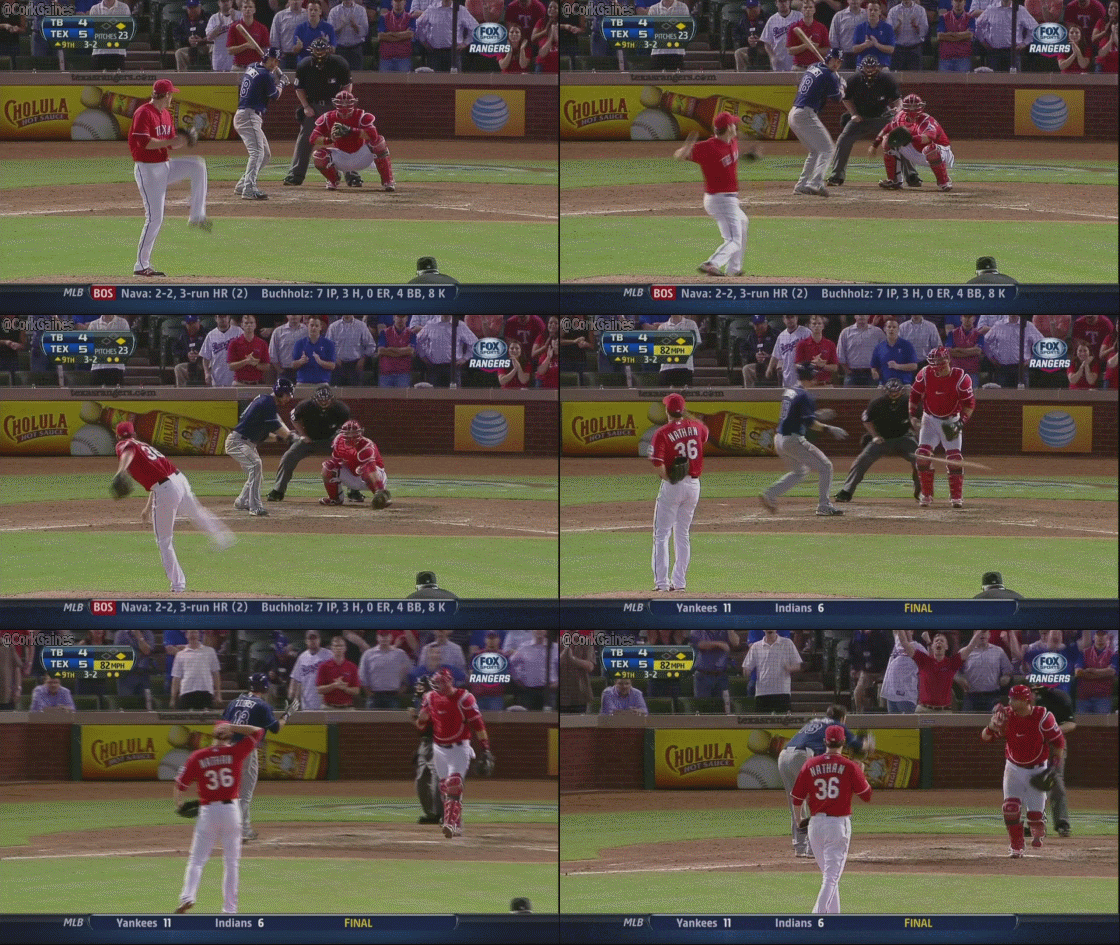
While America was watching Spike Albrecht and Luke Hancock, the Tampa Bay Rays lost on one of the most horrendous umpiring calls you'll ever see. Ben Zobrist was at the plate for the Rays in the bottom of the ninth, his team down a run. This two-out, full-count pitch was somehow called a strike, ending the game for the Rangers:

Come on. Seriously? Here's a list of people who knew that pitch was ball four.
1) The viewer; you have the benefit of multiple viewings and are presumably not blind.
2) The catcher, who makes literally no effort to even try and frame the pitch, and then begins walking towards the pitcher with the likely intention of hashing out their strategy against the next hitter.
3) The pitcher, Joe Nathan, who, having thrown the pitch, was the most biased person in that ballpark. Yet he clearly mutters something angrily to himself and raises his hand to his head in frustration, because the pitch was a BALL. Then he sees the strike call and awkwardly tries to convert that annoyed-head-touching motion into a victory fist-pump. Well played, Nathan. You're one smooth customer.
4) Rangers fans directly behind home plate. Even they know the pitch is a ball. Most don't react at all when the pitch is delivered; a few are even visibly frustrated or disappointed. Then the umpire makes his 'strike three' motion, and they all explode spontaneously, their joy doubled by the complete unexpectedness of the ridiculous call.
5) Ben Zobrist. Poor dude. He literally has no idea what just happened.
6) Pretty much everyone except the guy who went through vigorous training to correctly call balls and strikes.
Here's a better visual representation, with pitch #6 being the one in question:

If there's anything out there that could possibly make Zobrist and the Rays feel better, it's the reminder that this pitch thrown by Livan Hernandez was once called 'strike three,' too -- and it actually ended Game 5 of a 1997 playoff series against the Braves:

Come on. Seriously? Here's a list of people who knew that pitch was ball four.
1) The viewer; you have the benefit of multiple viewings and are presumably not blind.
2) The catcher, who makes literally no effort to even try and frame the pitch, and then begins walking towards the pitcher with the likely intention of hashing out their strategy against the next hitter.
3) The pitcher, Joe Nathan, who, having thrown the pitch, was the most biased person in that ballpark. Yet he clearly mutters something angrily to himself and raises his hand to his head in frustration, because the pitch was a BALL. Then he sees the strike call and awkwardly tries to convert that annoyed-head-touching motion into a victory fist-pump. Well played, Nathan. You're one smooth customer.
4) Rangers fans directly behind home plate. Even they know the pitch is a ball. Most don't react at all when the pitch is delivered; a few are even visibly frustrated or disappointed. Then the umpire makes his 'strike three' motion, and they all explode spontaneously, their joy doubled by the complete unexpectedness of the ridiculous call.
5) Ben Zobrist. Poor dude. He literally has no idea what just happened.
6) Pretty much everyone except the guy who went through vigorous training to correctly call balls and strikes.
Here's a better visual representation, with pitch #6 being the one in question:

If there's anything out there that could possibly make Zobrist and the Rays feel better, it's the reminder that this pitch thrown by Livan Hernandez was once called 'strike three,' too -- and it actually ended Game 5 of a 1997 playoff series against the Braves:

Friday, April 5, 2013
The Trade That Has To Happen
On Thursday, the Texas Rangers officially announced an eight-year, $120 million extension with their shortstop, Elvis Andrus (who has already played in over 600 major league games despite only being 24 years old). Coincidentally, the Rangers also have an even younger shortstop in their minor league system named Jurickson Profar, who's almost-universally recognized as the best position-player prospect in all of baseball. He's a more-than-capable defender who hit 14 homers with a .820 OPS in Double-A last year -- as a 20-year old middle-infielder. He could be ready for the majors as soon as this summer. But Andrus is now locked in at shortstop for the foreseeable future. At second base, Ian Kinsler is just entering Year One of a five-year contract worth $75 million. There's no room for Profar in Texas.
The Rangers now have three options:
A) Play Profar at second base and move Kinsler to another position (first base or outfield).
B) Trade Kinsler.
C) Trade Profar.
Plan A looks like the best one on paper, because it allows Texas to keep all three of their middle infielders. But Kinsler is far less valuable at a position other than second base: he doesn't hit as well as a typical first baseman or outfielder, and such a move would eliminate the defensive value he provides. Ian Kinsler at a position besides second base isn't worth $75 million, nowhere close. Plus, for what it's worth, he was resistant to the idea of a switch during the offseason, and the Rangers might not be willing to go through another ugly Michael Young situation again.
If the Rangers could find a way to make Plan B work by trading Kinsler, they'd have to consider it. But I'm not so sure teams would be lining up for the chance to pay Ian Kinsler $75 million through 2017. Especially considering he'll be 32 in June, and his offensive production took a nosedive last year. The Dodgers would probably take him, given the bottomless pit of cash that the team is swimming in, but the Rangers probably wouldn't get much -- if anything -- back in return. At that point they'd just be giving away a solid player for nothing, and what's the point of that?
No, assuming Kinsler is sticking around at second base, the most efficient use of the Rangers' resources would be Plan C: trading Jurickson Profar. And it just so happens that the perfect trade target is out there waiting for them: Giancarlo Stanton.
Giancarlo Stanton hit 93 home runs before he turned 23 years old. That's more than Ted Williams had at that age; more than Jimmie Foxx; more than Ken Griffey Jr. In fact, only five players hit more career home runs before their 23rd birthday than Stanton: Mel Ott, Eddie Mathews, Alex Rodriguez, Tony Conigliaro, and Frank Robinson. Needless to say, those are good baseball players. Stanton's OPS has increased from .833 in his first season to .893 in his second to .969 last year, when he also led all of baseball in slugging percentage (.608). He had a higher slugging percentage than the guy who won the Triple Crown. As a 22-year-old. In just his third full season. Playing for the Miami Marlins. On a surgically-repaired right knee. With virtually no lineup protection. In a pitcher's park. Hot damn.
Stanton won't hit free agency until 2017. Which means that if Team X traded for him tomorrow, Team X would have him under contract for the rest of 2013, and 2014, and 2015, and 2016. That simple fact, along with the above paragraph, makes Stanton the most valuable trade chip in baseball not named Harper or Trout. So why would the Marlins deal him away? Because they probably won't be any good for a long time, and because it's extremely unlikely that their cheap owners will want to pay him once he gets expensive, and because, well, why would Stanton want to sign a long-term extension with this dysfunctional franchise? Trading Stanton now, while he still has four years of team control left, would maximize the Marlins' potential return. Four years of Stanton is so incredibly valuable that there are only a handful of hyper-elite prospects the Marlins would even consider accepting in exchange for him. Jurickson Profar is one of those few -- a low-risk, low-cost, potential-franchise-cornerstone that the Marlins so desperately need.
On the Rangers' side, giving up Profar would sting. In fact, they'd probably have to include several additional prospects along with Profar to make a Stanton deal work, which would damage their farm system even more. But if there's a team in baseball that could ever afford to trade away perhaps the best prospect in baseball, it's the Rangers, thanks to Elvis Andrus and his new long-term extension. Regardless, Stanton would be worth it. The Rangers have a need for outfielders, with Nelson Cruz scheduled to be a free agent after this season and David Murphy being, you know, just David Murphy. And Stanton could wreak untold damage playing his home games in the Rangers' homer-happy ballpark, sandwiched between Elvis Andrus and Adrian Beltre. It's a drool-worthy scenario.
Giancarlo Stanton is a generational talent. The kind you trade for, no matter the cost, the instant he becomes available. The last time a hitter of his caliber was traded at such a young age was more than five years ago, when these same Marlins dealt away a dude named Miguel Cabrera.
Miguel Cabrera, through age 22: 405 games, 78 home runs, .300/.366/.523, .889 OPS, 133 OPS+
Giancarlo Stanton, through age 22: 373 games, 93 home runs, .270/.350/.553, .903 OPS, 141 OPS+
The Rangers have a chance to fix a roster inefficiency by swapping one of their excess shortstops for an MVP-caliber outfielder. The Marlins have a chance to cash in an elite trade chip they may never get to use themselves in order to rebuild their franchise around younger, cheaper players, including the best prospect in baseball. Jurickson for Giancarlo. It makes too much sense.
Sunday, March 31, 2013
Live Reactions from Baseball's Opening Night
Baseball is back! The season is about to open with a Rangers-Astros game in Houston. To honor the occasion, here are some real-time reactions to our first live baseball in months.
7:47 PM: The Baseball Tonight roundtable is doing some pre-game chatting. Present here is a smorgasbord of analysts whose opinions I have virtually no interest in: Karl Ravech (annoying), Tim Kurkijan (weird voice), Curt Schilling (bleuughh), Alex Cora (apparently qualified to talk about baseball thanks to his career .243 batting average in the majors), and Barry Larkin (lesser-known father of a famous Miami point guard). For some reason, they're discussing the Los Angeles Angels even though tonight's game is between the Rangers and Astros, so ... good effort, chaps.
7:51 PM: The Rangers' lineup is announced. It's noticeably not as strong as in recent years -- David Murphy is a nice player, but he's hitting fifth. Ex-Astro, current-Ranger Lance Berkman gets a loud reaction from his one-time home crowd. Mostly positive, so good for them. Matt Harrison is pitching for the Rangers, Bud Norris for the Astros. Norris is the highest-paid player on the Astros and he's making $3 million. That is not a typo.
7:53 PM: The Astros lineup is announced, and it's a veritable Who's-Who of ex-Triple-A All-Stars. The two most recognizable names are Carlos Pena and Jose Altuve; the rest of the lineup is made up of Brett Wallace, Chris Carter, Justin Maxwell, Jason Castro, Matt Dominguez, Brandon Barnes, and Ronny Cedeno. Ugly. This is why the Astros are all but certain to lose 100 games for the third consecutive season.
7:55 PM: "Four-time Grammy Award winner" and country-music-star Lyle Lovett sings the national anthem, awkwardly accompanied by a violin. This is the part where the rest of the country regrets the league's choice to open the season in Texas.
7:57 PM: J.J. Watt of the NFL's Houston Texas emerges to throw the first pitch, and he gets more cheers than the entire Astros lineup combined.
7:58 PM: Turns out J.J. Watt is better at locating holes in the offensive line than the strike zone.
8:04 PM: Some pregame chatter in the booth between ESPN's broadcasters, Dan Shulman, Orel Hershiser, and John Kruk. Shulman is excellent and Hershiser is bearable, but Kruk is seriously useless. He's talking about the AL East right now. Again: this is a Rangers-Astros game. What makes him even more annoying is the fact that everyone insists on calling him "Krukie."
8:05 PM: Buster Olney informs us that the Houston Astros' payroll this year is about $18 million dollars, and there are more than 20 individual players in baseball are making more than their entire team. That's actually relevant information. Much appreciated, Buster.
8:08 PM: Bud Norris of the Astros throws the first pitch of the season, a 92 mile per hour strike to Ian Kinsler. Baseball! Kinsler flies out on the second pitch.
8:11 PM: Norris strikes out Elvis Andrus. There's hope in Houston! Things have not fallen apart immediately! Lance Berkman steps to the plate, and this time, he gets a much more mixed reaction from the crowd before grounding out. Bud Norris is no-hitting the Texas Rangers! Baseball history!
8:15 PM: It's the bottom of the first and Jose Altuve, perhaps the only above-average player in this lineup, steps to the plate for the Astros. He singles on the first pitch he sees and proceeds to get thrown out stealing second -- but the replay shows he was actually safe. Took less than ten minutes for our first blown call of the 2013 season. If there's one frustrating thing about Major League Baseball (besides "Krukie") it's the archaic resistance to incorporating more instant replay. Meanwhile, the Astros fail to score, making this inning no different than almost every other Astros inning.
8:26 PM: In the top of the second, ESPN shows a graphic that lists the Rangers' "Notable Losses" from last season -- Josh Hamilton and Mike Napoli, for instance. Bizarrely, they've included Michael Young under this column. Removing Young from your everyday lineup is a Notable Addition By Subtraction. Meanwhile, Norris has walked two batters in this inning, apparently going for the A.J. Burnett-style no-hitter.
8:31 PM: And Norris surrenders his first hit, off the bat of new Ranger A.J. Pierzynski (whose presence on any major league team makes it instantly easier to dislike that major league team). There will be no baseball history made tonight. Norris does, however, strike out Mitch Moreland to escape the inning unscathed.
8:40 PM: Highlights from the bottom of the second: Carlos Pena strikes out against a left-hander and looks awful doing so; then Adrian Beltre casually grabs a screaming line-drive like it was no big deal. Business as usual for both parties.
8:52 PM: Another bad call from an umpire. The top of the third ends when Elvis Andrus sends a looping liner into center that Justin Maxwell dove and "caught" -- though he clearly trapped the ball. Maxwell sprints off the field as quickly as possible before the umpire gets a chance to change his mind.
9:03 PM: Lance Berkman (who ESPN has just informed me is "Texas through-and-through") lines a leadoff single in the top of the fourth. Dan Shulman then drops this knowledge bomb: Berkman has the second-highest slugging percentage all-time among switch-hitters, behind only Mickey Mantle. ("Krukie" wisely deduces that this means Berkman has a higher slugging percentage than Chipper Jones and Eddie Murray. Way to put the pieces together, dude.) So Berkman's career line now sits at .296/.409/.544 with 360 home runs. Hall of Fame worthy? The Rangers still remain scoreless.
9:20 PM: And the Astros are threatening! Singles by Brett Wallace and Carlos Pena have put two men on with two outs in the bottom of the fourth. Up now in this crucial spot, the Astros' number-five hitter ... Justin Maxwell, who hit .229 with a .304 OBP last year. Ouch.
9:22 PM: But Maxwell delivers! Never doubted him! He crushes a high fly ball to left field that bounces on the very top of the wall; the left-fielder has no idea what just happened, two runs score, and Maxwell ends up at third. 2-0 Astros! Hope for bad teams everywhere!
9:30 PM: It's the top of the fifth, the Rangers are losing, and right away John Kruk begins talking about the leadership that the Rangers are lacking with Michael Young no longer around. Hilariously ridiculous.
9:56 PM: The Rangers have finally arrived. A Kinsler walk and Berkman single has runners on the corners with one out. Adrian Beltre to the plate -- and he lines a bullet right at the pitcher. Everything's coming up Astros.
10:01 PM: Until now. David Murphy gets the Rangers' first run home with a single to right. Then Nelson Cruz knocks in another run with a single past the shortstop. All with two outs. Suddenly it's 4-2 and Bud Norris is out. In comes ... Erik Bedard. Once an ace, now exiled to the Astros' bullpen. He could never stay healthy. Interesting idea by Houston, using him out of the bullpen. He gets his team out of the jam.
10:13 PM: In the bottom of the sixth, Harrison gets his ninth strikeout (of Carlos Pena ... again). But he puts two runners on with two outs and gets yanked. For some reason, Rangers manager Ron Washington is bringing in Derek Lowe here. Really? Derek Lowe is little more than a long man at this point. Using your worst pitcher in one of the game's most important situations may not end well.
10:24 PM: Sure enough: three-run home run. By Rick Ankiel, of all people. That's what you get when you bring in Derek Lowe in a key situation. 7-2 Astros. Ron Washington, will you ever learn?
10:41 PM: After the Rangers go down without making noise in the top of the seventh, Lowe gets replaced by Jason Frasor, who retires the side in the bottom of the inning. Frasor is actually a competent reliever. Was he really a worse option than Lowe in the sixth? Still struggling to understand the logic ...
10:44 PM: Top of the eighth, Astros third baseman Matt Dominguez makes a sweet play fielding a tough ground ball and throwing to first on the run for the out. It's players like Dominguez that the Astros are wisely trying to stockpile. They got him from the Marlins last summer by trading away a half-season of the overpaid Carlos Lee. He's cheap, young, plays excellent defense at third, and even hit a little in his major league debut last year. The Astros are throwing so many darts at prospects like Dominguez that eventually a few are going to hit.
10:47 PM: Bedard retires the side again. Seven consecutive outs and looking strong, too. Is he on his way to the rare three-inning save? That would be a pretty cool move by new Astros manager Bo Porter, who's looking for his first-ever win.
10:53 PM: Justin Maxwell gets his second triple of the game down the right-field line (with an assist from a Rangers defense that has looked atrocious tonight). Maxwell will never take a walk, but he's got serious power and is a safe bet to lead the Astros in home runs this year. He's also on pace for 324 triples, so there's that.
10:55 PM: Speaking of horrendous defense ... with Maxwell on third and two outs, Dominguez dribbles a grounder up the middle that Rangers second baseman Ian Kinsler just whiffed on. The run scores. 8-2. Kinsler was clearly missing Michael Young's leadership on that play.
11:00 PM: Top of the ninth and Bedard is still out there to finish this thing off. Love the move. Managers are too wedded to the idea of using certain relievers in certain innings. From the looks of this, Bo Porter will be a bit more flexible. That makes sense, considering the Astros are one of the most forward-thinking organizations in baseball (even if their players suck).
11:08 PM: Astros win! Fireworks are going off! They're in first place! Bo Porter is undefeated as a major league manager! Unfortunately, this may be he high point of Houston's season. But at least for one night, the Astros were winners on national television. They deserved this victory. There won't be many of them in 2013.
7:47 PM: The Baseball Tonight roundtable is doing some pre-game chatting. Present here is a smorgasbord of analysts whose opinions I have virtually no interest in: Karl Ravech (annoying), Tim Kurkijan (weird voice), Curt Schilling (bleuughh), Alex Cora (apparently qualified to talk about baseball thanks to his career .243 batting average in the majors), and Barry Larkin (lesser-known father of a famous Miami point guard). For some reason, they're discussing the Los Angeles Angels even though tonight's game is between the Rangers and Astros, so ... good effort, chaps.
7:51 PM: The Rangers' lineup is announced. It's noticeably not as strong as in recent years -- David Murphy is a nice player, but he's hitting fifth. Ex-Astro, current-Ranger Lance Berkman gets a loud reaction from his one-time home crowd. Mostly positive, so good for them. Matt Harrison is pitching for the Rangers, Bud Norris for the Astros. Norris is the highest-paid player on the Astros and he's making $3 million. That is not a typo.
7:53 PM: The Astros lineup is announced, and it's a veritable Who's-Who of ex-Triple-A All-Stars. The two most recognizable names are Carlos Pena and Jose Altuve; the rest of the lineup is made up of Brett Wallace, Chris Carter, Justin Maxwell, Jason Castro, Matt Dominguez, Brandon Barnes, and Ronny Cedeno. Ugly. This is why the Astros are all but certain to lose 100 games for the third consecutive season.
7:55 PM: "Four-time Grammy Award winner" and country-music-star Lyle Lovett sings the national anthem, awkwardly accompanied by a violin. This is the part where the rest of the country regrets the league's choice to open the season in Texas.
7:57 PM: J.J. Watt of the NFL's Houston Texas emerges to throw the first pitch, and he gets more cheers than the entire Astros lineup combined.
7:58 PM: Turns out J.J. Watt is better at locating holes in the offensive line than the strike zone.
8:04 PM: Some pregame chatter in the booth between ESPN's broadcasters, Dan Shulman, Orel Hershiser, and John Kruk. Shulman is excellent and Hershiser is bearable, but Kruk is seriously useless. He's talking about the AL East right now. Again: this is a Rangers-Astros game. What makes him even more annoying is the fact that everyone insists on calling him "Krukie."
8:05 PM: Buster Olney informs us that the Houston Astros' payroll this year is about $18 million dollars, and there are more than 20 individual players in baseball are making more than their entire team. That's actually relevant information. Much appreciated, Buster.
8:08 PM: Bud Norris of the Astros throws the first pitch of the season, a 92 mile per hour strike to Ian Kinsler. Baseball! Kinsler flies out on the second pitch.
8:11 PM: Norris strikes out Elvis Andrus. There's hope in Houston! Things have not fallen apart immediately! Lance Berkman steps to the plate, and this time, he gets a much more mixed reaction from the crowd before grounding out. Bud Norris is no-hitting the Texas Rangers! Baseball history!
8:15 PM: It's the bottom of the first and Jose Altuve, perhaps the only above-average player in this lineup, steps to the plate for the Astros. He singles on the first pitch he sees and proceeds to get thrown out stealing second -- but the replay shows he was actually safe. Took less than ten minutes for our first blown call of the 2013 season. If there's one frustrating thing about Major League Baseball (besides "Krukie") it's the archaic resistance to incorporating more instant replay. Meanwhile, the Astros fail to score, making this inning no different than almost every other Astros inning.
8:26 PM: In the top of the second, ESPN shows a graphic that lists the Rangers' "Notable Losses" from last season -- Josh Hamilton and Mike Napoli, for instance. Bizarrely, they've included Michael Young under this column. Removing Young from your everyday lineup is a Notable Addition By Subtraction. Meanwhile, Norris has walked two batters in this inning, apparently going for the A.J. Burnett-style no-hitter.
8:31 PM: And Norris surrenders his first hit, off the bat of new Ranger A.J. Pierzynski (whose presence on any major league team makes it instantly easier to dislike that major league team). There will be no baseball history made tonight. Norris does, however, strike out Mitch Moreland to escape the inning unscathed.
8:40 PM: Highlights from the bottom of the second: Carlos Pena strikes out against a left-hander and looks awful doing so; then Adrian Beltre casually grabs a screaming line-drive like it was no big deal. Business as usual for both parties.
8:52 PM: Another bad call from an umpire. The top of the third ends when Elvis Andrus sends a looping liner into center that Justin Maxwell dove and "caught" -- though he clearly trapped the ball. Maxwell sprints off the field as quickly as possible before the umpire gets a chance to change his mind.
Maxwell exiting centerfield at Trapping speed8:59 PM: Matt Harrison of the Rangers doesn't normally strike out many batters, but the Astros are making him look like Pedro Martinez. He's now struck out five and breezed through three innings on just 38 pitches. Then again, the three batters he just dominated were Matt Dominguez, Brandon Barnes, and Ronny Cedeno. Analysis: the Astros won't be scoring many runs this year.
— Jonathan Bernhardt (@jonbernhardt) April 1, 2013
9:03 PM: Lance Berkman (who ESPN has just informed me is "Texas through-and-through") lines a leadoff single in the top of the fourth. Dan Shulman then drops this knowledge bomb: Berkman has the second-highest slugging percentage all-time among switch-hitters, behind only Mickey Mantle. ("Krukie" wisely deduces that this means Berkman has a higher slugging percentage than Chipper Jones and Eddie Murray. Way to put the pieces together, dude.) So Berkman's career line now sits at .296/.409/.544 with 360 home runs. Hall of Fame worthy? The Rangers still remain scoreless.
9:20 PM: And the Astros are threatening! Singles by Brett Wallace and Carlos Pena have put two men on with two outs in the bottom of the fourth. Up now in this crucial spot, the Astros' number-five hitter ... Justin Maxwell, who hit .229 with a .304 OBP last year. Ouch.
9:22 PM: But Maxwell delivers! Never doubted him! He crushes a high fly ball to left field that bounces on the very top of the wall; the left-fielder has no idea what just happened, two runs score, and Maxwell ends up at third. 2-0 Astros! Hope for bad teams everywhere!
9:30 PM: It's the top of the fifth, the Rangers are losing, and right away John Kruk begins talking about the leadership that the Rangers are lacking with Michael Young no longer around. Hilariously ridiculous.
OH MY GOD WE'RE STILL TALKING ABOUT MICHAEL YOUNG.9:40 PM: Bottom of the fifth, and more Astros runs! Ronny Cedeno slaps a ball into right field that Nelson Cruz misplays (stop me if you've heard this before), pushing the lead to 3-0. Then Jose Altuve singles home another run. 4-0. It's a rout! Derek Lowe is warming in the bullpen for the Rangers, which is the baseball equivalent of a white flag. Strange outing for Matt Harrison.
— Colin Wyers (@cwyers) April 1, 2013
9:56 PM: The Rangers have finally arrived. A Kinsler walk and Berkman single has runners on the corners with one out. Adrian Beltre to the plate -- and he lines a bullet right at the pitcher. Everything's coming up Astros.
10:01 PM: Until now. David Murphy gets the Rangers' first run home with a single to right. Then Nelson Cruz knocks in another run with a single past the shortstop. All with two outs. Suddenly it's 4-2 and Bud Norris is out. In comes ... Erik Bedard. Once an ace, now exiled to the Astros' bullpen. He could never stay healthy. Interesting idea by Houston, using him out of the bullpen. He gets his team out of the jam.
10:13 PM: In the bottom of the sixth, Harrison gets his ninth strikeout (of Carlos Pena ... again). But he puts two runners on with two outs and gets yanked. For some reason, Rangers manager Ron Washington is bringing in Derek Lowe here. Really? Derek Lowe is little more than a long man at this point. Using your worst pitcher in one of the game's most important situations may not end well.
10:24 PM: Sure enough: three-run home run. By Rick Ankiel, of all people. That's what you get when you bring in Derek Lowe in a key situation. 7-2 Astros. Ron Washington, will you ever learn?
10:41 PM: After the Rangers go down without making noise in the top of the seventh, Lowe gets replaced by Jason Frasor, who retires the side in the bottom of the inning. Frasor is actually a competent reliever. Was he really a worse option than Lowe in the sixth? Still struggling to understand the logic ...
10:44 PM: Top of the eighth, Astros third baseman Matt Dominguez makes a sweet play fielding a tough ground ball and throwing to first on the run for the out. It's players like Dominguez that the Astros are wisely trying to stockpile. They got him from the Marlins last summer by trading away a half-season of the overpaid Carlos Lee. He's cheap, young, plays excellent defense at third, and even hit a little in his major league debut last year. The Astros are throwing so many darts at prospects like Dominguez that eventually a few are going to hit.
10:47 PM: Bedard retires the side again. Seven consecutive outs and looking strong, too. Is he on his way to the rare three-inning save? That would be a pretty cool move by new Astros manager Bo Porter, who's looking for his first-ever win.
10:53 PM: Justin Maxwell gets his second triple of the game down the right-field line (with an assist from a Rangers defense that has looked atrocious tonight). Maxwell will never take a walk, but he's got serious power and is a safe bet to lead the Astros in home runs this year. He's also on pace for 324 triples, so there's that.
10:55 PM: Speaking of horrendous defense ... with Maxwell on third and two outs, Dominguez dribbles a grounder up the middle that Rangers second baseman Ian Kinsler just whiffed on. The run scores. 8-2. Kinsler was clearly missing Michael Young's leadership on that play.
11:00 PM: Top of the ninth and Bedard is still out there to finish this thing off. Love the move. Managers are too wedded to the idea of using certain relievers in certain innings. From the looks of this, Bo Porter will be a bit more flexible. That makes sense, considering the Astros are one of the most forward-thinking organizations in baseball (even if their players suck).
11:08 PM: Astros win! Fireworks are going off! They're in first place! Bo Porter is undefeated as a major league manager! Unfortunately, this may be he high point of Houston's season. But at least for one night, the Astros were winners on national television. They deserved this victory. There won't be many of them in 2013.
Friday, October 5, 2012
Picking the Wild Card Winners
Orioles Over Rangers
This pick makes absolutely no sense, for the following reasons:
1) The game is in Texas
2) The Rangers are starting Yu Darvish, who is filthy-good
3) The Orioles are starting Joe Saunders, who is filthy-bad, especially against right-handers
4) The Rangers' lineup is primarily right-handed
But the whole Orioles season doesn't make sense. Why should reason get in the way now?
The O's have a significant strategic advantage over the Rangers because Buck Showalter is a great tactician and Ron Washington is whatever the opposite of a great tactician is. Joe Saunders is probably going to get rocked, and Showalter isn't stupid. At the first sign of trouble, he'll have no qualms about yanking Saunders and handing the game over to his excellent bullpen. From that moment on, the Orioles will have the advantage. In the middle and late innings, the game could come down to pitching changes, pinch-hitters, and platoon advantages, and Showalter will out-maneuver Washington in this department.
If I was Showalter, I would have Saunders start but only pitch to the first three hitters (so his ultimate job is to retire Josh Hamilton). Then I'd bring in Steve Johnson, a right-handed starter, to go a couple innings. Ron Washington will certainly stack his lineup with righties against Saunders, so bringing in Johnson counters that move. It forces Washington to either give up the platoon advantage for the first half of the game, or burn his pinch-hitters early. This should stunt the Rangers' offense. Then Showalter can mix and match with his great bullpen for the final five or six innings.
The point is that Joe Saunders is extremely unlikely to pitch well tonight. But Showalter is the kind of manager who won't be timid about taking him out early if necessary. After all they've done, why pick against the Orioles now?
Orioles advance in a high-scoring, home-run-happy thriller.
Braves Over Cardinals
I give Braves manager Fredi Gonzalez a lot of credit (despite being known as the Ron Washington of the National League) for making two tough lineup decisions in advance of this do-or-die game.
For one, he chose to start the less-proven (but completely dominant) Kris Medlen in this game as opposed to experienced veteran Tim Hudson. A lot of managers would defer to the 'guy who's been there before.' Medlen is the better choice and Gonzalez got it right. In twelve starts this season, his ERA is 0.97. That's insane.
Gonzalez also chose to bench his struggling starting catcher, Brian McCann, in favor of backup David Ross. This would've been considered unthinkable a few months ago. But McCann is struggling through a shoulder injury so Gonzalez is going with the superior defender in what should be a low-scoring affair. A tough decision, but again, the right one.
The Cardinals are starting Kyle Lohse, a right-hander, who has been spectacular this season. He also doesn't have much of a platoon split, so the fact that the Braves are very left-handed won't matter too much. It could, however, matter in the late innings when Lohse is gone. The Cardinals don't have a shutdown left-handed reliever, which will be a problem against Michael Bourn, Jason Heyward, Freddie Freeman, and switch-hitters Martin Prado and Chipper Jones.
The Braves, on the other hand, have the best reliever in baseball: their closer, Craig Kimbrel. The Cardinals aren't going to score on him. In fact, if Fredi Gonzalez is willing to use Kimbrel for two innings, and Medlen goes seven, the Cardinals will be trying to score against the two most unhittable pitchers in baseball right now. The fact that the Braves also have one of the best defenses in baseball makes them masters of preventing runs.
And the fact that the Braves have Chipper Jones karma...well, that doesn't mean nothing.
Braves advance in a tight affair.
Friday, August 24, 2012
Adrian Beltre's Week
Between Saturday, August 18th, and Friday, August 24th, Adrian Beltre put up the following stat line:
15-for-30 (a .500 average for the math-challenged)
Four doubles and five homers
ZERO strikeouts
A three-homer game
A cycle
Is that good?
15-for-30 (a .500 average for the math-challenged)
Four doubles and five homers
ZERO strikeouts
A three-homer game
A cycle
Is that good?
Saturday, July 28, 2012
Go West, Young Man
On Friday evening, the Los Angeles Angels acquired 28-year-old ace Zack Greinke from the Milwaukee Brewers in exchange for three of their top prospects. Greinke is a free agent after the season, so without a contract extension, the move is only about 2012 for the Angels. What this means for each of the parties involved:
The Angels: they likely would've made the playoffs without Greinke: since starting the season 18-25, eight games back of the Rangers, the Angels have gone 37-20 to pull within four games of the AL West lead. No, acquiring Greinke isn't about the wild card. It's about the division. A third ace won't do you any good if you're subject to the randomness of the one-game wild card playoff. Therefore, getting Greinke is about avoiding that nightmarish scenario and setting the Angels up for a longer, more favorable playoff series in which their opponents must deal with Jered Weaver twice, C.J. Wilson, and Greinke. With a trio like that, the Angels would be favored in any five- or seven-game playoff series. In a one-game playoff series, no one can be favored. That's what LA--in full win-now mode--wants to avoid at all costs.
The Angels' rotation: now composed of Jered Weaver, C.J. Wilson, Zack Greinke, Dan Haren, and one of several fifth starter candidates. This is the best rotation the American League has seen in many many years.
The Angels' farm system: General Manager Jerry DiPoto did well in trading for Greinke without giving up pieces that are helping the Angels win this year. That would be players like speedy center fielder Peter Bourjos and fifth starter/bullpen candidate Garrett Richards. Instead, DiPoto gave up major-league-ready infield prospect Jean Segura and two high-ceiling Double-A hurlers, Ariel Pena and John Hellweg. That completely decimates the Angels' farm system, but like the Detroit Tigers, the Angels rightly shouldn't be worried about that given the level of investment in the major league roster.
The Brewers: throwing up the white flag on 2012, and possibly 2013 too. At least they got good value for their ace, and Greinke was a huge part of the best season in Brewers' history.
Zack Greinke: the only hesitation teams have about Greinke is his ability to perform on a big stage. In LA, he gets a chance to prove himself in a major market, during a pennant chase and potential playoff run. If he performs well, he'll make himself tens of millions of extra dollars during free agency, with the Angels or elsewhere.
The Rangers: uh-oh. They lost one Colby Lewis, and the Angels gained one Zack Greinke. The worst-case scenario for the first-place team in the AL West. Right now, Texas' ideal rotation consists of Matt Harrison, whichever version of Yu Darvish chooses to show up, Roy Oswalt's balky back, the rehabbing Neftali Feliz, and Derek Holland. That doesn't come close to sniffing Weaver-Wilson-Greinke-Haren, and it's not better than what Oakland currently has, either. Without a trade of their own (Josh Johnson? James Shields?) the Rangers are in danger of losing the AL West to the Angels.
The Athletics, White Sox, Orioles, Rays, Red Sox, Indians, etc: the rest of the American League wild card contenders are probably dismayed by the Greinke trade, because the Angels have just sewn up one of their two available playoff spots. If any of these teams has an inside track on that last berth, it's the White Sox. In the last month of the season, when the AL East is pummeling itself and the A's are playing the Angels and Rangers, the White Sox get to feast on the weak AL Central. Look for Chicago to act on that advantage and make a trade or two before Tuesday's deadline.
Sunday, July 22, 2012
A Dirty Little Secret
Hey. Hey, you there.
Yeah, you. Come over here. Shhh, not so loud. Come closer. I've got a secret for you.
Know who's scored the fewest runs in July so far? No, not the Pirates, you idiot, don't you know who Andrew McCutchen is? The Pirates have actually scored the most. The fewest? Actually the Texas Rangers.
Yeah, the Rangers. The fewest, man. Not like, the second-fewest, or bottom-five. Dead last. Fewer than the Astros. And I've heard they're not very good.
Who's to blame here? Well, time for another dark secret: Josh Hamilton has been close to an automatic out since June. Since the 1st of the that month, his average is .209, his OBP is .303, and he's struck out 47 times in 38 games. The Rangers are 21-17 over that period. In July, Hamilton's been even worse, hitting .178 in 13 games (the Rangers are, unsurprisingly, 5-8 in the month). Pitchers aren't throwing Hamilton strikes and he's obliging. Among qualified hitters, Josh swings at pitches outside the strike zone more than anybody else (45.7% of the time), even more than infamous free-swingers Delmon Young and Jeff Francoeur. And Hamilton's swinging-strike percentage is worst in baseball (19.6%) by a wide margin; Danny Espinosa is second at 14.8%. Hamilton is a great slugger when hot, but he can't be in the "best hitter in baseball" discussion when he's literally swinging at everything.
More slumping Rangers:
Ian Kinsler. The Rangers' second baseman is still hitting leadoff despite the worst OPS of his career (.768). He's also having a poor year in the field. Disappointing.
Michael Young. Nobody hitting .269/.300/.347 should be hitting so high in the lineup, let alone deserves the DH spot.
Nelson Cruz. News flash: Nelson Cruz isn't a particularly good ballplayer, and is extremely overrated. He was a beast in 2010, but he's no longer hitting for enough power (.435 slugging percentage and only 11 homers) to justify his poor OBP (.323).
Mike Napoli. Mike, Mike, Mike...you were so unbelievably fantastic last year. You were so hot in the postseason that you essentially had a cult following. Now you're hitting .231 with the worst OPS (.754) of your career while costing yourself tens of millions of dollars in your upcoming free agency. What happened, buddy?
Adrian Beltre, Elvis Andrus, and the bench can't carry this team to the division title, let alone the World Series. The Angels have scored twice as many runs as Texas this month, and they have two pitchers better than anything their rivals have. The way each team is playing, it would not shock me in the slightest if the Angels rallied to win the division. The Rangers are up six games with two months to play; as we learned last year, that kind of lead can vanish mighty quick. And it will if this offense doesn't come around soon.
Tuesday, July 17, 2012
When 228 Baseball Players Get It Wrong
Sports Illustrated recently polled 228 MLB players, asking them to identify the "Most Underrated Position Player" in baseball. "Underrated" is a very broad term, so there aren't many players that would universally qualify as "bad" choices for the "Most Underrated" title.
In fact, there's really no excuse for the winner of this poll to be a controversial selection at all. The players could've picked any talented, well-liked guy from a small market (Ben Zobrist, Shin Soo-Choo, whomever), and they would've been right. Or even a well-paid star in a large market who just doesn't get his due for some reason (Adrian Beltre, Paul Konerko). There are so many justifiable options out there for Most Underrated.
Instead, they chose Michael Young. Michael Young, the most underrated player in baseball. Why is this a terrible and very ironic choice? Because Michael Young of the Texas Rangers might actually be the most overrated player in baseball.
This season, Young's batting average has taken a dive down to .273. His on-base percentage is just .304, below the league average of .320. His slugging percentage is only .352, well below the league average of .406. That leaves Young's OPS at .656, also below the league average of .726. The average player walks 8.1% of the time; Young's walk-rate is at 4.6%. He has just three home runs. His adjusted OPS+ is currently 71, meaning his offense is about 29% worse than league average. And for some perspective: Young is practicing all of this offensive mediocrity in one of the most offense-friendly home ballparks in baseball.
To make matters worse, Young has started 65 of his 87 games at either DH or first base this season. So not only is he an offensive liability--he's an offensive liability at positions reserved entirely for offense.
And as for his "leadership" and other "intangibles" that he always gets credit for: he threw a hissy fit when the Rangers asked him to change positions to accommodate the signing of Adrian Beltre two offseasons ago. Rather than gracefully accepting a move that greatly improved his team's World Series chances, Michael Young publicly demanded a trade. Draw your own conclusions.
Now, for some comparisons. One usually gets two standard answers when one asks the masses, "Who are the most overrated players in baseball?" These players are Derek Jeter and Alex Rodriguez. Please note these 2012 statistics:
Michael Young: .273/.304/.352, 3 HRs, 71 OPS+
Derek Jeter: .308/.353/.411, 7 HRs, 103 OPS+
Michael Young: .273/.304/.352, 3 HRs, 71 OPS+
Alex Rodriguez: .270/.353/.442, 14 HRs, 111 OPS+
On top of those numbers, both Jeter and Rodriguez play the field more often than Young does, and actually provide baserunning value (they've stolen a combined 17 bases while getting caught a total of 3 times; Young has successfully stolen just two bags on four attempts). Jeter and A-Rod, universally confirmed as overrated players, are easily outperforming Michael Young, apparently the poster child for the underrated and unappreciated.
In Young, we have a 35-year-old who plays first base and DH in an offense-friendly ballpark for a first-place team, yet isn't doing any of the following things: hitting for average, hitting for power, walking, stealing bases, or playing good defense (or any defense at all). Add it all up and Young has been worth -1.0 Wins Above Replacement this season. His "contributions" have cost his team a win. And oh-by-the-way, he's pulling in $16 million for his efforts this season, making him the highest-paid player on his team.
So yeah, when I look at Michael Young, I think, "Man, this guy is so underrated."
Tuesday, May 8, 2012
Hamilton's Paradox
On Tuesday, Texas outfielder Josh Hamilton mercilessly victimized the Orioles by becoming the 16th player in MLB history to hit four home runs in one game. With all the early-season hoopla surrounding Matt Kemp, it was easy to forget about Hamilton's equally-impressive start, until now. The Rangers star has suddenly surpassed his Dodgers counterpart in home runs, 14 to 12, and the rest of his line looks like this: .406./458/.840, 36 RBIs, 25 runs scored. And he missed a series against Toronto with a bad back. He's unstoppable. It's been true for a few years now: when Hamilton is in the lineup, he's the best hitter in baseball.
But there's the kicker: when he's in the lineup. For the past three years, Hamilton has played in 89, 133, and 121 games. He's guaranteed to spend some time on the shelf every season and the constant lurking of his substance-abuse problems provides another concern. At 30, he's not getting any younger, either.
Now, Josh Hamilton is going to be a free agent at the end of 2012. He's on pace for another monster year. The market for position players is going to be very weak. The newly-reborn Dodgers might love to pair Hamilton with Kemp and Andre Ethier in an All-World outfield. The bidding war is going to be crazy. So unless Texas manages to lock him up during the season, Hamilton is going to make himself a huge pile of money this winter. Heck, Jayson Werth earned $126 million. Carl Crawford got $142 million. Hamilton is easily the superior player. What kind of unspeakably huge contract is he going to pull down?
We don't know, and it doesn't matter. Whoever gives Hamilton such a deal will be taking a fairly massive gamble, one that is highly unlikely to pay off. Long-term, big-money contracts for safe, durable players rarely provide good return. If even baseball's Iron Men break down physically as they enter their 30's, how can one justify dedicating a massive chunk of team payroll to Josh Hamilton, who is already 30, gets hurt constantly, and recently went through his second alcohol relapse? Committing so much money to such a risky asset is brutally irresponsible and shortsighted.
Therein lies Hamilton's Paradox. Josh Hamilton might be the most talented baseball player on the planet, a one-man wrecking crew who accomplished one of the game's most legendary Herculean feats last night. Yet the team that signs Hamilton to a long-term contract this winter will be making a mistake. It's remarkable that such an elite MVP player in his prime can simultaneously represent such a hopelessly reckless investment. Who will decide to tether their fortunes to Josh Hamilton's gifted, hurting body for the rest of the decade? You should hope it won't be the people running your favorite team.
Monday, April 23, 2012

Friday, March 30, 2012
MLB Season Preview: Texas Rangers
With a rising payroll, enviable pitching depth, a stacked farm system, and an elite offense, the Texas Rangers have become a true baseball superpower.
Offense: The Rangers scored the third-most runs and had the highest batting average in the majors last year. The lineup reads like a murderers' row. Ian Kinsler is one of baseball's best second basemen, posting a 30-30 season with a .355 OBP in 2011. Elvis Andrus' numbers have only improved since cracking the majors as a 21-year-old shortstop. Josh Hamilton is still an MVP-caliber hitter when he's healthy. Adrian Beltre could be baseball's best third baseman; he's a Gold Glover who's nearly a lock to go .300-30-100. Mike Napoli, coming off an unbelievable season in which he hit .320/.414/.631 and was a postseason hero, will split time at catcher and first base. Michael Young is 35, but he hit .338 last year essentially as this team's utility infielder. Nelson Cruz's numbers dropped precipitously from 2010 to 2011 yet, as he showed in the playoffs, he continues to display massive raw power. Even role players like Mitch Moreland and Craig Gentry are solid at the bottom of the lineup. Health is the only Achilles' heel: Kinsler, Hamilton, Beltre, Napoli, and Cruz have all missed significant time within the last two years.
Pitching: If the Rangers don't win the AL West, it will be because their pitching staff lacks a true ace now that C.J. Wilson is gone. Still, they almost won the World Series last year with Wilson pitching poorly, and there's a number of guys who could take his place atop the rotation. The big acquisition, of course, is Yu Darvish, who may not be an ace right away but could end up being the team's best starter. The other 'addition' is Neftali Feliz. Once a top starter in the minors, Feliz is moving into the rotation--a transition C.J. Wilson once conquered--to realize his full potential. Derek Holland and Matt Harrison are two more youngsters prepared to take a step forward; Holland won 16 games with a 3.95 ERA and Harrison (3.39) was even better. These four guys have so much potential that Colby Lewis, the Opening Day starter, could eventually end up being the rotation's weakest option. The depth continues into the bullpen, as Alexi Ogando and Scott Feldman could start for a lot of other teams. And Koji Uehara and Mike Adams were once elite setup men who just stumbled down the stretch. There are concerns about whether or not Joe Nathan can be a top closer again, though.
Breakout Candidates: Pretty much anyone in the rotation--Darvish, Feliz, Holland, and Harrison--is capable of becoming the team's top starter. Based on talent and the flashes of brilliance we saw last year, Holland might be the best bet.
3 Key Questions: Can Josh Hamilton set aside concerns about his contract, relapse, and health to put up big numbers? How will Yu Darvish and Neftali Feliz handle difficult transitions? And can the offense stay healthy to take the pressure off a young rotation?
Best Case Scenario: Hamilton stays healthy and focused, Napoli is an MVP candidate again, Darvish is an instant sensation, Elvis Andrus morphs into Jose Reyes Lite, and the Rangers win the World Series.
Worst Case Scenario: Darvish wilts in the Texas heat, Hamilton, Kinsler, and Cruz miss significant time, Napoli regresses, and the Rangers miss the playoffs in the hypercompetitive AL wild card race.
Predicted Finish: The Rangers essentially return everyone from last year's pennant-winning team, just swapping out Wilson for Darvish and filling Feliz's hole in the bullpen with Nathan. And there's reason to believe that the pitching will actually improve. The Rangers will win the AL West and they're well-equipped to challenge for a World Series title yet again.
 |
| Why is Mike Napoli a Ranger? Because the Angels wanted to pay Vernon Wells a lot of money to suck at baseball. |
 |
| It's only March, and the "Yu" puns are already getting old. |
 |
| Anyone with doubts about Derek Holland's potential can refer to Game 4 of the 2011 World Series. |
3 Key Questions: Can Josh Hamilton set aside concerns about his contract, relapse, and health to put up big numbers? How will Yu Darvish and Neftali Feliz handle difficult transitions? And can the offense stay healthy to take the pressure off a young rotation?
Best Case Scenario: Hamilton stays healthy and focused, Napoli is an MVP candidate again, Darvish is an instant sensation, Elvis Andrus morphs into Jose Reyes Lite, and the Rangers win the World Series.
Worst Case Scenario: Darvish wilts in the Texas heat, Hamilton, Kinsler, and Cruz miss significant time, Napoli regresses, and the Rangers miss the playoffs in the hypercompetitive AL wild card race.
Predicted Finish: The Rangers essentially return everyone from last year's pennant-winning team, just swapping out Wilson for Darvish and filling Feliz's hole in the bullpen with Nathan. And there's reason to believe that the pitching will actually improve. The Rangers will win the AL West and they're well-equipped to challenge for a World Series title yet again.
Subscribe to:
Posts (Atom)