It's hard to think of a more overlooked baseball player from the past decade than Todd Helton of the Colorado Rockies. Even his recent retirement announcement was completely overshadowed in the media, thanks to the hubbub surrounding Mariano Rivera's farewell. But there's one way Helton can grab your full attention almost immediately: by instructing you to visit BaseballReference.com, find the career leaders for OPS, and scroll down past the top 15 names or so. Doing so reveals some surprising information:
...
18 Johnny Mize: .959
19. Jim Thome: .956
20. Todd Helton: .954
21. Jeff Bagwell: .948
22. Mel Ott: .9471
...
The constantly-marginalized Helton sneaks into the top twenty all-time in OPS, his name mingling with some of the most prolific sluggers ever. Now compare Helton against a few Hall of Fame first basemen from recent decades:
Todd Helton: .954
Willie McCovey: .889
Willie Stargell: .889
Harmon Killebrew: .884
So: Helton's OPS ranks in the top 20 among all hitters ever, and he's in a different stratosphere compared to the recent great players at his position. His career line of .317/.414/.540 is nothing short of sensational. That has to be a Hall of Fame career, right?
Not exactly. By just using raw OPS, we're ignoring the most important word when it comes to Helton's candidacy: context. No batting line can be evaluated in a vacuum. And Helton played the bulk of his career in the most hitter-friendly environment in baseball history: Coors Field in the early-2000s. Playing in an era when hitting stats were inflated, playing in a ballpark where hitting stats were comically inflated, Helton's offense just wasn't as valuable as it would have been in a different time or place. Taking that context into consideration, his bat just doesn't stand out like a Hall of Famer's should. There are a few statistical ways to demonstrate this assertion, and some are much better than others.
One possible route is to use home/road splits. This is a bad idea. Inevitably, future baseball writers will discredit Helton's career accomplishments just by looking at these two statistical lines:
Helton's career at home: .345/.425/.576 (OPS of 1.048)
Helton's career on the road: .287/.386/.470 (OPS of .856)
As if this somehow proves that Helton was entirely a creation of Coors Field. No. This isn't smart. Don't use home/road splits. Why? For a lot of reasons. Namely: these splits tell me that Todd Helton hit way better at Coors Field than he did elsewhere, which is true of EVERY PLAYER WHO HAS EVER HIT AT COORS FIELD. Plus, the Hall of Fame has already enshrined players with large home/road splits (see: anyone who played in Fenway Park), so precedents exist. These splits don't provide any insight.
Instead, adjusted-OPS (OPS+) is far more telling. Raw OPS doesn't say anything about how a player performed relative to the players around him, which is one of the most important factors of Hall of Fame voting. OPS+, on the other hand, tells us how much better (or worse) a player's OPS was relative to the league average at the time. Because it uses a universal scale (with 100 being the average), it also provides a more accurate way to compare players across eras.
Helton's career OPS+ is 133 (his offense was 33% above average). That's certainly very good. But now let's re-do a previous comparison, pitting Helton against three notable first basemen in the Hall of Fame, this time using OPS+ instead of plain OPS:
1. Willie McCovey: 147
2. Willie Stargell: 147
3. Harmon Killebrew: 143
4. Todd Helton: 133
Now there's a significant gap. This reveals a crucial point. Helton might have better raw numbers than any of these players -- a higher batting average, on-base percentage, and slugging percentage. But comparing those numbers across eras is a flawed apples-and-oranges argument. The Hall of Fame cares about players' numbers relative to their peers. And based on OPS+, it's clear that McCovey, Stargell, and Killebrew were more dominant hitters within their eras than Helton was in his.
That makes a lot of sense when you think about it -- especially considering how much more prevalent offense was in the 2000s compared to other eras. To illustrate that point, here's the average number of runs that teams scored per game in six different seasons. See if you can spot the outlier:
In 1960, teams scored an average of 4.31 runs per game.
In 1970: 4.34.
In 1980: 4.29.
In 1990: 4.26.
In 2000: 5.14.
In 2010: 4.38.
One of these things is not like the other. From about the mid-1990s to the mid-2000s, the number of runs scored per game took a huge spike relative to historical norms, culminating in that ridiculous 2000 season (over five runs per game!!!). Of course, the bulk of Helton's career came during that offensive explosion. So the value of the offense he provided was significantly devalued. That effect is compounded by Helton's home park during all those years, Coors Field, where offense was even more prevalent than it was everywhere else. In 2000, for instance, teams playing in Coors Field averaged over six runs per game. Six! In such an inflated run-scoring environment, the value of Helton's bat was severely diminished.
With that handicap in play, Helton's numbers aren't really "better" than those of past inductees like McCovey, Stargell, and Killebrew. But how does he compare to his contemporaries? The news isn't good on that front, either. Here's an OPS+ leader-board for some select first basemen and DHs during Helton's era:
Albert Pujols: 165
Mark McGwire: 163
Frank Thomas: 156
Jeff Bagwell: 149
Edgar Martinez: 147
Jim Thome: 147
Lance Berkman: 144
Jason Giambi: 140
David Ortiz: 139
Carlos Delgado: 138
Fred McGriff: 134
Todd Helton: 133
Rafael Palmeiro: 132
Helton's just too far down the totem pole.
On a final note: BaseballReference.com offers a pretty cool feature where they convert a player's stats into a "neutral" setting (a universe where 4.42 runs are scored per game). Helton's neutralized career batting line is .292/.387/.496, a fair step back from his actual career line of .317/.414/.540. The computer docks about 70 points from his OPS, from .954 down to .883. That's basically the difference between Jeff Bagwell and Fred McGriff.
Ultimately, it's fair to say that Helton's career looks a lot more like McGriff's than it does Bagwell's. Both were underrated, overlooked, upstanding baseball players. But they weren't among the very best at their position during their era, which is why Helton will fall short in his bid for the Hall of Fame.
Showing posts with label Retirement. Show all posts
Showing posts with label Retirement. Show all posts
Friday, September 27, 2013

Friday, March 29, 2013
Is Johan Santana a Hall of Famer?
Regardless of the answer to the question above, let's get this out of the way: there are literally dozens of pitchers in the Hall of Fame right now who were not as good as Johan Santana. So if he had the luxury of a few more healthy seasons, this wouldn't even be a debate. He'd be a lock.
Unfortunately, Santana no longer has that luxury. The Mets announced this week that Santana has suffered a tear of the anterior capsule in his left shoulder, the second time he's had this injury. The first time, he had to miss the entire 2011 season. Expecting a second recovery from the same surgery would be foolish. He's not returning in 2013, and probably not ever.
 As they stand right now, Santana's career totals aren't nearly high enough to give him any chance at Cooperstown. His innings count is what really kills him -- just over 2,000 for his whole career. That ranks him outside the top 400 in major league history. In fact, forty different pitchers have thrown twice as many innings as Santana, including Jamie Moyer and Tommy John. The only post-1900 starting pitcher in the Hall of Fame with fewer than 2,000 total innings is Dizzy Dean (and, incidentally, Babe Ruth). Santana won't even get a second of consideration from voters who think that a reasonably-lengthy career is a prerequisite for any prospective Hall candidate not named Koufax.
That doesn't shut the door on Santana, though. The most important thing to know about his career is just how nasty-good he was for most of those 2,000 innings. His career ERA+, adjusted for league and park factors, is 136, which is tied for 18th all-time. The only modern starters ahead of him on that list are Pedro Martinez (154), Roger Clemens (143), and Brandon Webb (142). That's it. He slots in just ahead of Randy Johnson (135), Roy Halladay (134), and Greg Maddux (132). In terms of traditional ERA, Santana's is 3.20, a tick worse than Clemens and Maddux but a tick better than Halladay and Johnson. So yes, there weren't a lot of innings, but the ones that he did throw were -- as kids like to say these days -- pretty neat.
It's the five-year peak that really makes Santana's case interesting. He threw at least 200 innings in each of the five seasons between 2004 and 2008, the only five times he did that in his entire career. And he was unhittable. Across those five years, he led all of baseball in innings (1,146.2), ERA (2.82), WHIP (1.02), and strikeouts (1,189). He won three ERA titles, three strikeout titles, and two Cy Youngs (and it should have been three ... thanks for nothing, 2006 Bartolo Colon). Santana was far and away the best pitcher in baseball during that stretch.
So if one was going to make the "Johan Santana For Cooperstown" pitch, there's one current Hall of Famer who serves as a surprisingly decent comparable: Sandy Koufax.
Neither one had a very long career, but both pitched like gods for five straight seasons. The gap in career ERA makes sense given Koufax played in the pitching haven known as 1960s Dodger Stadium while Santana was stuck in the high-offense 2000s. That's why ERA+ has Santana slightly ahead. Koufax did turn in some dominant postseason performances, while Santana's only memorable moment is his no-hitter for the Mets last year. But all in all, the comparison isn't crazy.
Johan Santana exists entirely in a Hall of Fame grey area. Where one stands on his candidacy depends entirely on one's own personal interpretation of the institution's purpose. For those who think the Hall should be more selective and only honor the very best careers of all time, Santana will fall well short. For those who think the Hall should recognize different kinds of greatness, including short-lived dominance, Santana would be an easy selection. If he hypothetically appeared on next year's Hall of Fame ballot, I wouldn't vote for him, not with so many qualified candidates eligible right now. Ignoring everyone else and just making a call on Santana -- I'm staunchly on the fence, and would therefore still default towards "no" for the time being. But after examining his case, he's much more worthy than I thought he would be ... and like all things in baseball, I reserve the right to change my mind.
Unfortunately, Santana no longer has that luxury. The Mets announced this week that Santana has suffered a tear of the anterior capsule in his left shoulder, the second time he's had this injury. The first time, he had to miss the entire 2011 season. Expecting a second recovery from the same surgery would be foolish. He's not returning in 2013, and probably not ever.
That doesn't shut the door on Santana, though. The most important thing to know about his career is just how nasty-good he was for most of those 2,000 innings. His career ERA+, adjusted for league and park factors, is 136, which is tied for 18th all-time. The only modern starters ahead of him on that list are Pedro Martinez (154), Roger Clemens (143), and Brandon Webb (142). That's it. He slots in just ahead of Randy Johnson (135), Roy Halladay (134), and Greg Maddux (132). In terms of traditional ERA, Santana's is 3.20, a tick worse than Clemens and Maddux but a tick better than Halladay and Johnson. So yes, there weren't a lot of innings, but the ones that he did throw were -- as kids like to say these days -- pretty neat.
It's the five-year peak that really makes Santana's case interesting. He threw at least 200 innings in each of the five seasons between 2004 and 2008, the only five times he did that in his entire career. And he was unhittable. Across those five years, he led all of baseball in innings (1,146.2), ERA (2.82), WHIP (1.02), and strikeouts (1,189). He won three ERA titles, three strikeout titles, and two Cy Youngs (and it should have been three ... thanks for nothing, 2006 Bartolo Colon). Santana was far and away the best pitcher in baseball during that stretch.
So if one was going to make the "Johan Santana For Cooperstown" pitch, there's one current Hall of Famer who serves as a surprisingly decent comparable: Sandy Koufax.
|
|
Johan
Santana
|
Sandy
Koufax
|
|
Career Innings
|
2025.2
|
2324.1
|
|
Career ERA
|
3.20
|
2.76
|
|
Career ERA+
|
136
|
131
|
|
Best Five-Year ERA+
|
157
|
167
|
|
Best Single-Season ERA+
|
182
|
190
|
|
Cy Young Awards
|
2
|
3
|
Neither one had a very long career, but both pitched like gods for five straight seasons. The gap in career ERA makes sense given Koufax played in the pitching haven known as 1960s Dodger Stadium while Santana was stuck in the high-offense 2000s. That's why ERA+ has Santana slightly ahead. Koufax did turn in some dominant postseason performances, while Santana's only memorable moment is his no-hitter for the Mets last year. But all in all, the comparison isn't crazy.
Johan Santana exists entirely in a Hall of Fame grey area. Where one stands on his candidacy depends entirely on one's own personal interpretation of the institution's purpose. For those who think the Hall should be more selective and only honor the very best careers of all time, Santana will fall well short. For those who think the Hall should recognize different kinds of greatness, including short-lived dominance, Santana would be an easy selection. If he hypothetically appeared on next year's Hall of Fame ballot, I wouldn't vote for him, not with so many qualified candidates eligible right now. Ignoring everyone else and just making a call on Santana -- I'm staunchly on the fence, and would therefore still default towards "no" for the time being. But after examining his case, he's much more worthy than I thought he would be ... and like all things in baseball, I reserve the right to change my mind.
Tuesday, February 12, 2013
Brandon Webb Was Really Good At Baseball
The wonderful site at BaseballReference.com offers a nifty stat called ERA+. It adjusts a pitcher's Earned Run Average to account for his context (league and ballpark), which allows us to more accurately compare pitchers from different eras. If we just used raw ERA all the time, well, we'd think Smoky Joe Wood and Eddie Plank were the greatest pitchers who ever lived just because they were around during the low-scoring dead-ball era of the early-20th century.
Brandon Webb is tied for the 11th-best ERA+ of all time. Remove from consideration any pitcher who debuted before 1920, and Webb moves up to seventh. Remove from consideration any relief pitcher, and Webb moves up to fourth. In other words, the only modern starting pitchers with a better ERA+ than Brandon Webb are Pedro Martinez, Lefty Grove, and Roger Clemens. That's it.
 Why does he rank so highly? Because his career ERA was a stellar 3.27 across more than 1,300 innings, and he pitched in Arizona's Chase Field, a hitter-friendly park, and he did so between 2003 and 2008, a hitter-friendly era. Across that span, his ERA was second-best in all of baseball, behind only Johan Santana and tied with Roy Halladay. He won the Cy Young in 2006, finished second for the award in 2007, and finished second again in 2008. Unlike traditional aces, his secret was groundballs, not strikeouts. When a hitter put a ball into play against Brandon Webb, it was a groundball almost two-thirds of the time, an absurd rate. He was so ruthlessly effective at inducing harmless groundouts that for his career, he held opposing right-handed batters to a pathetic .213/.267/.292 line. That's approximately the same as what batters hit against Sandy Koufax.
Unfortunately, Brandon Webb is a non-factor in baseball these days despite still being just 33 years old. In fact, he retired last week, to little fanfare (and he was upstaged a bit by a similar announcement from Chris Carpenter). All of this happened because on Opening Day of the 2009 season, he was forced to leave his start after only four innings, and he would never throw another major league pitch again. He was diagnosed with right shoulder bursitis, went on the Disabled List the next day, and underwent season-ending surgery in August. Setbacks kept him from returning in 2010 and a comeback attempt in 2011 was derailed by rotator cuff surgery. He finally gave up last week. His shoulder just stopped working.
What makes Webb's demise so unexpected is that he doesn't fit the profile of a high-injury-risk pitcher. He didn't over-exert his arm to light up the radar gun; on the contrary, his primary pitch was his sinker, which rarely even exceeded 90 miles per hour. It's not like he was Mark Prior or Kerry Wood. And he was a model of consistency before the injury struck, essentially never missing a start. He was the Justin Verlander or C.C. Sabathia of his day, one of the last guys you'd pick to suddenly break down.
Webb serves as a reminder of the cruel fickleness of pitching injuries. At the age of 30, he was on pace to become one of the most dominant pitchers ever. At the age of 33, he's retiring from the game without anyone really noticing. Throwing a baseball is one of the more unnatural physical activities humans have ever dreamed up, and doing it 100 times every five days has consequences we don't really understand. Some people, like Chris Carpenter, have an uncanny ability to recover from seemingly-damning diagnoses enough times to cobble together a memorable career. Others, like Brandon Webb, go from durable iron man to spectator in the space of about four innings, because their arms just fall off and that's the end of that. Granted, Webb doesn't need much sympathy, because he made over $30 million during his playing days. I just wonder how much of that he'd be willing to give back in exchange for a healthy right shoulder.
Brandon Webb is tied for the 11th-best ERA+ of all time. Remove from consideration any pitcher who debuted before 1920, and Webb moves up to seventh. Remove from consideration any relief pitcher, and Webb moves up to fourth. In other words, the only modern starting pitchers with a better ERA+ than Brandon Webb are Pedro Martinez, Lefty Grove, and Roger Clemens. That's it.
Unfortunately, Brandon Webb is a non-factor in baseball these days despite still being just 33 years old. In fact, he retired last week, to little fanfare (and he was upstaged a bit by a similar announcement from Chris Carpenter). All of this happened because on Opening Day of the 2009 season, he was forced to leave his start after only four innings, and he would never throw another major league pitch again. He was diagnosed with right shoulder bursitis, went on the Disabled List the next day, and underwent season-ending surgery in August. Setbacks kept him from returning in 2010 and a comeback attempt in 2011 was derailed by rotator cuff surgery. He finally gave up last week. His shoulder just stopped working.
What makes Webb's demise so unexpected is that he doesn't fit the profile of a high-injury-risk pitcher. He didn't over-exert his arm to light up the radar gun; on the contrary, his primary pitch was his sinker, which rarely even exceeded 90 miles per hour. It's not like he was Mark Prior or Kerry Wood. And he was a model of consistency before the injury struck, essentially never missing a start. He was the Justin Verlander or C.C. Sabathia of his day, one of the last guys you'd pick to suddenly break down.
Webb serves as a reminder of the cruel fickleness of pitching injuries. At the age of 30, he was on pace to become one of the most dominant pitchers ever. At the age of 33, he's retiring from the game without anyone really noticing. Throwing a baseball is one of the more unnatural physical activities humans have ever dreamed up, and doing it 100 times every five days has consequences we don't really understand. Some people, like Chris Carpenter, have an uncanny ability to recover from seemingly-damning diagnoses enough times to cobble together a memorable career. Others, like Brandon Webb, go from durable iron man to spectator in the space of about four innings, because their arms just fall off and that's the end of that. Granted, Webb doesn't need much sympathy, because he made over $30 million during his playing days. I just wonder how much of that he'd be willing to give back in exchange for a healthy right shoulder.
Tuesday, February 5, 2013
Chris Carpenter, Forever Immortal
The baseball world was taken by surprise on Tuesday when news broke that St. Louis Cardinals pitcher Chris Carpenter might never appear on a mound again. Continued concern over nerve damage in his neck and shoulder is going to prevent him from pitching at all in 2013. He's already had one serious procedure to correct his condition; it's difficult to envision him ever fully recovering. If he is in fact done with baseball, he's leaving behind of the most memorable and bizarre major league careers we've ever seen.
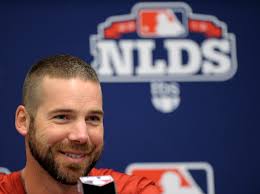 While Carpenter is best known for his work in St. Louis, he actually began his career in Toronto. He arrived in the majors at the same time as a pitcher named Roy Halladay, and the two of them were supposed to anchor the Blue Jays staff for years. Only one of the two delivered on their promise. Across six seasons between 1997 and 2002, Carpenter's ERA was a mediocre 4.83 in 135 total starts. He was unremarkable and injury-prone. In his final season in Toronto, he was placed on the Disabled List three separate times for a shoulder injury and ended up needing surgery. The Blue Jays understandably cut him. He signed on with the Cardinals in 2003, but didn't throw a single pitch that entire season thanks to a torn labrum. It would not have been a surprise if Carpenter never appeared in the majors again.
Instead, somehow, he immediately transformed himself into an ace. In 2004, he turned in the best season of his career. In 2005, he won the Cy Young Award with a 2.83 ERA in 241.2 innings. In 2006, the suddenly-quite-durable Carpenter threw another 221.2 innings with a 3.09 ERA and finished third in the Cy Young voting. He helped the Cardinals win the championship that year with eight shutout innings against the Detroit Tigers in Game 3 of the World Series. He earned a five-year, $65 million contract to stay in St. Louis. It was a stunning rebirth for a pitcher who had been left for dead.
Then it all came crashing down, again. Carpenter pitched six innings on Opening Day in 2007; they were the only innings he would throw all season. Bone spurs in his elbow forced him back under the knife. As he was attempting to return to the mound, it was discovered that he would also need Tommy John surgery, which wiped out most of the following season. Between 2007 and 2008, Carpenter made a total of four starts. Again, it appeared as though his career was in jeopardy.
And, again, he returned from the dead to regain his ace form. His 2009 season, despite the recovery from all those arm troubles, was spectacular. In 192.2 innings he led the league with a microscopic 2.24 ERA and finished second in a close Cy Young race. He went on to surpass the 200-inning mark in each of the next two years. And then came the 2011 postseason, where he left his permanent mark on the game. His Cardinals were massive underdogs in their first-round series against the mighty Philadelphia Phillies. In the decisive Game 5, he went up against Roy Halladay, his former teammate and the best pitcher of the previous decade. Halladay gave up one run in the first inning and nothing else. Carpenter had no margin for error. Here are the highlights from that start:
He ended up throwing a masterful complete-game, three-hit shutout in Philadelphia that ranks as one of the most dominant postseason starts ever. The Cardinals rode all that momentum to the World Series against the Texas Rangers. With that series knotted at three games apiece, Carpenter was tabbed to pitch Game 7. He did so on just three days' rest, even though his elbow and shoulder were at this point held together by string and Scotch tape:
He completed six innings against the best offense in baseball and the Cardinals won the World Series.
Appropriately, Carpenter followed up his stellar 2011 with an injury-plagued 2012. He began the season on the Disabled List and was eventually diagnosed with thoracic outlet syndrome, which was causing dangerous nerve problems in his shoulder. He underwent surgery that involved the removal of one of his ribs and, hit with a six-month recovery time, he was declared out for the rest of the season in July. Of course -- because he's Chris Carpenter -- he was back by September. He made three starts in the playoffs and helped knock off the favored Washington Nationals in the first round.
But now, finally, it seems as though he's run out of pixie dust. He's still experiencing numbness and other symptoms of thoracic outlet syndrome. Forget about his pitching career -- his livelihood could be at stake. The Cardinals have already announced that he's unlikely to play in 2013, which is the final year of his contract anyway. The writing's on the wall: this time, this time, he's definitely finished as a major league pitcher.
So when he's starting Game 7 of the 2014 World Series, try to act surprised.
Saturday, May 19, 2012
Kerry Wood Walks Away
There have been 274 no-hitters in MLB history, and 21 perfect games. Both feats are remarkable. But both require some degree of luck, and both have been achieved by some fluky pitchers (Philip Humber and Dallas Braden most recently, for example). The far rarer feat--one that depends almost entirely on pitching skill rather than fortune--is the 20-strikeout game. It serves as the ultimate barometer of true pitching dominance, and it's been accomplished only four times in a nine-inning game. Roger Clemens, arguably the greatest right-handed pitcher of all time, did it twice. Randy Johnson, arguably the greatest left-handed pitcher of all time, did it too. The only other man to accomplish the impossible feat? The now-retired Kerry Wood, on May 6th, 1998, which doubles as the single best pitching performance in baseball history. Wood was 20 years old at the time and it was his fifth major league start for the Chicago Cubs.
Wood finished that 1998 season with a staggering 233 strikeouts in just 166.2 innings. That 12.6 K/9 is the third-best single-season mark of all time. But then came the arm troubles. He missed the entire 1999 season thanks to Tommy John surgery, and was plagued by frequent DL stints throughout his career. Eventually his injury woes pushed him from starting to relieving, and from relieving to retirement.
That's the most tragic part of Kerry Wood's story: the embodiment of unfulfilled promise, he easily would've been one of the greatest pitchers of all time had his body and mechanics not failed him. Even with all the injuries, Wood still finished his career with the second-best strikeout rate (10.31) and 10th-best hit rate (7.1) of all time among pitchers with at least 1,000 career innings. Hitters couldn't touch him when he was on the mound; he just couldn't stay there long enough.
He remains a walking contradiction to this day. He was beloved as an underdog despite the great talents bestowed upon him. He's the author of the best-pitched nine-inning game in baseball history but will forever be remembered for a disappointing career that fell short of expectations. How fitting, then, that he entered his final appearance on Friday with an ugly ERA of 8.64, yet casually struck out Dayan Viciedo on three nasty pitches to finish his career the same way he started it: dominant.
Subscribe to:
Posts (Atom)