Showing posts with label MLB Playoffs. Show all posts

Friday, October 18, 2013

Chrysler Disapproves of Your Steroid Use

A Chrysler commercial titled "Road to Greatness," featuring Miguel Cabrera, has been airing throughout the MLB playoffs. But it's not just trying to sell you a car -- it's also sending a subliminal message about baseball morality:


So, two things stand out. First, when the voice-over says, "The road to greatness is the same for everyone -- no rest stops, no fast lanes, and definitely no short cuts," this image of a guy holding up a sign appears:


What looks like a Chinese character is probably supposed to be an asterisk. Not coincidentally, the image appears exactly when the voice-over emphasizes the phrase "no short cuts" and the music suddenly becomes ominous. So this has to be a judgmental jab at steroid cheaters like Barry Bonds and Mark McGwire, who apparently have foregone their chance at "greatness" by taking artificial "shortcuts." According to the supreme moral arbiter known as ... Chrysler. How this is relevant is beyond me.

The message is confirmed later in the commercial, in a far more obvious way. The voice-over continues: "It's a road paved with hardship ... and crafted by hard work. That is how true greatness is made." During that last phrase, this image scrolls by:


Very subtle. Roger Maris' home run record was "true greatness," achieved through "hardship" and "hard work." Cheating asterisks Barry Bonds and Mark McGwire, on the other hand, just popped a bunch of short-cutting homer-pills to set their records. No hard work or greatness to be found there.

This tiresome moral lecture is bad enough. But what's truly maddening is the placement of Miguel Cabrera and the Detroit Tigers as the centerpiece of the sermon. The Tigers probably wouldn't even be in the ALCS this year if not for Jhonny Peralta's massive three-run home run in Game Four of the ALDS. Yet Peralta was named in the same Biogenesis drug scandal as the much-maligned Ryan Braun and Alex Rodriguez. He served a 50-game suspension for taking banned substances JUST THIS SUMMER. So yeah, as long as Cabrera and the Tigers are benefiting from Peralta's postseason production, it's hard to take this hypocritical moral indignation -- imported from Detroit! -- too seriously.

On top of that: Chrysler thought it would be a good idea to make a preachy car commercial with Miguel Cabrera as its star ... when Cabrera has a DUI and several other alcohol-related incidents on his record. Here are a few paragraphs from his Wikipedia page:

In the early morning of October 3, 2009, police were called to the Cabrera's home and took Cabrera in for questioning. Cabrera had come home at 6:00am, after a night of drinking at the nearby Townsend Hotel, and got in an argument with his wife. He was seen later that day at a game at Comerica Park, with scratches on his face. Cabrera told reporters that the scratches came from his dog and refused to discuss the matter further. It was later reported he had a blood alcohol level of .26 when tested, which is over three times Michigan's legal limit.

On January 21, 2010, it was reported that Cabrera spent three months in an alcohol abuse treatment center to help him recover from his addiction. He said at the time he had not drunk alcohol since he was taken into custody in October 2009, and that he would continue his treatment into spring training and the regular season.

Television station WXYZ had obtained a police report from an incident the preceding August, in which Cabrera was involved in a verbal altercation with diners at a restaurant inside the Townsend. Witnesses say Cabrera threatened to fight the group outside and indicated that he had a gun. Restaurant employees asked Cabrera to leave and police were called. There was no weapon in Cabrera's vehicle and Cabrera told team officials he did not own one. Cabrera then told team officials he had been dealing with personal issues and got upset, and the diners ended up dropping the matter.

Cabrera was arrested in Florida on suspicion for drunk driving and resisting arrest on February 16, 2011.

Chrysler pretentiously lecturing baseball players on taking "shortcuts" and questioning their "true greatness" is one thing. But doing so while championing a drunk driver as the legitimate standard of greatness, and then using his image to sell CARS, of all things? Talk about undermining your own moral high ground. And hey, speaking of "shortcuts" -- didn't Chrysler get a multi-billion dollar bailout from the federal government just, like, a few years ago? Was that not a "shortcut"?

But hold up, this is getting off track. Let's get back to Chrysler's message, because we cant afford to lose sight of what's really, truly important here: those baseball players who took those drugs that one time.

Monday, October 14, 2013

Beltran, the Greek God of Clutch

His game-tying grand slam in the eighth inning of Game 2 of the ALCS was yet another clutch postseason triumph for David Ortiz. But claiming that Ortiz has the supernatural ability to perform at a higher level in the playoffs ignores the facts:

David Ortiz career OPS: .930
Career postseason OPS: 935

Ortiz has more than his fair share of epic October moments. He is one of only two players with multiple walk-off home runs in the playoffs. His overall postseason performance, however, is almost exactly in line with his overall regular season performance. The 'clutch' reputation ascribed to Ortiz is a product of our minds' tendency to remember the extraordinary (his handful of big hits) and forget the ordinary (his many failures).

This irrational labeling of certain players as 'clutch' is of course not exclusive to David Ortiz. Our need for narrative has pushed that label onto quite a few players from the last few decades of postseason play. And almost none of them truly deserved it:

Derek Jeter career OPS: .828
Career postseason OPS: .838

Bernie Williams career OPS: .858
Career postseason OPS: .850

Reggie Jackson career OPS: .846
Career postseason OPS: .885

Manny Ramirez career OPS: .996
Career postseason OPS: .937

Andy Pettitte career ERA: 3.85
Career postseason ERA: 3.81

Jack Morris career ERA: 3.90
Career postseason ERA: 3.80

There is certainly something to be said for the ability of these players to maintain (and in Reggie Jackson's case slightly improve upon) their regular season performances in the playoffs, given the elite pitching and higher stakes. It is, however, hyperbole to claim that a few players (Ortiz, Jeter, etc.) somehow possess the supernatural ability to elevate their performance to previously-unseen heights just because the calendar reads "October."

Except in the case of Carlos Beltran.

Carlos Beltran career OPS: .854
Career postseason OPS: 1.188

Only five players have a higher postseason OPS than Beltran, and Beltran has more plate appearances than all of them. His career line in the postseason is .340/.448/.740. In 41 postseason games, he has 51 hits, 16 home runs, 34 RBIs, 11 steals without getting caught once, and 29 walks against just 21 strikeouts. In 2004, he tied the record for home runs in a single postseason (eight) despite playing in only two postseason series (just 12 games).

Beltran has been so good in the playoffs that he's earned the 'clutch' label without ever even appearing in the World Series once. Beltran has been so good in the playoffs that he's earned the 'clutch' label despite spending almost 90% of his career with the Kansas City Royals, Houston Astros, and New York Mets. These are impressive feats.

His reputation was muddied for a while after he took a called strike three with the bases loaded to end Game 7 of the 2006 NLCS. But the pitch he took was an Adam Wainwright curveball, and in the seven years since 2006 we have learned that succumbing to Adam Wainwright's curveball is hardly something to be ashamed of. And anyway, Beltran hit three home runs and had an OPS of 1.054 in that series.

In his two-year stint with the Cardinals, Beltran has rebuilt his postseason reputation for the benefit of those who temporarily doubted his powers. Last year, his OPS totals in two series were 1.486 and .964. In the deciding Game 5 of the NLDS against the Washington Nationals, with his team trailing by two in the ninth, he hit a leadoff double that began a four-run series-clinching rally. Most recently, in Game 1 of this year's NLCS against the Dodgers, Beltran hit a game-tying two-run double in the third, threw out the potential go-ahead run at the plate in the 12th, and hit the game-winning walk-off single in the 13th.

Beltran is now two wins away from finally advancing past the NLCS. In a postseason that has already eliminated all potential underdogs, rooting for Beltran to reach his first-ever World Series stands out as a noble rooting cause. Because if he gets there, the destruction he unleashes could be downright biblical.

Tuesday, October 8, 2013

Managers and Mistakes

One of the many quirks of baseball is how little a manager can do to help his team win games. Compared to a sport like football, where coaching is everything, baseball managers don't offer much positive value. Take Joe Maddon off the Rays and they're still a good team; put him on the Padres and they're still a bad team. A manager's most important functions are filling out a lineup card and making pitching changes; the success of those 'strategic' moves are mostly decided by the personnel at his disposal, which a manager does not control. Unless he's batting Delmon Young leadoff, or using Freddy Garcia as an ace reliever, a manager's typical functions don't allow him the opportunity to really hurt the quality of their team.

That's why the collective failures of John Farrell, Don Mattingly, and Fredi Gonzalez on Monday night were so impressive. All three managed to make questionable strategic blunders in their Game 4 matchups, proving that managers really can have a negative impact on their teams -- if you try hard enough.

Mistake 1: John Farrell Gets What He Asked For
Up 2-0 in the best-of-three series, Red Sox manager John Farrell came tantalizingly close to finishing off the Rays in the ALDS on Monday. Game 3 was tied headed into the top of the eighth, and David Ortiz led off the inning with a walk. Farrell decided to pinch-run for Ortiz with Quintin Berry, removing Ortiz from the game. This wasn't a bad decision on its own -- Farrell was playing for the go-ahead run, and Berry is one of the best base-stealers around. In fact, he stole second (though possibly helped by a blown call).

After a groundout, intentional walk, and a strikeout, Stephen Drew was due up with two outs and runners on first and second. Jake McGee, a lefty, was on the mound. Drew has been miserable against lefties this season -- a .196 average and .246 OBP. Fortunately, Farrell had an option on his bench: Xander Bogaerts, one of the top young prospects in the game, a right-handed hitter who could pinch-hit for Drew and replace him at shortstop. But Farrell didn't use him. Drew popped out, ending the inning. Farrell gave up Ortiz for the rest of the game in a gamble to try and score the go-ahead run, but by letting Drew hit against a lefty, he compromised his chances of scoring that run. Why is Bogaerts on the postseason roster if Farrell isn't going to use him in that situation?

The strangeness of that decision was compounded by another one an inning later. The Rays had grabbed a 4-3 lead, so the Red Sox were down to their last three outs in the top of the ninth facing Rays closer Fernando Rodney. The inning began with a five-pitch walk to Will Middlebrooks and a single by Jacoby Ellsbury, putting the tying and go-ahead runs on base. Rodney's control was iffy -- six of his first seven pitches were balls. But then Shane Victorino laid down a bunt, moving the runners over to second and third. If John Farrell instructed Victorino to bunt, then it's absolutely fair to question his judgment.

Because Farrell had already removed his cleanup hitter Ortiz, Boston's chances of winning an extended extra inning game weren't good, especially since they were on the road. The Red Sox should have been trying to win the game in the ninth by scoring multiple runs in the inning. They were in a great situation to do just that, with two runners on, good speed on the bases, a shaky Rodney on the mound, and Shane Victorino and Dustin Pedroia due up. Instead, Farrell chose to give away Victorino's at-bat to play for one run. Even though Victorino isn't a double play risk; even though he's been awesome against right-handed pitching; even though Rodney hadn't yet proven he could actually throw a strike.

Victorino bunted the runners over and a Pedroia ground-out did get that tying run home. But the winning run was stranded when pinch-hitter Mike Carp (batting at the DH spot where Ortiz would have been, mind you) struck out. And the Rays won the game on Jose Lobaton's walk-off in the bottom of the inning.

John Farrell asked for one run. He got exactly one run. Unsurprisingly, he also got a loss.

Mistake 2: Don Mattingly's Bunt Fetish
There might not be any manager in baseball who likes to bunt more than Dodgers manager Don Mattingly. Hopefully, the 8th inning of Monday's Game 4 against the Atlanta Braves will teach him a lesson. (Spoiler: it won't.)

Entering the top of the eighth inning, things were looking pretty grim for the Dodgers. Sure, they were up 2-1 in the series, but they were also trailing by a run with six outs to go in Game 4 against a dynamite Braves bullpen. A loss would mean that the Dodgers had wasted a Clayton Kershaw start on short rest against notable zombie Freddy Garcia with a decisive Game 5 looming in Atlanta. Without a doubt, this was a dire situation.

Yasiel Puig provided a spark by leading off the bottom of the eighth with a double. Juan Uribe was due up next ... and Mattingly apparently asked him to bunt Puig over to third. Now, Juan Uribe is no Shane Victorino. He's not a particularly good hitter. But he's above average, which is more than you can say for the guys following Uribe in the lineup: Skip Schumaker and A.J. Ellis. Both are pretty bad hitters. Uribe was clearly the best chance the Dodgers had at scoring the tying run. And Mattingly wanted to throw away that chance to put the game in the hands of Skip Schumaker and A.J. Ellis. Bad idea.

Fortunately, Juan Uribe is a bad bunter. He failed to put the ball in play twice, taking the bunt off the table. And then he crushed a two-run homer, putting the Dodgers on top 4-3 and sending them to the NLCS.

See, John Farrell? Sometimes, when you let your players hit instead of sacrificing them to the God of Bunts, good things happen.

Mistake 3: Fredi Gonzalez Doesn't Budge
This was easily the least forgivable mistake of the three. Farrell and Mattingly's teams were both ahead in their respective series; Gonzalez's Braves were down 2-1, one loss away from the end of their season. His mistake had far more lasting consequences.

Gonzalez was on the other side of that dramatic Uribe home run. His team was up 3-2, needing six more outs to stave off elimination and force a Game 5 in Atlanta. He brought in setup man David Carpenter to pitch the eighth, not a poor decision considering how good he's been this season. But then Puig led off the inning with a double, and suddenly the tying run was on second and the go-ahead run was at the plate. And with the best short-stint pitcher in the world available to him in the bullpen, Fredi Gonzalez never budged from the dugout.

That's amazing if you think about it. The Braves were up a run in the eighth inning of a game they needed to win, and Craig Kimbrel didn't even face a single batter. Kimbrel is the best relief pitcher in baseball. Over the past two seasons combined, he has a 1.11 ERA with 214 strikeouts and just 66 hits allowed in 129.2 innings. David Carpenter is great, but Craig Kimbrel is better, because Craig Kimbrel is the best.

Still, Gonzalez stuck with Carpenter after the leadoff double to Puig. He's shown a willingness to bring in Kimbrel for a four-out save in the past (he did it in Game 2 of this series, in fact). But needing six outs, in an elimination game, with the tying run on second? In that scenario, Gonzalez refused to summon Kimbrel. To reiterate: had the season been on the line with four outs to go, Kimbrel would've been in the game. But with the season on the line with six outs to go, Kimbrel wasn't an option. That rigid stubbornness lost the Braves the game, as Uribe hit the game-winning two-run homer off Carpenter with Kimbrel watching helplessly from the bullpen.

We traditionally think of mistakes as sudden, unwise deviations from an expected course of action. This mistake wasn't that at all. It wasn't a mental lapse or a brain fart. Quite the opposite: Gonzalez actually adhered to the same bullpen routine he's always followed, the same bullpen routine that got him to the playoffs in the first place -- Carpenter in the eighth, Kimbrel in the ninth. And that right there was the problem. Compared to the regular season, the playoffs are a different beast. Elimination games are a completely different beast. Desperate situations require flexibility; they require creativity; they require the willingness to push your best players to their physical limits, like the Dodgers did by starting Clayton Kershaw on three days' rest. The conservative Fredi Gonzalez showed none of those qualities. Instead, all he had was The Plan. And when The Plan went awry, he was left with nothing.

Monday, October 29, 2012

It's That Time of Year Again

"Did the Oakland Athletics win the World Series? No? Aha, 'Moneyball' has failed yet again!"

Some people actually think like this, including a national columnist for CBS Sports named Danny Knobler, who gave a recent article this gem of a title: "Whether the Giants or Tigers win, Moneyball loses" (this was a few days ago, when the World Series was still in doubt). Click here for a link, if you have sadistic tendencies and wish to read the whole thing (I've just taken relevant excerpts). It goes on to say:

"Two games in, we don't yet have a winner of this World Series, but we already have a loser. It's not the Tigers (yet, anyway). It's Moneyball. If the Giants continue this fun run they're on, Moneyball loses, because if there's one team in the game that's more old school and less Moneyball than anyone else, it's the Giants. Unless it's the Tigers. If the Tigers become the first team since the 1996 Yankees to overcome a two games to none deficit (since then, eight teams have tried but failed), then Moneyball loses, too. And don't think some defenders of old-school scouting aren't watching and celebrating."

There are so very many things wrong with these statements, the most fundamental of which is drawing any kind of meaningful conclusions from the World Series participants. What if the A's make the World Series next year? Would that instantly validate 'Moneyball' strategies as the only way to build a baseball team? No! The playoffs are unequivocally, preposterously random. The Giants wouldn't have gotten to the Series without winning six straight elimination games, four of which were on the road. One loss in those six games and they never make it. The Tigers wouldn't have gotten there without playing in a god-awful division; they didn't even have one of the 10 best records in baseball. If you want to draw conclusions about "right" or "wrong" ways to build baseball teams, use the larger sample size of regular season results. Saying that 'Moneyball' doesn't work because "anti-Moneyball" teams got to the World Series in one random year is like saying that Duke and UConn are bad basketball programs because they lost in the first round of the NCAA Tournament last year.

Now, we get to the really juicy stuff:

"For almost a decade now, ever since the Michael Lewis book that sold plenty of copies and sold plenty of fans on the idea that the A's won games because of a better use of computers, the old school/new school debate has been baseball's hottest."

Is that the worst sentence ever written? I mean...it's certainly up there, right? If you read/saw Moneyball and came away from that book/movie and thought it was about "how the A's won games because of a better use of computers"...man, I don't even know.

For the rest of this article, Knobler operates under the premise that Moneyball was about a baseball team eschewing old-school scouts in favor of computers and advanced statistics. In a micro sense, that's true. But really, that premise is wrong. The Moneyball philosophy was about a low-payroll team trying to find market inefficiencies in order to field a competitive roster. At the time, Beane's scouts were overvaluing certain attributes (speed, defense, bunting) and undervaluing others ("bad-body" athletes, on-base skills, advanced statistics). Beane responded accordingly. As markets shifted to compensate, those inefficiencies changed over time. The landscape is completely different today! Billy Beane's team in 2012 was built on speed and defense, skills he might have scoffed at a decade ago! But writers like Knobler can't seem to understand that Beane and other progressive front offices aren't ideologically wedded to stuff like sabermetrics and on-base percentage. Those were tools used in the execution of a broader strategy, NOT the strategy itself. The tools have changed. Why am I wasting my time.

"The divide within the game never was as great as it was portrayed. The A's and other 'Moneyball teams' rely on scouting (without it, the A's never sign Yoenis Cespedes). The Tigers and Giants and other 'old-school' teams hire smart young guys who can analyze the numbers coming out of their computers."

Yes! Exactly! This is reasonable! Every front office uses a variety of different methods, ranging all across the "Baseball Ideas" spectrum. Because it would be silly not to use as many strategies to gather as much information as possible. Why does the rest of this article exist, then?

"But if it's not black and white, there are quite a few variations of gray, with the Tigers and Giants at one end of the scale and Moneyball as a concept at the other."

Knobler: "So the divide within the game was exaggerated, a balance of ideas exists, and it's not black-and-white." [realizes he now has nothing more to say and his article is effectively over] "Oh no wait, it's actually very polarizing, and let me explain why..."

"While the Tigers front office uses statistics as part of the evaluation process, 'it's not going to make the decision for us,' Dombrowski said. 'For some teams, it does.'

Giants general manager Brian Sabean said the same thing. The Giants front office wants all the information it can get, but would never make or reject a possible deal simply because of something they saw in the numbers."

There's two ways of looking at these comments.
1. Who in the heck bases their decision-making solely on numbers?
2. Who in the heck never uses numbers in their decision-making?

There obviously has to be a balance between statistics and scouting in front offices, a balance that Knobler has already admitted exists, yet ignores. Suggesting that executives in 'Moneyball' front offices are robots who pour data into Excel spreadsheets and make their decisions based on the numbers their computers spit out is preposterous. It's a straw man argument. I'm surprised that Dombrowski is playing along with this crap. Then again, this is the same guy who decided it would be a great idea if he could get Delmon Young to be his DH and hit in the 5-hole.

"Most decisions both these teams make come out of a strong belief about a player by one scout or another.

'You can't eliminate the human element of the game,' said Scott Reid, who has long been in charge of Dombrowski's pro scouting staff."

Because if it were up to Billy Beane, baseball wouldn't have a human element. It wouldn't even be a human game. Ideally, it wouldn't be "played" so much as "simulated" between opposing computer programs that could reduce the entire season to 0.074 seconds, with the "winner" receiving some terse congratulatory handshakes before retiring to his mother's basement for the winter.

"Scott Reid has worked with Dombrowski for 20 years. Dick Tidrow has been with Sabean for nearly that long, and Paul Turco has been with him even longer. They're exactly the type of guys who were most offended by the portrayal of scouts in Moneyball."

That's so weird, because Hollywood is usually so good about portraying real-life people and events with stunning accuracy.

"They're exactly the type of guys who are most satisfied to see a 2012 World Series involving two teams that lean the other way. 'We've always tried to stay up with the times,' Reid said. 'The sabermetric stuff has been great for the game. It's great for the fans. But it's information based on past performance. It does sometimes verify what your eyes and your scouting people are seeing.'

Ohmygod ohmygod ohmygod. "Sabermetric stuff"--or, "numbers," to the rest of us nerds--DOES verify what your eyes are seeing. That's what numbers do. That's why they exist. To quantify and record what our eyes see, because our minds can't remember every single data point. Eyewitness testimony absolutely has its uses. It's also unreliable because its subject to the whims and biases and other shortcomings of the brain. Numbers attempt to remove that human flaw and just record facts. But apparently they're worthless because all they're based on is "past performance." What good could they possibly do?!

"But when there are conflicts, the Tigers and Giants are more likely to trust their eyes and their scouts.

This year, the eyes are winning."

No, my eyes lost. They had to read this garbage.

Wednesday, October 24, 2012

3 Keys to the World Series

1. Barry Zito's Left Arm
Here's a misleading statement: Game 1 of the World Series will be a matchup of two former Cy Young winners. One of them is Justin Verlander, but the other is Barry Zito. Barry Zito, Game 1 starter for the San Francisco Giants in the World Series. This guy didn't even make the Giants' playoff roster when the Giants won it all two years ago. Zito's fastball is slower than the majority of Justin Verlander's pitches, and that isn't hyperbole. His fastball averaged 83.7 miles per hour this year, the slowest in baseball except for R.A. Dickey, who throws knuckleballs for a living. Verlander's changeup averaged 86.7 mph and his slider averaged 84.6 mph. Barry Zito isn't very good at pitching.

The cool thing about baseball is that Barry Zito might still beat Justin Verlander despite everything we know about these two pitchers. Imagine this actually happened. People would still claim that you can predict this sport! They would look very silly!

Fun Fact About Barry Zito: He made only made $1 million less than Justin Verlander in 2012. That wasn't a clerical error!

A Second, Almost-As-Fun Fact About Barry Zito: Take a gander at this post-Game 7 celebration photo:


That sleazy, hairy man with an 84-mph "fastball" on the far right? Barry Zito. Immediately to his left? Barry Zito's wife. What's up with that?

2. Delmon Young's "Glove"
Games 1 and 2 of the World Series will be played in San Francisco (because, if you remember, Melky Cabrera's testosterone helped win the All-Star Game), as well as potential Games 6 and 7. In the Giants' National League park, there won't be a DH, leaving ALCS MVP Delmon Young with nowhere to play. Because Tigers manager Jim Leyland has some kind of obsession with Young, he'll probably stick him in left field, which--and I can't stress this enough--would be a good thing for an audience searching for comic relief, but a bad thing for the Tigers' chances of winning baseball games. Left field at AT&T Park is very spacious. Among players who had at least 220 innings in left field (Young had 226, presumably as part of some cruel social experiment), Delmon Young was the worst defender of them all. Worse than well-known corpses like Bobby Abreu and Raul Ibanez and Jason Bay. A visual representation of Young's defensive skills:


You'd better hit like Barry Bonds if you field fly balls like that. Unfortunately, Delmon Young is the closest thing to the opposite of Barry Bonds. He walked 20 times all year. ALL YEAR. Barry Bonds was intentionally walked more than 20 times in 15 different seasons. Young swung the bat a greater percentage of the time than any other player in baseball (More than Josh Hamilton! Almost 60% of the time!). Only Alexei Ramirez had a lower walk rate than Young. Etc etc.

The point is: regardless of the fact that the Yankees couldn't get him out, Delmon Young is a bad hitter, and certainly isn't worth taking a massive defensive penalty in left field for a few games. The Tigers have a number of solid outfield options, including Andy Dirks and Quintin Berry and Avisail Garcia. Any of them would be a better World Series left fielder than Delmon. We're going to see Delmon out there anyway. So strap in.

Fun Fact About Delmon Young: He's walked 145 times in his six-plus-year career. Barry Bonds once walked 232 times in a single season.

3. Buster Posey's Bat
Buster Posey is probably going to win the National League MVP award, even though he looks like a 12-year-old in a Giants jersey who happened to wander into the Giants dugout while his parents were buying him a Pepsi:


Despite being his team's best hitter, Posey actually hasn't done much in the postseason so far. He has eight hits in 12 postseason games, and didn't have an extra-base hit against the Cardinals in the NLCS. He's a crucial lineup cog for the Giants. In front of him, Angel Pagan, Marco Scutaro, and Pablo Sandoval have been wreaking havoc, so he'll have plenty of chances to hit with runners on base. If he doesn't come through in those situations, he's followed in the lineup by Hunter Pence, who has shown no ability to knock runners in (except apparently when a pitch breaks his bat, hits the shards three times, and squirts away from the shortstop into the outfield). The Giants are leaning heavily on Barry Zito, so obviously they'll need to score some runs. Posey needs to be a huge part of that.

Fun Fact About Buster Posey: He's the only player currently in the Giants' starting lineup who also started for the team in the 2010 World Series. That 2010 lineup: Andres Torres, Freddy Sanchez, Posey, Pat Burrell, Cody Ross, Aubrey Huff, Juan Uribe, Edgar Renteria. It's amazing that the Giants have completely turned over every offensive position except catcher since 2010, yet they're back in the World Series.

So, Who Wins?
Head says Tigers, heart says Giants. The Tigers have a more powerful lineup and a better rotation that's rested and ready to go, but they also have the onus of Delmon Young. The Giants have the better bullpen, defense, and more speed, but the onus of Barry Zito. I'll pick the Tigers to win in six. But the team with Buster, The Freak, The Panda, SCU-TA-RO, Vogelsong, and the Enigma Known As Barry Zito is just a lot more fun.

Friday, October 19, 2012

Maybe Come Up With a New Angle?

Joe Posnanski is a fairly prominent sports writer who, like many other sports writers at the moment, has written a lengthy piece on the end of the Yankees' season. Except that it's not a eulogy on the Yankees' season; it pronounces the end of the Yankees dynasty (specifically, the Jeter Era). It includes hyperbolic gems like:

"The Yankees still have money, and they still have talent, and they still have history. Derek Jeter will come back, so will some other stars, and others will be found. I have little doubt that the Yankees can still win. But they will never be the same. Rome has fallen."

This is what I don't get. The Yankees have won one championship in the last decade. That isn't a dynasty. That isn't Rome. Rome won the World Series every year, because they were Rome and that was the deal. There's no Rome in baseball. Only one team has won multiple championships in the last decade (Red Sox, with two). That's not "Roman Empire." That's "Congress of Vienna." Balance of power. Parity. I know that it's fun pretending the Yankees still have a "dynasty" so that we can pronounce it dead every year, but there's no such thing as a postseason dynasty in baseball anymore. The playoffs are too random.

"The Yankees aren't the Yankees anymore."

...no, by definition, they kind of are.

"Oh, they might win again. They might, like the Six Million Dollar Man, rebuild faster, stronger and more powerful. They have the money. They have the clout. But this is the point: It won't be this Yankees team."

...right, because this Yankees team...was just...eliminated? So, like, it physically can't be this Yankees team. Glad we're clear on how "sports" works.

"But it wasn't just a team going into a slump. It is a team at war with itself."

I love hyperbole just as much as the next cat but sheesh come on.

"I'm thinking the best the Yankees can hope for is that the U.S. Government will declare them too big to fail."

Hahahaha! Get it?! Financial pun! High-five!

"And now, for the first time in almost two decades, the New York Yankees have no idea what happens next. Just like the rest of us."

Here's the problem: I've read this article before, or some variant of it, every year. Every October that doesn't end in a Steinbrenner holding up the World Series trophy inevitably results in sportswriters pronouncing the Yankee dynasty dead, pining for the old days of Posada and Williams and Brosius and O'Neill and Torre. I'm tired of reading it. Either the Yankees dynasty IS gone, in which case there shouldn't be any more words wasted on the subject, or it's reborn every April only to die every October, which makes it a seasonal dynasty and I don't really know how those work.

Anyway: Posnanski's article gets written every single year, just with the words rearranged in a different order. The following excerpt is from an article in the New York Daily News on October 6, 2002:

Yankee Year Goes To Heck, Dynasty Reaches End Of Road As Angels Rejoice
-Anthony McCarron
"Some Yankees seemed stunned at the team's three-games-to-one loss in the AL division series. But others knew that the Yankees had been outhit, outfielded and, most importantly, outpitched in making their earliest playoff departure since 1997, the last year they didn't reach the World Series...This is certainly not the ending George Steinbrenner had envisioned when he and his lieutenants put together a team and paid $140 million for it."

Then the following year, October 26 2003, Los Angeles Times:

The Fish That Ate New York
-Bill Shaikin
"Beckett's five-hit shutout gives the Marlins a 2-0 Game 6 victory for their second title in seven years and may signal end of an aging Yankee dynasty...The Yankee Stadium ghosts are out of business."

Two years later, October 12 2005, New York Times:

Angels kill Yankees softly in playoff decider
-Tyler Kepner
"The Yankees spoiled themselves, their fans and their principal owner by winning four championships in five seasons through 2000. But the glory years are gone, fading deeper into memory each fall. Now, they have gone five years without one...All of the millions for all of the mercenaries could not wake the dynasty from the dead."

Two years after that, October 8 2007, ESPN.com:

Consider the Yankees dynasty officially over
-Howard Bryant
"The old dynasty finally fell, and for good Monday night in the Bronx...The dynasty is over in New York, giving way to age and time, and nothing could revive it...The dismantling of the dynasty will surely follow, and finally, but not without some degree of melancholy, the old building faces the wrecking ball...And perhaps it is time, for all dynasties ultimately crumble and decay, and losing to the Indians seemed as much a disappointment for the Yankees as it was the recognition that they have witnessed the end of something larger, something grander...In New York, even a dynasty needs to be told when to say goodbye."

A year later, September 24 2008, New York Daily News:

Dynasty's slow demise bottoms out with Yankees' September swan song
-Mike Lupica
"It had to happen eventually and now it has, because this Yankee team, even wounded, did not measure up in so many ways...Another Yankee team to go in with the first-round losers of the last three years...Alex Rodriguez, for all his gaudy numbers, did not have a good season, did not ever carry the team, was a bigger stick for the tabloids than he was for Girardi...Robinson Cano played an entire season looking as if his head were up in the clouds. Or somewhere. The Yankees say they don't want to move him. Think about something: Just think about how everything looks in the AL East if the Yankees had Dustin Pedroia playing second for them this season instead of Cano."

(side note: it's interesting that, four years later, the scapegoats are still the same: A-Rod (choker) and Cano (lazy) aren't True Yankees because they aren't as gritty and scrappy and gutsy as small white guys like Dustin Pedroia or Derek Jeter).

So Joe Posnanski isn't writing anything new. He's recycling the same old hackneyed garbage. How many times will the "Dynasty" have to die before we can stop hearing about it? I'm afraid of the answer.

Tuesday, October 16, 2012

One of the Many Benefits of Being Justin Verlander

It's fairly common practice for baseball's elite starting pitchers to get more favorable ball/strike calls from umpires. This is especially true for Justin Verlander, the best pitcher in baseball. As you might imagine, Justin Verlander is already a very good pitcher without getting the benefit of the doubt from umpires, because he is Justin Verlander, someone who has won the Most Valuable Player Award as a pitcher, which is a very difficult thing to do. So when Justin Verlander does get a favorable strike zone from the umpire--regardless of whether or not he needs it--well, there's not much you can do as a hitter except go through the formalities of your official at-bat and forget about acquainting yourself with first base.

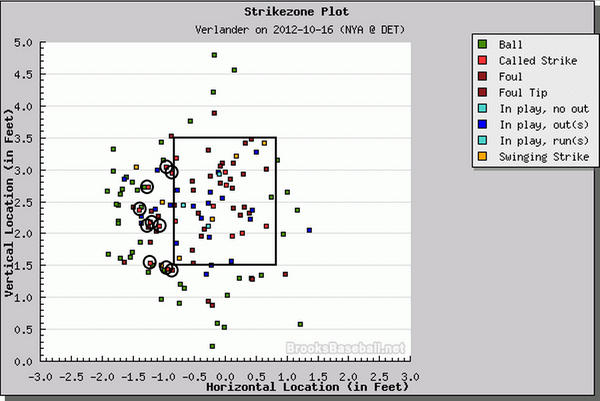
On Tuesday night, Verlander carried his Detroit Tigers to a 3-0 series lead on the New York Yankees by pitching into the ninth inning and only allowing three hits and one run. He also did not walk anybody. This is an impressive feat, because even though the Yankee are currently mired in an epic offensive slump, they are still the Yankees, and they tend to take a lot of walks regardless of other factors. Below is the strike zone Verlander got from the home plate umpire, depicted from the catcher's perspective; the red squares are called strikes, green squares are balls. Circled are the pitches that were called strikes by the umpire, but were in reality, as we can see, out of the strike zone:


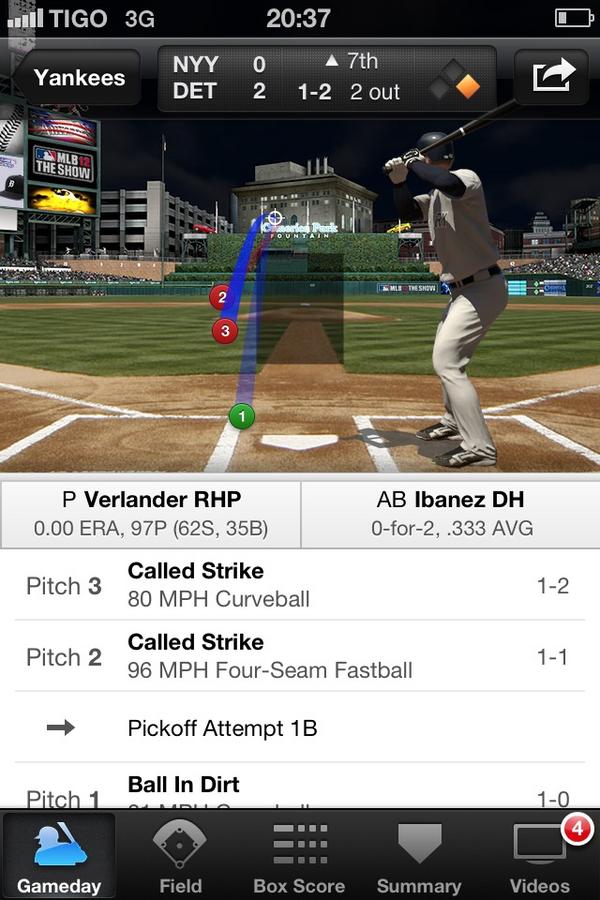
Seven of the nine Yankees facing Verlander were batting left-handed, and thus were standing on the right-hand side of the above image. On top of having to contend with Justin Verlander, which is difficult enough on its own, they had to contend with a home plate umpire who consistently called pitches several inches off the outside part of the plate as strikes. That is, as they say, a tall order. Below is an example of how this challenge manifested itself: a seventh-inning at-bat between Verlander and Raul Ibanez, the latter of whom represented the tying run for the Yankees with two outs:


The first pitch, as the image shows, was some sort of breaking pitch in the dirt that Ibanez laid off of, making the count 1-0. Ibanez could then expect to be thrown a fastball in the zone--a potentially tasty pitch for a dead-red fastball hitter like Ibanez. Verlander did throw a fastball, but at this point he knew he did not have to actually throw it as a strike for it to be called a strike. He threw two pitches Ibanez couldn't do anything with, a fastball and a curveball off the plate, and both are called as strikes. The count is suddenly 1-2 even though Ibanez would see it as 3-0. Ibanez would ground out weakly to first to end the inning.

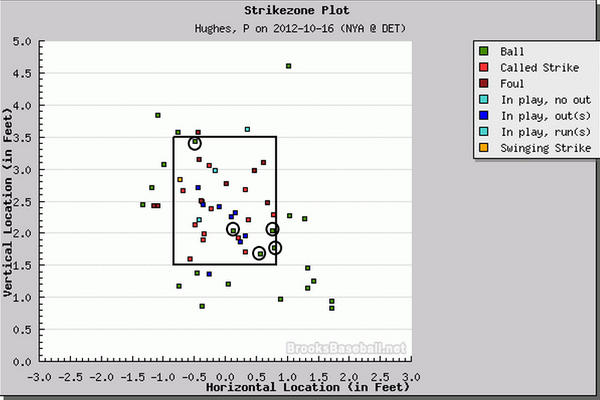
Did the starter opposite Verlander, Phil Hughes, reap the same benefits of an expanded strike zone? Not really. In fact, the opposite. Below is Hughes' strike zone. The circled green dots are pitches thrown by Hughes that were within the strike zone, but were nevertheless called as balls by the umpire:


So based on this, five of Hughes' 61 pitches (8%) were balls that should have been called strikes. Verlander was not squeezed in the same way: another brief skim of his strike zone above shows that just one of his 132 pitches (0.7%) was a ball that should have been a strike. Conversely, 10 of Verlander's pitches that were off the plate were called strikes anyway. Not once did Hughes get a call like that in his favor.

While Justin Verlander was getting called strikes several inches off the edge of the plate, Phil Hughes threw one pitch almost down the middle of the strike zone that was called a ball. This is not to say that Verlander is actually a worse pitcher than we think, or that Hughes is a better pitcher than we think. This is just to say that the home plate umpire can sometimes make the job a little easier for the Justin Verlanders of the world, an advantage they hardly even need, and the home plate umpire can sometimes make the job a little tougher for the Phil Hugheses of the world, a disadvantage they hardly they can afford.

Saturday, October 13, 2012

Previewing Week 6

Joint baseball/football edition!

MLB Playoffs

Giants vs Cardinals: Both teams seem to have nine lives. The Cardinals rallied from a 6-0 deficit to beat the Nationals in Game 5 and the Giants won three straight in Cincinnati after losing the first two games at home. The fact that both teams had to play five games in the Division Series has misaligned their starting rotations, but that might hurt the Giants more because they're more reliant on one guy, Matt Cain, than the Cardinals are. Plus, the righty-heavy St. Louis lineup will make life tough for lefty San Francisco starters Madison Bumgarner and Barry Zito (if he gets a start). Why pick against the Cardinals at this point?
Prediction: Cardinals in six games.

Yankees vs Tigers: Another evenly matched series. The Tigers might have the inferior bullpen but their hitters aren't in as deep of a funk as the Yankees'. Detroit also caught a break in the scheduling: even though both teams had to play five games in the Division Series, and the Yankees are the higher seed, the Tigers got an extra day off to set their rotation while New York must play five playoff games in five days. That means Hiroki Kuroda will be starting on short rest in Game 2. C.C. Sabathia will also need to pitch on short rest once if he wants to make two starts in the series, while his Tigers counterpart Justin Verlander will be fully rested for both Game 3 and a potential Game 7. The pitching matchups, and the different places these two offenses are in right now, favor Detroit.
Prediction: Tigers in six games.

NFL Week 6

Last week's predictions: 10/14
Season tally: 47/77, 61%

Cincinnati Bengals (-2.5) @ Cleveland Browns
The Browns are still winless despite what seems like steadily improving play from rookie quarterback Brandon Weeden and rookie running back Trent Richardson. It feels like they're due for a win already. The Bengals, meanwhile, looked pretty anemic in a loss at home (!!!) to the Dolphins. This is your shot, Cleveland!
The pick: Browns "improve" to 1-5.

Indianapolis Colts @ New York Jets (-3.5)
Really can't fathom why the Jets are favored in this game. Maybe just because they played the Texans tough on Monday night. Still, they're going up against a suddenly-dangerous Colts team that just beat the Packers. And Mark Sanchez is still Mark Sanchez.
The pick: Colts pull off the "upset."

Kansas City Chiefs @ Tampa Bay Buccaneers (-4)
Easily the ugliest game of the week. Brady Quinn is starting in place of an injured Matt Cassel (which might not actually be a downgrade...) and both teams have been embarrassing. Watch if you enjoy punting.
The pick: Chiefs.

Oakland Raiders @ Atlanta Falcons (-9.5)
Mismatch of the week. There may not be a wider discrepancy in football between the Falcons dynamite passing game and the Raiders sad secondary. Enjoy the feast, Falcons.
The pick: Falcons.

Dallas Cowboys @ Baltimore Ravens (-3)
A nice test for the Cowboys, especially for their revamped pass defense. Contending with Joe Flacco is much more difficult when he's playing at home. The Cowboys desperately need a big win but they just might not be very good after all.
The pick: Ravens.

Detroit Lions @ Philadelphia Eagles (-3.5)
Apparently the Eagles' strategy for winning games is to give the football away for most of the game, take the lead on their final possession thanks to an ugly fourth-quarter drive, leave enough time on the clock for the other team to drive down the field, and pray that their kicker misses the uprights as time expires. It's worked for two straight weeks. But goshdarn if it just doesn't feel like a winning strategy.
The pick: Lions.

St. Louis Rams @ Miami Dolphins (-4.5)
A sneaky-interesting game between two bad teams that are actually less bad than we thought. Speaking of 'less bad than we thought': Dolphins rookie QB Ryan Tannehill. Lost in the Luck/RGIII frenzy, he's been quite decent.
The pick: Dolphins.

New England Patriots (-3.5) @ Seattle Seahawks
Oh, this has upset written all over it. The Seahawks defense has been brutal to opposing quarterbacks. But the Patriots offense is no longer one-dimensional. Their ability to lean on their new running game should prove to be the difference.
The pick: Patriots.

Buffalo Bills @ Arizona Cardinals (-4)
This could rival Chiefs-Bucs as the ugly game of the week. The Bills have been a complete mess. But the Cardinals have no offensive line. But the Bills can't stop anyone. But the Cardinals might have the worst running game in football. And so on.
The pick: Edge goes to, I suppose, the better defense. And the home team. Cardinals.

Minnesota Vikings @ Washington Redskins (-1.5)
This line makes even less sense than the Colts-Jets spread. The Redskins defense has been a joke while the Vikings have been one of the best all-around teams in football so far. And Robert Griffin III suffered a concussion last week. Minnesota obviously still isn't getting any respect.
The pick: Vikings.

New York Giants @ San Francisco 49ers (6.5)
This isn't the same 49ers team that the Giants beat in last year's NFC Championship Game. This team has a much more competent passing game and an even better rushing attack. The Giants can absolutely win this game because they're never out of it with Eli Manning under center. It'll just be very difficult.
The pick: 49ers.

Green Bay Packers @ Houston Texans (-3.5)
One of the more even matchups between a 2-3 team and a 5-0 team. The Texans have played a cupcake schedule so far and certainly aren't "best team in football" good. But are they good enough to beat a Packers team that just hasn't hit its stride yet? Certainly. Along with Giants-Niners, this is a must-watch: top quarterback against top defense.
The pick: Texans.

Denver Broncos (-1) @ San Diego Chargers
Peyton Manning is back on Monday Night Football and this game should end in a better result than his three-interception Falcons debacle. The Chargers just lost to the awful Saints (a winless team with an interim-interim-head coach); their 3-2 record is a nice little mirage.
The pick: Broncos.

Wednesday, October 10, 2012

Twitter Reacts To What Happened Last Night

Every once in a while, baseball has one of THOSE nights. Last year, it was Game 162, and the David Freese Game in the World Series. This year, it was last night. Because it is impossible to capture with words what happened in the wee hours of Wednesday night and Thursday morning, here are some select real-time reactions from Twitter that do a much better job of showcasing raw emotion and shock than postgame recaps or SportsCenter segments.

First: Orioles-Yankees, Game 3, around midnight.


Second: Tigers-Athletics, Game 4, around 1 A.M.


Four more games on Thursday, but they'll have to work hard to top this.

Tuesday, October 9, 2012

Please Ignore Facts and Stick to Narrative

Carlos Beltran of the St. Louis Cardinals clobbered two home runs in a rout of the Washington Nationals on Monday, helping his team tie the Division Series at one game apiece. Beltran is no stranger to postseason heroics: he famously parlayed his 2004 playoff explosion (8 homers in 12 games!) into a huge contract with the New York Mets. As Beltran's second Monday homer left Busch Stadium, baseball insider and CBS Sports writer Jon Heyman had this to say on Twitter:
Heyman is probably referring to one specific moment of Beltran's playoff career with the Mets: Game 7 of the 2006 National League Championship Series, when Beltran came to the plate in the bottom of the ninth with the bases loaded and his team trailing 3-1. Beltran famously struck out looking on an Adam Wainwright curveball and the Mets were eliminated.

So because Beltran didn't come through in that moment, he was a playoff choker with the Mets. Never mind that Beltran actually scored the Mets' only run of the game. Never mind that Beltran's OPS during that seven-game series was 1.054, and he hit three home runs. Never mind that in the previous series, when the Mets swept the Dodgers, Beltran reached base in half of his 14 plate appearances. Never mind that Beltran is one of the greatest active postseason players with a line of .362/.478/.819 and 13 home runs in 25 career playoff games. He failed that one time, so he couldn't have been very good after all.

Beltran's career is still defined by this one moment in one postseason at-bat, and for people like Heyman, that one moment clouds all of his other accomplishments. When Beltran's name appears on the Hall of Fame ballot, Heyman might not vote for him in part because of the looming specter of that one bad postseason moment. On the flip side, Heyman is more sympathetic to players like Jack Morris because of one great postseason moment. Yet in a vacuum, Morris making the Hall and Beltran missing it would be a joke.

Truthfully, Carlos Beltran shouldn't need another signature postseason moment to erase the memory of that one strikeout in 2006. But for his sake, I'm kind of hoping he gets one anyway.

Friday, October 5, 2012

Previewing Week 5

A joint baseball/football edition!

MLB Playoffs

Reds vs Giants: This looks like the most evenly-matched playoff series of the first round. Both teams have strong bullpens and solid lineups. Each has two great starters, but question marks after that. The Reds are probably stuck starting Bronson Arroyo and the Giants must choose between Barry Zito and Tim Lincecum (no right answer). San Francisco gets the slight edge because they're throwing their two best pitchers (Matt Cain and Madison Bumgarner) at home in the first two games.
Prediction: Giants in 5 games.

Nationals vs Cardinals: It's offense against pitching. The Cardinals won a similar matchup in the wild card game, as well as a similar first-round series against the Phillies last year. The Nationals' top young pitchers seem to be wearing down after big workloads. And with Kyle Lohse, Adam Wainwright, and a healthy Chris Carpenter, it's not like the Cardinals don't have aces of their own.
Prediction: Cardinals in 4 games.

Yankees vs Orioles: Teams in the same division are now allowed to face each other in the first round. so these two know each other well after splitting 18 regular season games. They're the two best home-run hitting teams in the majors, so there should be some runs scored. The Yankees hope their edge in starting pitching (not even the Orioles are sure what their rotation looks like) will keep leads away from Baltimore's near-perfect bullpen. A huge factor will be Jason Hammel's knee; if healthy, he's the O's best pitcher.
Prediction: Yankees in 5 games.

Athletics vs Tigers: Probably the most intriguing matchup of the first round. It also seems like the most lopsided: the well-paid superstars against the no-name rookies. Yes, there's no question which team is more talented. But I think Jarrod Parker outduels Justin Verlander in Game 1 (go look up Verlander's postseason stats, or you can take my word for it when I tell you they aren't good). The A's can then return home just needing to win two out of three to advance. Oakland has a better bullpen, the deeper lineup, and superior defense. They can pull off the upset.
Prediction: Athletics in 5 games.

NFL Week 5

Last week's predictions: 11/15
Season tally: 37/63, 59%

Atlanta Falcons (-3) @ Washington Redskins
Should be a thrilling duel between perhaps the two best quarterbacks of the first four weeks: Matt Ryan and Robert Griffin. Still, Atlanta should be favored by more than three points; it's hard to imagine the porous Redskins defense stopping the Falcons' attack. Atlanta won't need its punter very much.
The pick: Falcons.

Philadelphia Eagles @ Pittsburgh Steelers (-3.5)
The Eagles are probably the least-scary 3-1 team ever, except for perhaps the Cardinals (and the Eagles lost to them). The Steelers are coming off a bye, getting healthier, and Ben Roethlisberger has looked unstoppable in the early going.
The pick: Steelers.

Green Bay Packers (-7) @ Indianapolis Colts
It's stunning that the Packers aren't favored by more than 7 points. This Colts defense gave up a game-winning drive to Blaine Gabbert last week. He plays for the Jaguars. Packers roll.
The pick: Packers.

Cleveland Browns @ New York Giants (-8.5)
Last week, the miserable Browns secondary made Joe Flacco look like Eli Manning. So by the transitive property, the miserable Browns secondary will make Eli Manning look like...who? Mike Trout?
The pick: Giants.

Baltimore Ravens (-6.5) @ Kansas City Chiefs
The home field advantage of Arrowhead used to mean something. Just not when the Chiefs suck.
The pick: Ravens.

Miami Dolphins @ Cincinnati Bengals (-3)
So there's nothing much to say about this game except that neither of these football teams are very good football teams.
The pick: Bengals.

Tennessee Titans @ Minnesota Vikings (-5.5)
People are starting to realize that the Vikings are one of those sneaky-good teams. The overmatched Titans defense can't possibly stop dual-threat QB Christian Ponder, two electric wide receivers (Percy Harvin and Jerome Simpson), a red-zone beast (Kyle Rudolph), and oh yeah, Adrian Peterson.
The pick: Vikings.

Seattle Seahawks @ Carolina Panthers (-3)
Tempted to go with the Seahawks. But they're a different team away from Seattle and the odds of Russell Wilson outscoring Cam Newton are too low.
The pick: Panthers.

Chicago Bears (-5.5) @ Jacksonville Jaguars
The Bears defense handled Tony Romo pretty well on Monday night; Blaine Gabbert shouldn't pose too much of a problem. Disclaimer: this is in no way an endorsement of Jay Cutler.
The pick: Bears.

Denver Broncos @ New England Patriots (-6.5)
Six-and-a-half points seems to put too much stock into the Patriots. One bad quarter in Atlanta and everyone jumps off the Peyton Manning bandwagon? If I was picking against the spread, I'd feel very confident in taking the Broncos. Straight-up, I'll have to stick with the Pats. Like every Manning-Brady duel, this will come down to the fourth quarter.
The pick: Patriots.

Buffalo Bills @ San Francisco 49ers (-9.5)
Ryan Fitzpatrick is very, very generous when it comes to interceptions. The 49ers should force too many turnovers for the Bills to move the ball effectively. And why fear the Bills defense that allowed 52 points to the Patriots last week?
The pick: 49ers.

San Diego Chargers @ New Orleans Saints (-3.5)
On Monday Night Football, against the totally-unpredictable and not-as-good-as-their-3-1-record Chargers, this feels like the Saints' first win. They almost beat the Packers last week. They can't stay winless forever, right? Right?
The pick: Saints.

Picking the Wild Card Winners

Orioles Over Rangers

This pick makes absolutely no sense, for the following reasons:
1) The game is in Texas
2) The Rangers are starting Yu Darvish, who is filthy-good
3) The Orioles are starting Joe Saunders, who is filthy-bad, especially against right-handers
4) The Rangers' lineup is primarily right-handed

But the whole Orioles season doesn't make sense. Why should reason get in the way now?

The O's have a significant strategic advantage over the Rangers because Buck Showalter is a great tactician and Ron Washington is whatever the opposite of a great tactician is. Joe Saunders is probably going to get rocked, and Showalter isn't stupid. At the first sign of trouble, he'll have no qualms about yanking Saunders and handing the game over to his excellent bullpen. From that moment on, the Orioles will have the advantage. In the middle and late innings, the game could come down to pitching changes, pinch-hitters, and platoon advantages, and Showalter will out-maneuver Washington in this department.

If I was Showalter, I would have Saunders start but only pitch to the first three hitters (so his ultimate job is to retire Josh Hamilton). Then I'd bring in Steve Johnson, a right-handed starter, to go a couple innings. Ron Washington will certainly stack his lineup with righties against Saunders, so bringing in Johnson counters that move. It forces Washington to either give up the platoon advantage for the first half of the game, or burn his pinch-hitters early. This should stunt the Rangers' offense. Then Showalter can mix and match with his great bullpen for the final five or six innings.

The point is that Joe Saunders is extremely unlikely to pitch well tonight. But Showalter is the kind of manager who won't be timid about taking him out early if necessary. After all they've done, why pick against the Orioles now?

Orioles advance in a high-scoring, home-run-happy thriller.

Braves Over Cardinals

I give Braves manager Fredi Gonzalez a lot of credit (despite being known as the Ron Washington of the National League) for making two tough lineup decisions in advance of this do-or-die game.

For one, he chose to start the less-proven (but completely dominant) Kris Medlen in this game as opposed to experienced veteran Tim Hudson. A lot of managers would defer to the 'guy who's been there before.' Medlen is the better choice and Gonzalez got it right. In twelve starts this season, his ERA is 0.97. That's insane.

Gonzalez also chose to bench his struggling starting catcher, Brian McCann, in favor of backup David Ross. This would've been considered unthinkable a few months ago. But McCann is struggling through a shoulder injury so Gonzalez is going with the superior defender in what should be a low-scoring affair. A tough decision, but again, the right one.

The Cardinals are starting Kyle Lohse, a right-hander, who has been spectacular this season. He also doesn't have much of a platoon split, so the fact that the Braves are very left-handed won't matter too much. It could, however, matter in the late innings when Lohse is gone. The Cardinals don't have a shutdown left-handed reliever, which will be a problem against Michael Bourn, Jason Heyward, Freddie Freeman, and switch-hitters Martin Prado and Chipper Jones.

The Braves, on the other hand, have the best reliever in baseball: their closer, Craig Kimbrel. The Cardinals aren't going to score on him. In fact, if Fredi Gonzalez is willing to use Kimbrel for two innings, and Medlen goes seven, the Cardinals will be trying to score against the two most unhittable pitchers in baseball right now. The fact that the Braves also have one of the best defenses in baseball makes them masters of preventing runs.

And the fact that the Braves have Chipper Jones karma...well, that doesn't mean nothing.

Braves advance in a tight affair.

Sunday, September 16, 2012

How To Lose Must-Win Games

For teams whose playoff futures are very much in doubt, like the Phillies, Rays, and Angels, every game from here on out is essentially a must-win. One game in the standings can mean the difference between a deep playoff run and a general manager losing his job. That means managers need to pull out all the stops to win at all costs, whether that means an aggressive hook for an underachieving starter, using a closer for a five-out save, or emptying the bench to gain a platoon advantage.

Unfortunately, in recent days, all of the above teams may have thrown away a win (or two) due to poor decision-making, primarily by managers.

1. Tampa Bay Rays and Joe Maddon: Last Wednesday, the Rays were playing the second game of their series with the Orioles, having already lost the first game. The score was tied at two with two outs in the top of the sixth inning and the Rays had the bases loaded. Unfortunately, their hitter in the situation was Jose Molina, who has very likely been one of the ten worst hitters in baseball this season. With the Rays struggling to score runs, and with a lights-out bullpen, one run in the sixth could have won the game. Letting Molina hit there would've been unconscionable, especially with September callups offering a multitude of potential pinch-hitters as well as two catchers to replace Molina. But Joe Maddon let Molina hit. He grounded out, shockingly. In the very next inning, Maddon had a chance to redeem himself. With a runner on second with two outs, righty Ben Francisco was up to face side-armer Darren O'Day, who murders right-handed hitters. Maddon should've pinch-hit. Instead, Francisco struck out. And right after that, Maddon replaced Francisco defensively. If you were going to take him out of the game anyway, why not do it against O'Day? The Rays lost on a walk-off in the ninth inning, 3-2, and were swept. Even winning just this one game in the series could have made a huge difference in the standings.

2. Los Angeles Angels and Mike Scioscia: Scioscia is one of the worst tactical managers in baseball, and the Angels' crushing defeat on Saturday was another example of why that is. Zack Greinke was pitching a shutout into the bottom of the ninth inning against the Royals in Kansas City. With his team up 2-0, Greinke got the first out, and then surrendered a single, bringing Billy Butler to the plate as the tying run. Scioscia pulled his starter for closer Ernesto Frieri, who had thrown 30 laborious pitches the night before. Frieri gave up two home runs in a span of four pitches, and the Angels lost. Scioscia had two viable options: he could have either left Greinke in (he was at 109 pitches and hadn't given up an extra-base hit all night), or taken him out for a right-handed reliever not named Frieri. Because Scioscia's closer, after being worked hard the night before, was very obviously the third-best option after a dominant Greinke and a fresh reliever. Scioscia chose his third-best option. The Angels lost. There's a correlation there.

3. Philadelphia Phillies and Charlie Manuel: The Phillies are miraculously back in the playoff race despite trading away some key pieces at the July 31 deadline. Last week, a seven game winning streak pulled the team back over .500 and within 3 games of the second wild card entering a series with the lowly Astros, essentially a Triple-A team.

Having not followed the series closely enough, I can't point to a single moment where manager Charlie Manuel made a tactical error. However, in the midst of an unlikely September comeback, Manuel's team somehow found a way to lose three out of four games to the Houston Astros. In the eyes of the baseball gods, that is a sin that the Phillies may not--and perhaps should not--bounce back from.

Thursday, September 13, 2012

20 Games To Go: Assessing the Playoff Races

On this date last year, the Rays were four games out of the AL wild card, and the Cardinals were 4.5 games out in the NL. There were 15 games to go but both teams made up their deficits to make the playoffs. This year, as of conclusion of play on September 13th, 18 teams are within 4.5 games of a playoff spot. Eighteen, with about 20 games to go. Of course, there are only 10 spots available. In the American League, all three divisions are still in play and in the National League, it's the wild cards that are completely up for grabs.

Race #1: The American League East
The Participants:
New York Yankees, Baltimore Orioles
The Situation: Baltimore and New York are tied atop the AL East at 81-62. They have no remaining head-to-head contests.
The Rundown: So this race is down to a 19-game mini-season. On the one hand, the Orioles are playing better baseball, and have been since August. However, health and scheduling slightly favor the Yankees. The O's have lost Nick Markakis and perhaps Jason Hammel for the season. Inversely, New York is putting Andy Pettitte and Ivan Nova back into their rotation over the next several days and Mark Teixeira should return before the final week of the season. As for the schedules: each team has one series remaining against the Athletics and Rays, but the Yankees are at home for both while the O's are on the road. The Yankees also get 10 combined games against the Blue Jays and Twins. In spite of all this, counting out Baltimore at this point would be beyond foolish. The loser of this division will still be in strong position to compete for a wild card. As an aside: the Rays are still within three, but what makes their mission challenging is the need to jump over BOTH the Yanks and O's.

Race #2: The American League Central
The Participants: Chicago White Sox, Detroit Tigers
The Situation: The Sox, 76-66, are currently a game up on the Tigers in the Central. With Thursday's game rained out, there is only one more head-to-head matchup remaining between these teams.
The Rundown: This is a high-stakes race, because unlike in Race #1, the loser probably won't get a wild card as a consolation (the Tigers, for example, are currently 5.5 games back of the second wild card). Both teams have easy schedules, but Detroit's is a cakewalk: a whopping sixteen of their remaining 20 games are against the Royals, Twins, and Indians. Comparatively, the White Sox have only twelve such games, and must also play seven combined against the desperate Angels and Rays. If the Tigers can't leapfrog the Sox over the next three weeks, they'll only have themselves to blame.

Race #3: The American League West
The Participants: Texas Rangers, Oakland Athletics
The Situation: The Rangers (85-58) are currently three games up on the A's. They still have seven remaining games to play against each other.
The Rundown: This is the least dramatic race in the AL, given the Rangers' three-game cushion and the fact that both teams are very likely making the playoffs regardless of who finishes first. What makes this interesting is the seven games they have left to play against each other, including a three-game set in Oakland to conclude the season. The A's must also play nine against the Orioles, Yankees, and Tigers, so their road is treacherous. But if they're still within three games entering that final series, anything can happen.

Race #4: The Two American League Wild Cards
The Participants: Losers of Races #1 and #3, Los Angeles Angels, Tampa Bay Rays
The Situation: The Athletics currently own the first wild card at 82-61. The second one would right now belong to the loser of the AL East, either the Orioles or Yankees, both of whom are a game back of the A's. The Angels are 3.5 games back and the Rays are 4 back. The Tigers should be acknowledged at 5.5 back given their easy schedule.
The Rundown: Right now, the wild cards look like safety nets for whichever two teams lose the AL East and West. The Angels and Rays are trying to change that, though recent developments have seriously hurt their efforts. The Angels just lost three of four at home to the A's and the Rays were swept in three straight at Baltimore. Things now don't look great for either of these two. The Angels missed their chance to slow down Oakland this week, and now have to play six against the Rangers and three against the White Sox. The Rays at least still have games against their wild card competition: a series against the Yankees this weekend and the last series of the season against the Orioles. They also get nine combined against the Red Sox and Blue Jays, but must play a four-game set at the White Sox, too. Unlike other teams that control their own destinies, LA and Tampa each need at least one other team to collapse in order to have a real chance.

Race #4: The First National League Wild Card
The Participants: Atlanta Braves
The Situation: The Braves, 81-63 and 5 games up in the first wild card, would have to completely collapse just to fall into the second wild card spot, let alone fall out of the playoffs entirely.
The Rundown: Atlanta is essentially a lock to win this wild card, which would allow them to host a one-game playoff against whoever wins the second one. So the only reason why this counts as an important "race" is because these very Braves showed us how good they are at September collapses last year. With nine games left against the hapless Marlins and Mets, though, there's no almost no way that history repeats itself. Right?

Race #5: The Second National League Wild Card
The Participants: Like, everyone: St. Louis Cardinals, Los Angeles Dodgers, Pittsburgh Pirates, Milwaukee Brewers, Philadelphia Phillies, Arizona Diamondbacks
The Situation: This is the best playoff race out there, and may very well come down to the final day of the regular season. It's very unlikely that the Braves relinquish their hold on Race #4, so only one of these six teams is making the playoffs. At the moment, the Cardinals (76-68) have a tenuous one-game hold on this playoff spot, followed by the Dodgers (2 games back), Pirates (3 GB), Brewers (3.5 GB), Phillies (4 GB), and Diamondbacks (4.5 GB).
The Rundown: Whew. This one is wild. The Cardinals looked to be in pretty good shape until they were swept in San Diego; their weekend series with the Dodgers is crucial. Those very same Dodgers are pretty ice-cold too, 6-12 since the huge trade with Boston. And after St. Louis, they have to embark on a brutal nine-game road trip to Washington, Cincinnati, and San Diego. Ouch. But no one is feeling worse right now than the Pirates, who have dropped 16 of their last 21. Despairing Pittsburgh fans can only point to 11 remaining games against the Cubs, Astros, and Mets as reasons for optimism. While the Cardinals, Dodgers, and Pirates have wasted chance after chance, the Brewers and Phillies have risen from the dead to rejoin the race. Neither has much of a chance to leapfrog three other teams, but all they have to do is just keep winning games. They're playing with house money and there's no pressure. The disappointing Diamondbacks may only be 4.5 games out, but with five viable contenders ahead of them and six remaining games against the San Francisco Giants, there's virtually no chance.

There they are: 18 teams for 10 spots. Considering that the Nationals, Reds, and Giants are locks to win their respective NL divisions, it's actually more like 15 teams for 7 spots. If forced to guess, I'd say that the AL divisions are won by the Yankees, Tigers, and Rangers, and the wild card one-game playoffs are Orioles-Athletics and Cardinals-Braves. Of course, we did learn last year that a lot of crazy stuff can happen in 20 baseball games.

Tuesday, September 11, 2012

I Don't Mean To Alarm You, But...

On this date (September 11) last year, the St. Louis Cardinals were 4.5 games out of a playoff spot.

On this date (September 11) in 2012, the Philadelphia Phillies are 5 games out of a playoff spot.