For teams whose playoff futures are very much in doubt, like the Phillies, Rays, and Angels, every game from here on out is essentially a must-win. One game in the standings can mean the difference between a deep playoff run and a general manager losing his job. That means managers need to pull out all the stops to win at all costs, whether that means an aggressive hook for an underachieving starter, using a closer for a five-out save, or emptying the bench to gain a platoon advantage.
Unfortunately, in recent days, all of the above teams may have thrown away a win (or two) due to poor decision-making, primarily by managers.
1. Tampa Bay Rays and Joe Maddon: Last Wednesday, the Rays were playing the second game of their series with the Orioles, having already lost the first game. The score was tied at two with two outs in the top of the sixth inning and the Rays had the bases loaded. Unfortunately, their hitter in the situation was Jose Molina, who has very likely been one of the ten worst hitters in baseball this season. With the Rays struggling to score runs, and with a lights-out bullpen, one run in the sixth could have won the game. Letting Molina hit there would've been unconscionable, especially with September callups offering a multitude of potential pinch-hitters as well as two catchers to replace Molina. But Joe Maddon let Molina hit. He grounded out, shockingly. In the very next inning, Maddon had a chance to redeem himself. With a runner on second with two outs, righty Ben Francisco was up to face side-armer Darren O'Day, who murders right-handed hitters. Maddon should've pinch-hit. Instead, Francisco struck out. And right after that, Maddon replaced Francisco defensively. If you were going to take him out of the game anyway, why not do it against O'Day? The Rays lost on a walk-off in the ninth inning, 3-2, and were swept. Even winning just this one game in the series could have made a huge difference in the standings.
2. Los Angeles Angels and Mike Scioscia: Scioscia is one of the worst tactical managers in baseball, and the Angels' crushing defeat on Saturday was another example of why that is. Zack Greinke was pitching a shutout into the bottom of the ninth inning against the Royals in Kansas City. With his team up 2-0, Greinke got the first out, and then surrendered a single, bringing Billy Butler to the plate as the tying run. Scioscia pulled his starter for closer Ernesto Frieri, who had thrown 30 laborious pitches the night before. Frieri gave up two home runs in a span of four pitches, and the Angels lost. Scioscia had two viable options: he could have either left Greinke in (he was at 109 pitches and hadn't given up an extra-base hit all night), or taken him out for a right-handed reliever not named Frieri. Because Scioscia's closer, after being worked hard the night before, was very obviously the third-best option after a dominant Greinke and a fresh reliever. Scioscia chose his third-best option. The Angels lost. There's a correlation there.
3. Philadelphia Phillies and Charlie Manuel: The Phillies are miraculously back in the playoff race despite trading away some key pieces at the July 31 deadline. Last week, a seven game winning streak pulled the team back over .500 and within 3 games of the second wild card entering a series with the lowly Astros, essentially a Triple-A team.
Having not followed the series closely enough, I can't point to a single moment where manager Charlie Manuel made a tactical error. However, in the midst of an unlikely September comeback, Manuel's team somehow found a way to lose three out of four games to the Houston Astros. In the eyes of the baseball gods, that is a sin that the Phillies may not--and perhaps should not--bounce back from.
Showing posts with label Mike Scioscia. Show all posts
Showing posts with label Mike Scioscia. Show all posts
Sunday, September 16, 2012

Thursday, July 19, 2012
Lefty/Righty Doesn't Really Matter
Old-school managers feel a compulsive need to alternate right-handed and left-handed hitters in their lineups. Theoretically, this makes the late innings difficult to navigate for the opposing manager, who must micromanage his bullpen arms to get the match-ups he wants.
Sometimes, this obsession with lefty-righty lineup symmetry goes too far and actually hurts a team's scoring expectancy. The relevant example here lies with Mike Scioscia's Angels. Scioscia's middle-of-the-order bats are Albert Pujols and Mark Trumbo, but both are righties, so for much of the season Scioscia felt compelled to separate the two with switch-hitter Kendrys Morales. This is despite the fact that Trumbo is hitting a Josh Hamilton-like .309/.361/.630 with 26 homers, while Morales' power has disappeared en route to a .423 slugging percentage and 9 home runs. Only recently did Scioscia relent and move Trumbo into his rightful cleanup spot behind Pujols, finally allowing the two righties to hit back-to-back (oh, the humanity!). The improvement won't be enormous, but one would expect the Angels to score more runs with their best hitters now concentrated together in the lineup.
Bobby Valentine of the Red Sox, meanwhile, has none of Scioscia's qualms about putting same-side hitters next to each other. On Monday against the White Sox, he actually had four straight lefties lead off his lineup: Jacoby Ellsbury, Carl Crawford, David Ortiz, and Adrian Gonzalez. In the bottom of the seventh inning of a 1-1 tie, White Sox manager Robin Ventura pulled his right-handed starter with those four lefties due up next, predictably bringing in a left-handed reliever, Leyson Septimo. And what happened?
Crawford walked. Ortiz walked. Adrian Gonzalez homered. 4-1 Red Sox. They won the game. Sometimes, good hitters are just good hitters, regardless of theoretical platoon disadvantages.
Since lineup construction has a very small impact over the course of a long season, it doesn't matter THAT much whether managers choose to prioritize lefty-righty matchups or just plain production. But as a rule of thumb, bunching your best hitters together in the lineup, regardless of right- or left-handedness, is probably the better way to go.
Wednesday, April 18, 2012
Mike Scioscia is a Bad Manager, and Other Tidbits
- Okay--Mike Scioscia is not a bad manager. But right now, he's not a very good one. First of all: his lineup card. I'd imagine that an Angels fan's ideal lineup would feature an outfield of Mark Trumbo, Peter Bourjos, and Mike Trout, with Maicer Izturis at third base and Kendry Morales DHing. In this scenario, Vernon Wells, Torii Hunter, and Bobby Abreu are far, far away. Instead, Wells and his .279 OBP have gotten 42 at-bats, while Trumbo and his team-leading (team-leading) 1.224 OPS have gotten 16. And Mike Trout's Triple-A numbers are: .407/.459/.593. Scioscia isn't putting his best team on the field each game.
The more inexcusable part of Scioscia's team management has been his bullpen usage. In fact, it may have been the reason the Angels lost on Tuesday night. With the Angels winning 2-1 with two outs in the bottom of the seventh, Scioscia inexplicably pulled starter Dan Haren, who had thrown just 85 pitches, after he surrendered a bunt single. Dominant lefty setup man Scott Downs entered the game and got out of the jam on four pitches, but again, inexplicably, Scioscia did not send him out to pitch the eighth. Neither did closer Jordan Walden, who has thrown just two innings this season. In came Kevin Jepsen, owner of a career 5.04 ERA and 1.54 WHIP. Predictably, Jepsen allowed the A's to score four runs en route to their comeback 5-3 victory.
So on offense, the Angels' best players (Trumbo, Trout) are losing at-bats to inferior options (Wells, Abreu, Hunter). In the bullpen, the Angels' best relievers (Walden, Downs) aren't pitching the most high-leverage innings, in favor of inferior options (Jepsen and Company). The only ways a manager can really hurt his team, besides putting himself in the cleanup spot or ordering Pujols to bunt, is by screwing up his lineup card and making poor bullpen moves. Scioscia is doing both. I'd be pissed if I was an Angels fan.
- To be impatient is to be human, which is why we often lose interest in hyped young players, even if they're billed as future superstars, because of early struggles or injury setbacks. Once Domonic Brown, Brian Matusz, and Justin Smoak don't instantly become All-Stars, they are quickly forgotten as everyone moves on to fawn over the next wave: Bryce Harper, Mike Trout, and Matt Moore. Which is why it's time to play 'Remember These Guys?' in which former top prospects who have somewhat fallen out of the spotlight, due to struggles with performance or injury, are recognized as Post-Hype Stars for their production so far:
Matt Wieters: .333/.442/.694, 4 HRs, 9 RBIs
Jason Heyward: .351/.429/.595, 2 HRs, 4 SBs
Buster Posey: .375/.429/.500, 1 HR
Nolan Reimold: .351/.368/.757, 4 HRs
Stephen Strasburg: 1.42 ERA, 0.95 WHIP, 19 K's, 5 BB's in 19 IP, .191 BAA
Jordan Zimmermann: 1.29 ERA, 0.79 WHIP, .184 BAA
Kyle Drabek: 1.42 ERA, 1.03 WHIP, .200 BAA
Rick Porcello: 1.84 ERA, 0.89 WHIP, .226 BAA
Neftali Feliz: 2.25 ERA, 1.08 ERA, .209 BAA
Jake Arrieta: 2.26 ERA, 0.89 WHIP, 16 K's, 4 BB's in 20.1 IP, .194 BAA
The pitchers' performances are far more volatile, given that they've got two or three starts under their belt. But it would not be surprising at all if Wieters and Heyward have permanently joined the ranks of the elite. And remember: Wieters is only 25. Heyward is just...22 (!!!).

- Monday night: the Tigers are clinging to one-run lead against the Royals. The bases are loaded with two outs in the ninth inning. Justin Verlander is on the mound, one out away from a complete-game victory. Alex Gordon is at the plate. Verlander then throws the following sequence of pitches:
-Pitch #127: 100 mph fastball, fouled off.
-Pitch #128: 100 mph fastball, high.
-Pitch #129: 100 mph fastball, inside.
-Pitch #130: 88 mph changeup, strike two looking.
-Pitch #131: 100 mph fastball, strike three looking, Tigers win 3-2.
Come on. That's not fair.
- Speaking of ridiculous arm strength...THIS is why no one should ever test A's right fielder Josh Reddick:
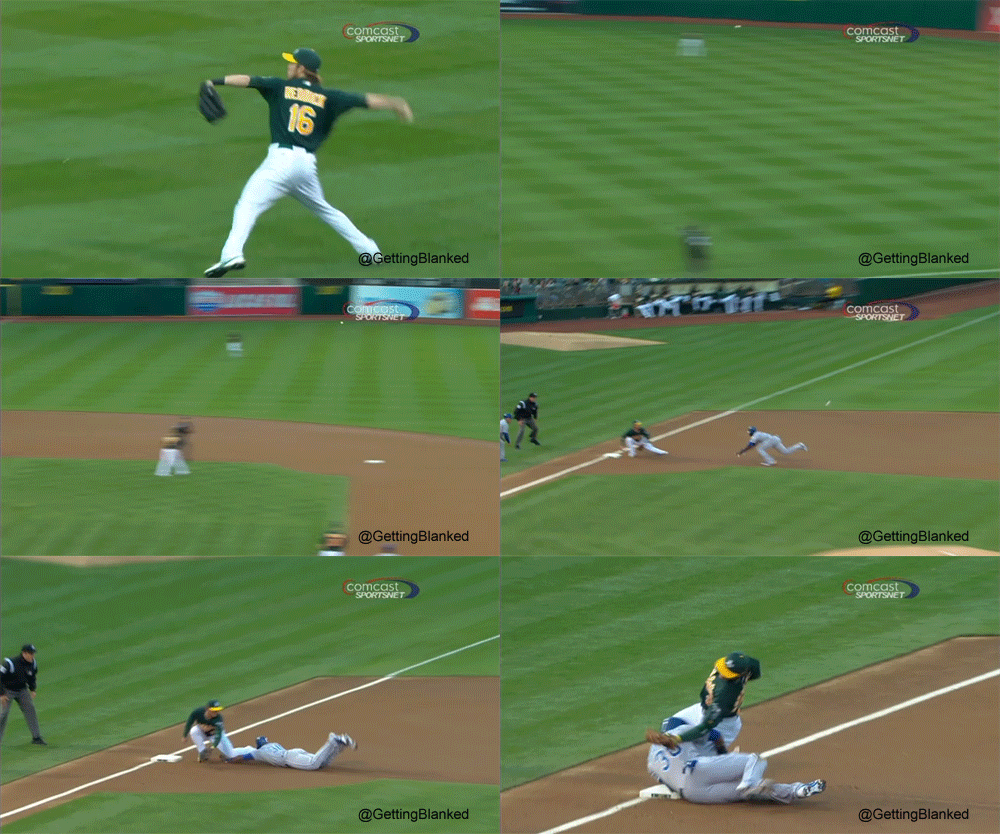
- Red Sox reliever Mark Melancon had a laughably poor outing against the Rangers on Tuesday night. With Boston already losing 8-2 in the eighth inning, the following sequence then occurred:
-Mark Melancon enters the game.
-Ian Kinsler doubles.
-Elvis Andrus walks.
-Josh Hamilton homers.
-Adrian Beltre homers.
-David Murphy walks.
-Nelson Cruz homers.
-Mark Melancon is removed from the game.
That Hamilton homer was one of the deepest, like, ever in Fenway Park. Appropriately, Melancon's ERA now sits at 49.50. The former Yankees prospect may very well be an embedded mole sabotaging the Red Sox from within as part of an elaborate sting operation. Other members of Melancon's crack team of double agents: Crawford, Carl and Lackey, John.
- This bit of news perfectly epitomizes the sad state of Minnesota Twins baseball:
"In a stunning turn of events on Tuesday, Twins righthander Scott Baker went in to have surgery on his flexor pronator tendon but exited with Tommy John reconstructive elbow surgery."
- And finally, the chronic erosion of one's love for baseball (and life in general) caused by wearing a Baltimore Orioles uniform over an extended period of time is illustrated by this heartbreaking chronological sequence of Robert Andino headshots:

Being an Oriole takes a toll on the soul.
Subscribe to:
Posts (Atom)