Showing posts with label Tampa Bay Rays. Show all posts

Monday, April 8, 2013

The Worst Strike Call Ever

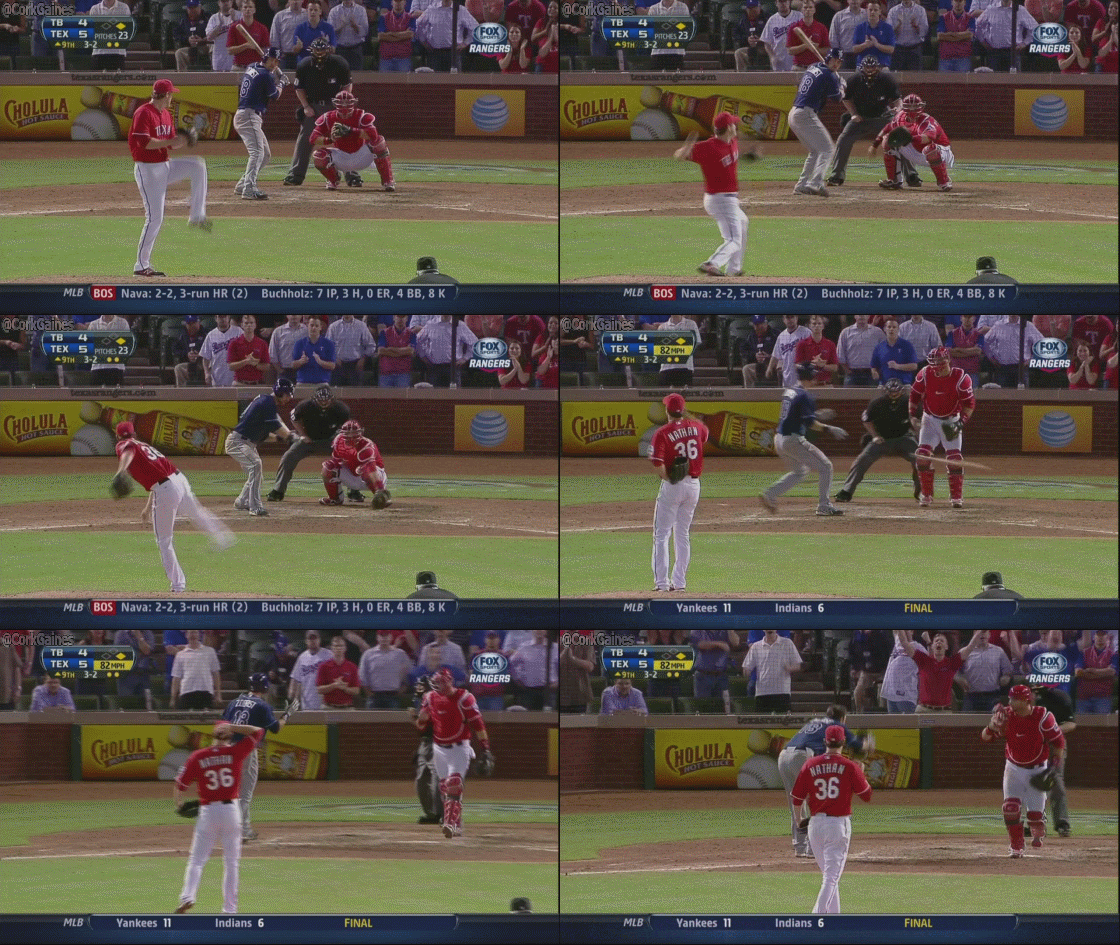
While America was watching Spike Albrecht and Luke Hancock, the Tampa Bay Rays lost on one of the most horrendous umpiring calls you'll ever see. Ben Zobrist was at the plate for the Rays in the bottom of the ninth, his team down a run. This two-out, full-count pitch was somehow called a strike, ending the game for the Rangers:


Come on. Seriously? Here's a list of people who knew that pitch was ball four.

1) The viewer; you have the benefit of multiple viewings and are presumably not blind.
2) The catcher, who makes literally no effort to even try and frame the pitch, and then begins walking towards the pitcher with the likely intention of hashing out their strategy against the next hitter.
3) The pitcher, Joe Nathan, who, having thrown the pitch, was the most biased person in that ballpark. Yet he clearly mutters something angrily to himself and raises his hand to his head in frustration, because the pitch was a BALL. Then he sees the strike call and awkwardly tries to convert that annoyed-head-touching motion into a victory fist-pump. Well played, Nathan. You're one smooth customer.
4) Rangers fans directly behind home plate. Even they know the pitch is a ball. Most don't react at all when the pitch is delivered; a few are even visibly frustrated or disappointed. Then the umpire makes his 'strike three' motion, and they all explode spontaneously, their joy doubled by the complete unexpectedness of the ridiculous call.
5) Ben Zobrist. Poor dude. He literally has no idea what just happened.
6) Pretty much everyone except the guy who went through vigorous training to correctly call balls and strikes.

Here's a better visual representation, with pitch #6 being the one in question:


If there's anything out there that could possibly make Zobrist and the Rays feel better, it's the reminder that this pitch thrown by Livan Hernandez was once called 'strike three,' too -- and it actually ended Game 5 of a 1997 playoff series against the Braves:


Monday, November 26, 2012

The Rays Are Stuck With Evan Longoria

The Tampa Bay Rays just signed a player to a $100 million contract.

At one time--maybe even last week--this would've been unthinkable. The Rays had the lowest attendance in baseball this year despite being in playoff contention until the final week of the season. The franchise hasn't agreed to a financial commitment this huge in fifteen years, since it gave somebody named Wilson Alvarez $35 million in 1997. Heck, even some large-market teams have never given out a $100 million contract, like the Chicago White Sox, the Atlanta Braves, the Baltimore Orioles, and the Seattle Mariners. Seeing Tampa Bay do so first is a bit surreal.

Of course, the Rays aren't signing a Wilson Alvarez type for $100 million. Quite the opposite. They locked up third baseman Evan Longoria, the face of the franchise and best player in team history, for the next decade. He was already under contract through 2016; this new extension pays him exactly $100 million over the six seasons between 2017 and 2022, plus a team option for 2023.

The Rays are obviously taking on a huge amount of risk by committing themselves to a nine-figure contract that won't even kick in for another four years. But this is an extremely fair deal. Assuming that their 2023 option is exercised, the Rays just signed their star third baseman for an average of about $15.5 million per year between the ages of 31 and 37. By comparison, the Los Angeles Dodgers will pay Adrian Gonzalez over $21 million per year between the ages of 31 and 36. With contracts like that existing as benchmarks, Longoria undoubtedly would have received much more than $100 million had he hit the free agent market after 2016, and the Rays could never have afforded him. Instead, he gave his hometown team a major discount. Considering how quickly baseball salaries are inflating, $100 million will probably look like even more of a steal in a few years.

And here's the real coup: Longoria didn't make the Rays renegotiate his already-existing contract that runs through 2016, which is an insanely team-friendly deal. Even with the extension, Longoria is still being paid at the impossibly-low rate of $6 million in 2013, $7.5 million in 2014, $11 million in 2015, and $11.5 million in 2016. So over the next four years, the prime of Longoria's career, the Rays will pay him a grand total of $36 million. That's a tremendous bargain. Tack that measly figure onto the rest of the extension, including the 2023 option, and you'll find that the Rays' ultimate commitment to Longoria looks like this: $144 million over the eleven seasons between 2013 and 2023. An average of $13 million per season to one of the best players in baseball, in a universe where Michael Young is pulling in $16 million. Either Longoria is a really nice guy, or a Rays executive has some incriminating photos of him hidden away somewhere. Regardless of the motivation, it's great news for the long-term competitiveness of Tampa Bay baseball.

But on a larger scale, here's the best news about the financially-challenged Rays keeping their star at a bargain price: they aren't the only ones doing it. Teams without top-five payrolls have been extending their stars at an encouraging rate recently. The Reds have Joey Votto. The Twins have Joe Mauer. The Brewers have Ryan Braun. The Orioles have Adam Jones. The Nationals have Ryan Zimmerman. The Giants have Matt Cain. The Pirates have Andrew McCutchen. The Blue Jays have Jose Bautista. The Rockies have Troy Tulowitzki. And now the Rays are wedded to Evan Longoria. The baseball equivalents of LeBron James leaving Cleveland and Dwight Howard forcing his way out of Orlando just aren't happening. The Marlins shipping out their entire roster was the exception, not the norm. Small-market baseball teams are finally able to afford their own homegrown stars, and that can't possibly be a bad thing for the sport.

Sunday, September 16, 2012

How To Lose Must-Win Games

For teams whose playoff futures are very much in doubt, like the Phillies, Rays, and Angels, every game from here on out is essentially a must-win. One game in the standings can mean the difference between a deep playoff run and a general manager losing his job. That means managers need to pull out all the stops to win at all costs, whether that means an aggressive hook for an underachieving starter, using a closer for a five-out save, or emptying the bench to gain a platoon advantage.

Unfortunately, in recent days, all of the above teams may have thrown away a win (or two) due to poor decision-making, primarily by managers.

1. Tampa Bay Rays and Joe Maddon: Last Wednesday, the Rays were playing the second game of their series with the Orioles, having already lost the first game. The score was tied at two with two outs in the top of the sixth inning and the Rays had the bases loaded. Unfortunately, their hitter in the situation was Jose Molina, who has very likely been one of the ten worst hitters in baseball this season. With the Rays struggling to score runs, and with a lights-out bullpen, one run in the sixth could have won the game. Letting Molina hit there would've been unconscionable, especially with September callups offering a multitude of potential pinch-hitters as well as two catchers to replace Molina. But Joe Maddon let Molina hit. He grounded out, shockingly. In the very next inning, Maddon had a chance to redeem himself. With a runner on second with two outs, righty Ben Francisco was up to face side-armer Darren O'Day, who murders right-handed hitters. Maddon should've pinch-hit. Instead, Francisco struck out. And right after that, Maddon replaced Francisco defensively. If you were going to take him out of the game anyway, why not do it against O'Day? The Rays lost on a walk-off in the ninth inning, 3-2, and were swept. Even winning just this one game in the series could have made a huge difference in the standings.

2. Los Angeles Angels and Mike Scioscia: Scioscia is one of the worst tactical managers in baseball, and the Angels' crushing defeat on Saturday was another example of why that is. Zack Greinke was pitching a shutout into the bottom of the ninth inning against the Royals in Kansas City. With his team up 2-0, Greinke got the first out, and then surrendered a single, bringing Billy Butler to the plate as the tying run. Scioscia pulled his starter for closer Ernesto Frieri, who had thrown 30 laborious pitches the night before. Frieri gave up two home runs in a span of four pitches, and the Angels lost. Scioscia had two viable options: he could have either left Greinke in (he was at 109 pitches and hadn't given up an extra-base hit all night), or taken him out for a right-handed reliever not named Frieri. Because Scioscia's closer, after being worked hard the night before, was very obviously the third-best option after a dominant Greinke and a fresh reliever. Scioscia chose his third-best option. The Angels lost. There's a correlation there.

3. Philadelphia Phillies and Charlie Manuel: The Phillies are miraculously back in the playoff race despite trading away some key pieces at the July 31 deadline. Last week, a seven game winning streak pulled the team back over .500 and within 3 games of the second wild card entering a series with the lowly Astros, essentially a Triple-A team.

Having not followed the series closely enough, I can't point to a single moment where manager Charlie Manuel made a tactical error. However, in the midst of an unlikely September comeback, Manuel's team somehow found a way to lose three out of four games to the Houston Astros. In the eyes of the baseball gods, that is a sin that the Phillies may not--and perhaps should not--bounce back from.

Thursday, April 26, 2012

A Tale of Two Brandons: Allen and Weeden

Here's a riddle. Brandon Allen, a recent waiver pickup for the eternally-lovable Tampa Bay Rays, is at the plate in the bottom of the ninth inning. His team is down one run, with B.J. Upton at first base. He has big-time power.

Opposing Allen is inconsistent Angels closer Jordan Walden, trying to protect his team's one-run lead and nail down the win to avoid a sweep. The Angels are currently in the midst of a nightmarish start to the season in which everything imaginable is going wrong.

Taking all this into account...what is the result of the Allen vs. Walden at-bat? The answer lies below in video form:


That was perhaps the most predictable ending in baseball history.

On a different note: with the 22nd overall pick in Thursday night's NFL Draft, the Cleveland Brows selected Brandon Weeden, a 28-year-old quarterback out of Oklahoma State. Remarkably, Weeden was also selected in the second round of the Major League Baseball Draft--ten years ago. He was picked by the New York Yankees 71st overall, as a right-handed pitcher, in the somewhat-famous "Moneyball draft" of 2002. Weeden's baseball career obviously never took off, but after the 2003 season, he was part of the trade that brought Kevin Brown to New York.

Yes, Cleveland: your quarterback of the future was traded for Kevin Brown almost a decade ago. Let that sink in.

This case also highlights the incredible randomness of the 50-round lottery known as the MLB Draft compared to the NFL's version. After the first 60 picks or so, perhaps one player per round becomes a useful major leaguer. Some random observations from 2002 to illustrate these points:
  • The Yankees selected Weeden nine picks before the Tigers drafted future-Yankees-center-fielder Curtis Granderson and fifteen rounds before the Dodgers grabbed future-Yankees-catcher Russell Martin.
  • Like all MLB drafts, the middle rounds were almost completely barren of MLB talent...except, oddly, for the 40th round, in which Hunter Pence was taken by the Brewers, Matt Garza was taken by the Rockies, and Jonathan Papelbon was taken by the A's. Obviously, none of those players signed with those teams, and all went to college before reentering the draft later.
  • Talk about random: the first three high school pitchers (a notoriously risky commodity) selected were Chris Gruler, Adam Loewen, and Clint Everts, none of whom amounted to anything. The next four high school pitchers taken? Zack Greinke, Scott Kazmir, Cole Hamels, and Matt Cain.
  • Want to know why the Pirates have been so bad for so long? With the first overall pick, in a draft that included the high school pitchers mentioned above, plus Prince Fielder, Joey Votto, B.J. Upton, Brian McCann, Jon Lester, Josh Johnson, Curtis Granderson, and Nick Swisher, the Pirates selected... Bryan Bullington. It has been a long trek through the desert for Pittsburgh.

Friday, March 23, 2012

MLB Season Preview: Tampa Bay Rays

Baseball's most lovable and cash-strapped underdogs enter 2011 with a low payroll but a stacked pitching staff and high expectations.

Evan Longoria is a stud, but the Rays are still
paying him in Trident Layers gum.
Offense: Last season, the Rays managed to sneak into the playoffs despite being a middle-of-the-pack offensive team. They should be better this year. Carlos Pena returns to Tampa as the first baseman to replace Casey Kotchman. Luke Scott will take Johnny Damon's place as the DH; last season broke Scott's streak of four consecutive years with at least 26 homers. The electrifying Desmond Jennings hit 10 homers and stole 20 bases in 287 at-bats last year, and has big upside in his first full season as the Rays' likely leadoff hitter and left-fielder. Next to Jennings in center-field, B.J. Upton could have a career season as a 27-year-old in a contract year. An assortment of flexible position players (like the ever-underrated Ben Zobrist), platoon candidates (Sean Rodriguez and Matt Joyce), and useful bench pieces (Jeff Keppinger, etc.) gives manager Joe Maddon an endless supply of lineup combinations. But the lynchpin of the lineup remains third baseman Evan Longoria, who, as a healthy 27-year old, is poised to have his best season yet.

"Big Game" James Shields: Finishes What He Starts.
Pitching: The Rays' offense may be mix-and-match, but their pitching is the crown jewel of the franchise. Few if any teams can match their rotation's blend of talent, youth, upside, and depth. The ace of the staff is its reisdent senior citizen, James Shields; the 30-year-old is coming off a season in which he struck out 225 in 249.1 innings with a 2.82 ERA and eleven complete games. When he makes his Opening Day start, he'll become the first Tampa Bay pitcher older than 30 to start a game since, astoundingly, May of 2007 (Shields actually started the streak, too, as a mere 25-year-old). David Price had a "disappointing" 2011 (3.49 ERA, 218 K's), but all his peripheral stats moved in the right direction and he should have another Cy Young-caliber year at the ripe age of 26. Jeremy Hellickson, reigning Rookie of the Year, will regress some from last season (2.95 ERA), but he's not even 25 yet. Yet the best of the lot could be 22-year-old lefty Matt Moore, who looked overpowering in last year's cameo in the majors. Either Wade Davis or Jeff Niemann, both capable starters, will fill out the back end of the rotation, and Triple-A is stuffed with depth. The bullpen is strong too, even if Kyle Farnsworth doesn't post a 2.18 ERA again. No pitching staff in the majors is built like this one.

Matt Moore will be terrorizing AL East hitters for a long time.
Breakout Candidates: The easy call is Matt Moore, who throws 97 mph like it's no big deal and boasts a nasty breaking ball. He's been called a left-handed Strasburg. He certainly lived up to his gaudy minor league record in his brief appearance in the majors last season, striking out 15 batters in 9.1 innings before shutting down the Texas Rangers in Game 1 of the ALDS. No other pitcher in the A.L. has his upside. Offensively, Desmond Jennings is a breakout candidate thanks to blazing speed and some pop, but he cooled off fast after a hot start to his major league career in 2011.

3 Key Questions: What will the Rays get from Carlos Pena and Luke Scott? Can they once again cobble together a bullpen on the fly? And just how good will Matt Moore be?

Best Case Scenario: Emulating the Giants of 2010, the Rays make a run to, and win, the World Series behind dominant starting pitching, clutch hitting from a cast of unlikely heroes, and the A.L. MVP, Evan Longoria.

Worst Case Scenario: Shields regresses to 2010 form, Moore isn't ready, the bullpen falls apart, the offense has too many black holes, and the penny-pinched Rays watch the rich teams compete in the playoffs.

Predicted Finish: The 2012 Rays have the pitching depth to survive the long slog through the AL East. They finish second and earn one of the league's two wild cards.